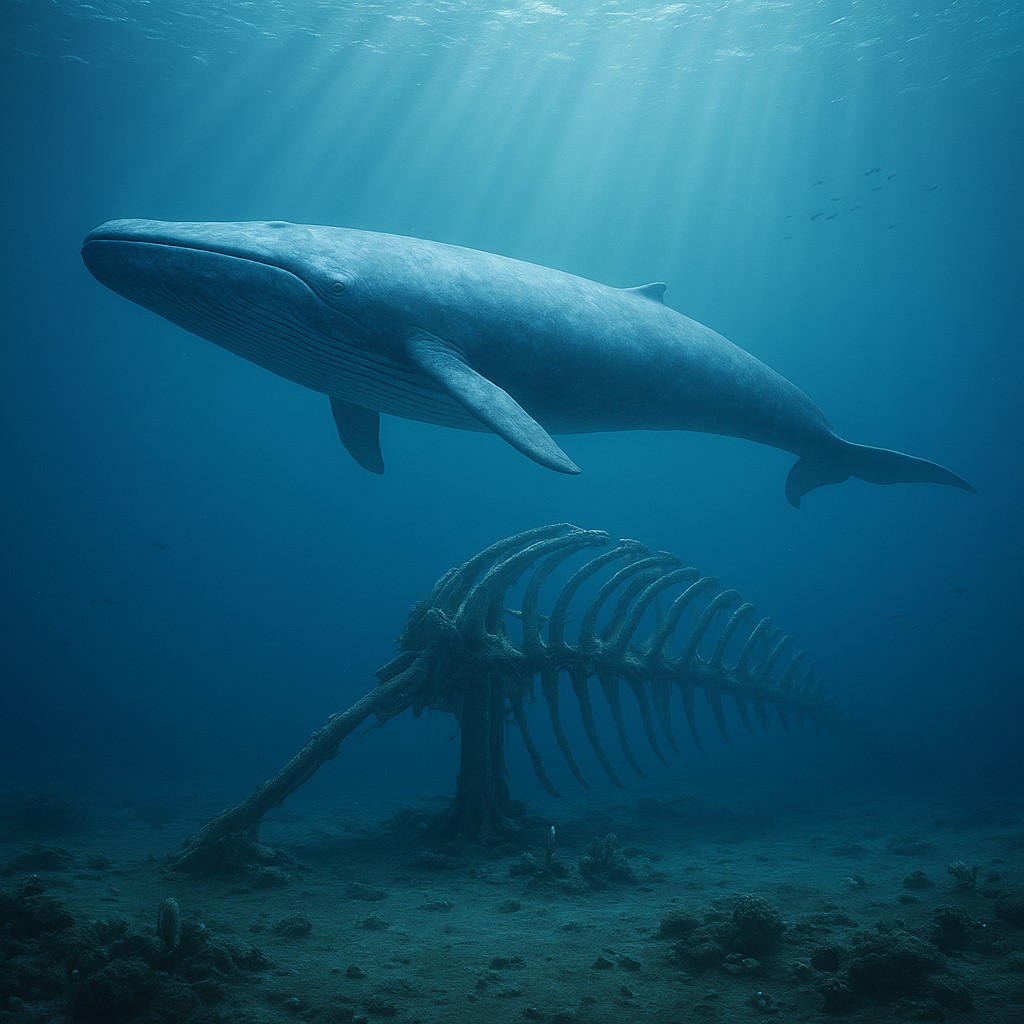
Imagine a massive, forty-ton blue whale gliding gracefully through the sunlit upper layers of the ocean - a living vault of stored carbon. Throughout its century-long life, this gentle giant consumes mountains of krill, effectively packing the carbon from those tiny organisms into its enormous skeleton and blubber. When the whale eventually dies, its body does not simply vanish. It begins a long, silent descent through miles of water, eventually coming to rest on the abyssal plain. This region of the seafloor is so deep that light and warmth are nothing more than distant memories. This event, known as a "whale fall," creates a localized hotspot for life in a biological desert and, more importantly, locks away tons of carbon for centuries.
While the natural cycle of whale falls has regulated our climate for millions of years, industrial activity has tipped the scales. This has prompted scientists to look toward the deep sea with a mix of desperation and ingenuity. International oceanographic trials are currently exploring a concept that sounds like science fiction: artificial whale falls. By engineering and sinking large, nutrient-dense organic structures designed to mimic a falling marine mammal, researchers are attempting to "hack" the planet’s biological pump. The goal is to bypass the messy decay near the surface and fast-track carbon to the one place on Earth where it is least likely to escape back into the atmosphere.
The Abyssal Vault and the Physics of Deep Sequestration
To understand why sinking objects to the bottom of the ocean is a clever climate strategy, we first have to appreciate the staggering physics of the deep sea. Once an object passes the 1,000-meter mark, it enters the bathypelagic zone, or the "midnight zone." Here, the pressure is immense, often exceeding 100 times the atmospheric pressure we feel at sea level. Combined with temperatures that hover just above freezing, these conditions create a natural refrigerator with a high-pressure seal. In the upper ocean, bacteria and fungi quickly break down organic matter, a process that releases CO2 back into the water and, eventually, the air. In the deep, however, microbial metabolism slows to a crawl, and the sheer weight of the water column keeps gases physically dissolved or trapped in the sediment.
This "geographic storage" is the main driver behind artificial whale fall experiments. When we talk about carbon sequestration, or capturing and storing carbon, we are looking for a timeline that makes the effort worthwhile. Planting a tree is helpful, but that tree might burn down or rot in fifty years, releasing its carbon back into the cycle. A whale fall, whether natural or man-made, aims for a storage timeline of 500 to 1,000 years. At depths of 3,000 meters or more, the water moves so slowly along a global "conveyor belt" that any dissolved carbon won't see the surface again for many human lifetimes.
Engineering a Modern Mummy from Terrestrial Waste
The challenge for modern oceanographers is recreating the specific chemical and physical makeup of a whale without needing an actual whale. Natural carcasses are unique because they are dense enough to sink quickly and rich in fats and proteins that support specialized deep-sea life. Researchers are currently testing "organic modules" made from land-based biomass that might otherwise be burned or left to rot. These materials include compressed agricultural waste, forestry byproducts, and even surplus seaweed grown specifically for this purpose. The trick is to package this material so it mimics the slow-release nutrients of a decaying whale while ensuring it doesn't break apart on the way down.
These artificial structures are often bound with biodegradable nets or encased in organic resins to survive the trip to the bottom. If the material is too loose, it will simply drift away and be eaten by surface fish, which defeats the point of deep storage. If it is too packed, it might sit on the seafloor like a block of plastic, failing to feed the deep-sea ecosystem. Finding a "Goldilocks" density is essential. Scientists are essentially building high-tech, carbon-rich "bricks" that serve as a gift to the seafloor - providing both a carbon sink and a feast for the mysterious creatures that live in the dark.
| Feature |
Surface Carbon Cycle |
Deep-Sea Sequestration (Whale Fall) |
| Primary Mechanism |
Photosynthesis and rapid decay |
High pressure and low-temperature storage |
| Retention Time |
Days to decades |
Centuries to millennia |
| Primary Actors |
Phytoplankton, trees, and land animals |
Specialist microbes, blind eels, and sediment |
| Stability |
Low (risk of fire, warming, or clearing) |
High (isolated from the atmosphere) |
| Nutrient Impact |
Rapidly recycled in the food web |
Creates localized "islands" of biodiversity |
The Ethics of Intervention and the Benthic Impact
While "sinking the problem" makes sense from a carbon perspective, we cannot ignore the residents of the deep. For a long time, humans viewed the abyssal plain as a vast, empty void - a convenient place to hide our mistakes. We now know that the deep sea is a delicate, slow-moving ecosystem populated by highly specialized species. Introducing massive amounts of artificial organic matter could provide a "buffet" for these creatures, but it could also cause a disruption. If we drop too many artificial falls in one area, we risk creating "anoxic zones," where oxygen is completely used up by a sudden explosion of bacteria, effectively suffocating the very life we are trying to understand.
Current trials are heavily focused on monitoring these "benthic impacts," or the effects on the seafloor. Researchers use Remotely Operated Vehicles (ROVs), which are underwater robots, to sit near these artificial falls for months at a time and record how the local animals react. They want to see if biodiversity increases healthily or if one specific type of scavenger takes over. There is also the question of chemical purity. If we sink farm waste contaminated with pesticides or heavy metals, we aren't just storing carbon; we are delivering a toxic package to an environment that has no way to process it. The artificial version must be as clean as the natural original.
Using the Biological Pump as a Climate Regulator
Zooming out, the artificial whale fall is just one tool in a larger strategy known as Marine Carbon Dioxide Removal (mCDR). The ocean already absorbs about 25 percent of the CO2 humans emit, but it does so mostly through the surface, which leads to ocean acidification. The "biological pump," on the other hand, is the process where biology moves carbon from the shallows to the depths. Phytoplankton die and sink as "marine snow," but this snow is light and easily eaten by fish. Large-scale sinking of organic matter is a "supercharged" version of this pump. It is an attempt to shift the global climate by using the ocean’s own gravity.
Critics and supporters alike often discuss "leakage" - the idea that some carbon will eventually work its way back up. However, the success of these trials isn't measured by perfection, but by comparison. Compared to the current situation, where carbon stays in the atmosphere trapping heat, a 90 percent success rate in the deep ocean is a major victory. As these trials continue, we are learning that the deep ocean is not just a sink; it is a regulator. It is a massive, slow-beating heart that keeps the planet’s chemicals in balance. By mimicking its natural processes, we are trying to give that heart a little extra help.
Misconceptions of the Deep and Final Considerations
A common myth is that the deep ocean is a "dead zone" where nothing happens. In reality, the arrival of a whale fall triggers a complex biological relay. First come the "mobile scavengers," like sleeper sharks and haggish, which can smell a carcass from miles away. Then come the "enrichment opportunists," such as worms and crustaceans that live in the nutrient-soaked mud. Finally, "sulfophilic" or sulfur-loving bacteria take over, breaking down the fats in the bones and creating a chemical energy source that can last for decades. When we create artificial falls, we are not just dumping trash; we are starting a decades-long biological play.
Another misconception is that this process is a "silver bullet" that lets us keep burning fossil fuels. It is vital to remember that while the deep sea is large, it is not infinite. We are currently in a learning phase to see if this can scale up without causing an ecological collapse. The trials in the Pacific and Atlantic are as much about biology as they are about physics. We are learning to speak the language of the deep - a language of pressure, cold, and slow, deliberate cycles.
As we look to the future, our view of the ocean is changing. It is no longer just a surface for sailing or a resource for mining; it is a partner in our survival. The artificial whale fall project teaches us that sometimes the best solutions to modern problems are found in the oldest, most natural rhythms of the Earth. By respecting the depth and the darkness of the seafloor, we might just find the space we need to catch our breath on the surface. Thinking of the ocean as a protector rather than a void reminds us to treat it with the respect it deserves.