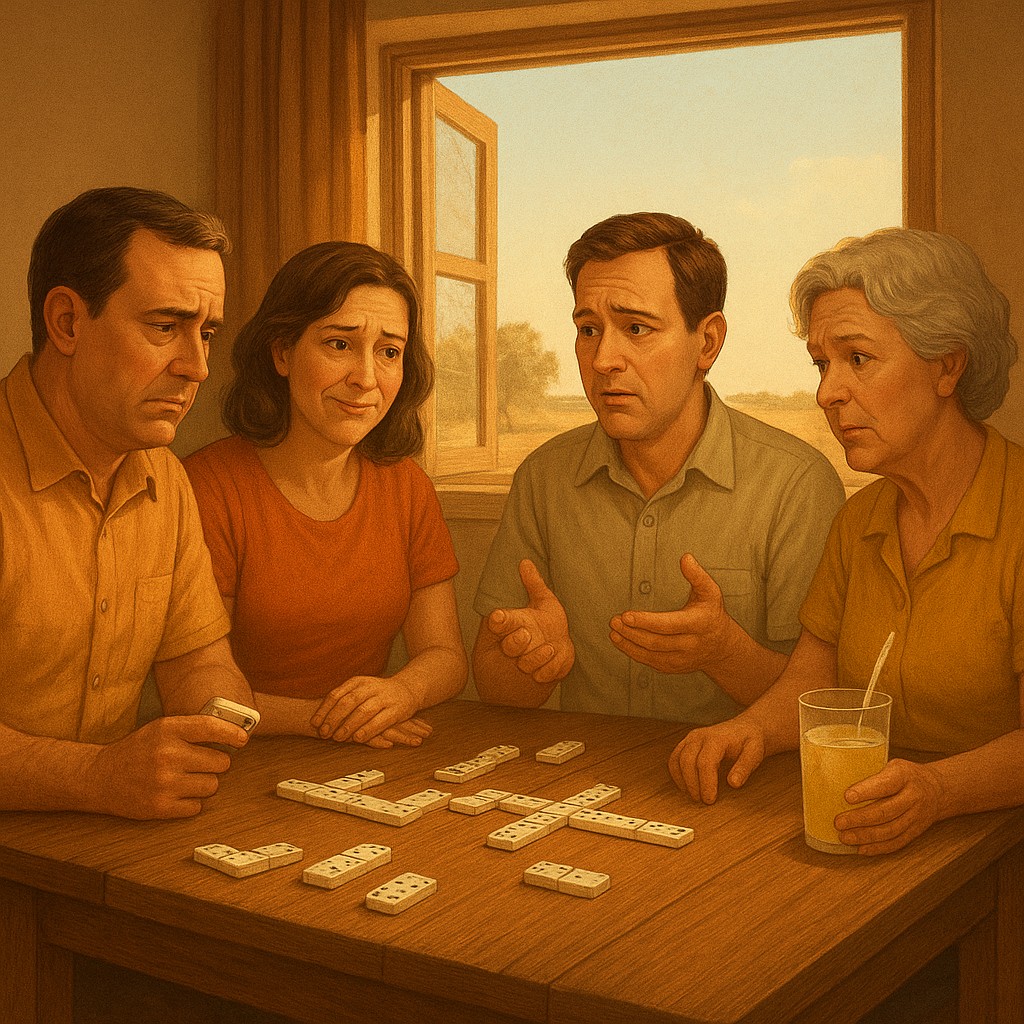
It is a sweltering July afternoon in Coleman, Texas. The temperature is hovering around 104 degrees, the wind is blowing dust across the porch, and the only things keeping the family sane are tall glasses of lemonade and a slow game of dominoes. Suddenly, the father-in-law suggests driving fifty miles to Abilene to eat at a cafeteria. The wife thinks it sounds like a miserable idea in this heat, but she assumes her husband wants to go. "Sounds like a great idea," she says. The husband, who also dreads the dusty car ride, assumes his wife is eager to go. He adds, "I just hope your mother wants to go." The mother-in-law chimed in, "Of course I want to go. I haven't been to Abilene in ages."
They pile into an un-air-conditioned 1958 Buick, suffer through a grit-filled drive, eat a mediocre meal, and return four hours later, exhausted and grumpy.
Once back home, the truth finally comes out. "I didn't really want to go," admits the mother-in-law. "I only went because you three were so enthusiastic." The husband says he only went to satisfy the rest of them. The wife claims she only went to be sociable. Finally, the father-in-law confesses he only suggested it because he thought the others were bored.
This is the heart of the Abilene Paradox: a group of people collectively decides on a course of action that not a single member of the group actually wants. They aren't victims of a bad leader or a lack of intelligence. They are victims of their own inability to manage agreement. We often think of conflict as the primary enemy of productivity, but as this dusty Texas tale proves, the way we agree with each other can be just as dangerous.
The Anatomy of a Social Trap
To understand why smart people do things they hate, we have to look at how we mismanage agreement. This isn't a case of "Groupthink," a term coined by Irving Janis to describe situations where people get so caught up in a group's momentum that they actually start believing a bad idea is good. In the Abilene Paradox, nobody is fooled. Everyone sitting in that Buick knew the drive would be hot, the food would be average, and the experience would be unpleasant. They didn't lose their ability to think critically; they lost their ability to tell the group what they actually wanted.
The paradox thrives in the gap between what we think and what we say. We are social animals, and our brains are wired to value belonging above almost everything else. In our evolutionary past, being cast out of the tribe meant a very literal death. Today, that instinct shows up as a crushing fear of being seen as "difficult" or "not a team player." When the father-in-law suggested the trip, every other person performed a private calculation. They weighed the cost of the hot drive against the social cost of being the "wet blanket" who ruined the fun. Because everyone incorrectly assumed that everyone else was excited, they all chose social safety over their own comfort, resulting in a collective disaster.
This phenomenon creates a bizarre mirror world of decision-making. In a typical conflict, we argue because we want different things. In the Abilene Paradox, we suffer because we actually want the same thing (to stay home), but we are too polite or too afraid to admit it. It is a failure of transparency, fueled by the mistaken belief that our private doubts are unique to us. We assume that if everyone else is nodding, they must be convinced, failing to realize that they are only nodding because we are.
Comparing the Dynamics of Group Dysfunction
It is helpful to distinguish the Abilene Paradox from other common group errors. While they might look similar from the outside, the internal feelings of the participants are wildly different. Understanding these nuances helps us identify which specific social "virus" is infecting our meetings or family dinners. When we know the symptoms, we can apply the right cure.
| Feature |
The Abilene Paradox |
Groupthink |
Peer Pressure / Conformity |
| Private Belief |
"I think this is a terrible idea." |
"I think this is a great idea (because they do)." |
"I know this is wrong, but I'll do it to fit in." |
| Group Atmosphere |
Overly polite, cautious, and agreeable. |
Overconfident, insulated, and invincible. |
Aggressive or exclusionary. |
| The "Problem" |
Mismanaged agreement. |
Lack of critical evaluation. |
Fear of direct punishment or rejection. |
| Individual Moral State |
Frustrated and confused by the group's choice. |
Enthusiastic and certain of success. |
Compliant while feeling guilty or pressured. |
| End Result |
Everyone is unhappy with the outcome. |
The group fails due to ignored risks. |
The individual acts against their own values. |
As the table shows, the Abilene Paradox is uniquely frustrating because it is entirely voluntary. There is no bully forcing the group down the road to Abilene. There is no charismatic leader hypnotizing the masses. It is a quiet, polite, and democratic march toward a destination that everyone finds repulsive. It is the tyranny of the assumed consensus, where our very kindness becomes the rope we use to tie ourselves to a bad decision.
The Psychological Drivers of False Consensus
Why is it so hard to just say, "Actually, I'd rather stay here"? The answer lies in our psychological defense mechanisms. One of the primary drivers is the "action anxiety" we feel when we realize that speaking up might lead to a confrontation. Even if the confrontation is minor, our bodies react as if we are facing a predator. We experience a form of "negative fantasy," where we visualize the worst possible outcome of our honesty. We imagine the father-in-law being deeply offended, the wife crying, and a permanent rift forming in the family, all because we said the drive was too hot.
Another factor is the confusion of "unanimous" with "unified." In healthy groups, unity is built on the hard work of debating, refining, and eventually committing to a path. In Abilene-prone groups, people skip the debate and go straight to agreement because it feels safer. We often tell ourselves that we are being selfless by going along with a plan we hate. "I'm doing this for them," we think. But the paradox shows that this is actually a form of unintentional selfishness. By withholding our true perspective, we deprive the group of the information it needs to make an informed choice. We are protecting our own social standing at the expense of the group’s actual well-being.
Finally, there is the issue of "social login," also known as social loafing or mirroring. When we are in a group, we often look to others to define reality for us. If everyone else seems okay with a plan, we assume they know something we don't. This creates a feedback loop of silence. Every person looks at the others for a sign of dissent, sees none (because everyone is hiding it), and concludes that their own doubt must be a personal quirk. This collective silence is then interpreted as enthusiastic support, locking the car doors and starting the engine for a trip no one wants to take.
Strategies for Turning the Car Around
Breaking the cycle of the Abilene Paradox requires more than just bravery. It requires a shift in how we view the role of the individual within a group. We must move away from the idea that agreement is the ultimate sign of a healthy team. Instead, we need to treat "checking the consensus" as a standard operating procedure. If the family in Texas had a culture where a quick, honest "Vibe Check" was normal, someone would have felt empowered to say, "I'm happy to go if you all want to, but I'm also perfectly content sitting right here. What is everyone’s real preference?"
One of the most effective ways to prevent a trip to Abilene is to assign a "Devil’s Advocate" during important discussions. This person’s job is to voice the reasons why the group should not proceed with the suggested plan. When it is someone’s designated role to disagree, the social risk of being the "difficult one" vanishes. The group can then explore the downsides of a decision without anyone feeling like they are attacking the person who suggested it. This makes dissent a tool for better decision-making rather than a spark for an argument.
Another practical tool is the "anonymous straw poll." If a leader suspects the group is drifting toward a false consensus, they can ask everyone to write their honest opinion on a slip of paper. When the papers are read aloud and the group sees that five out of six people actually hate the idea, the illusion of unanimity shatters instantly. This allows the group to re-evaluate and find a path that people actually support. It also helps to normalize "psychological safety," the belief that you won't be punished or humiliated for speaking up with ideas, questions, or concerns.
Cultivating the Courage to Be Honest
Ultimately, the Abilene Paradox is a reminder that being a "team player" isn't about saying yes to everything. It is about being committed enough to the group's success that you are willing to risk a moment of social awkwardness to save everyone from a four-hour drive through a dust storm. True loyalty involves the courage to tell the truth, even when you think you are the only one who sees the problem. We owe it to our colleagues, our friends, and our families to be honest about our preferences, because the alternative is a collective waste of time, energy, and happiness.
The next time you find yourself in a meeting where everyone is nodding along to a flawed plan, or a social gathering where the group is drifting toward an activity you find miserable, take a breath and speak up. You don't have to be aggressive; you simply have to be curious. Ask, "Does everyone actually want to do this, or are we just doing it because we think everyone else wants to?" You might be surprised to find that you aren't the only one hoping to stay on the porch. By speaking your truth, you might just save the whole group a trip to a place they never wanted to go, turning a potential disaster into a real connection.