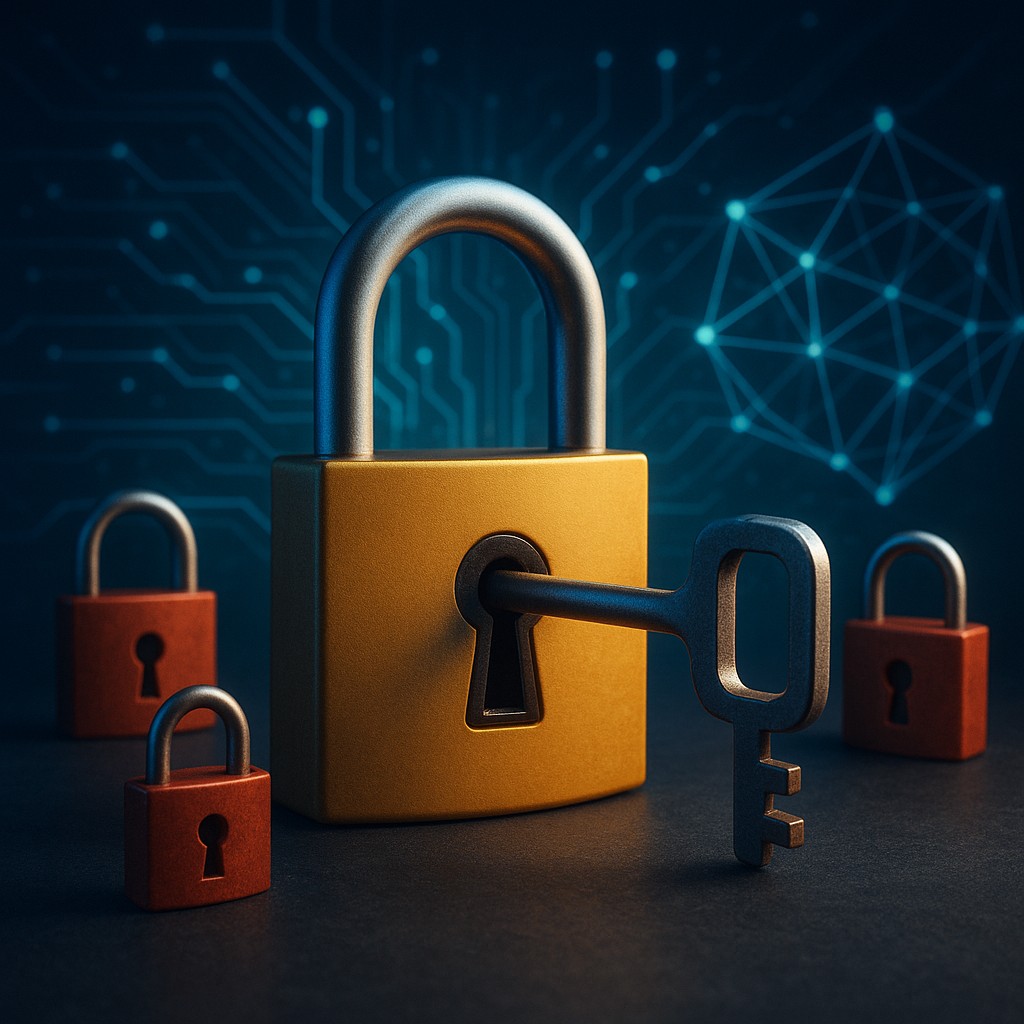
Imagine your digital life is protected by a series of locks that are incredibly difficult for humans to pick, but come with a hidden "backdoor" that only a specific type of futuristic skeleton key can open. Currently, almost every password you type, every credit card transaction you make, and every private message you send is shielded by math puzzles that would take a traditional supercomputer trillions of years to solve. We feel safe because we assume the sheer amount of time required to break these codes acts as an unbreakable wall. However, in physics labs around the world, a new kind of machine is being built that does not play by the rules of normal time and logic. This is the quantum computer, and to it, our current digital locks look less like reinforced steel and more like wet tissue paper.
The threat is not just a concern for the future; it is a "save now, decrypt later" problem. Adversaries are already harvesting encrypted data today, knowing that while they cannot read it now, they can simply wait for a powerful quantum computer to emerge in the next decade or two. To counter this, the world is making a massive shift in how software is built, known as Post-Quantum Cryptography (PQC). This transition is hitting a fever pitch in 2025 as global standards are finalized and put into place. It involves swapping our old locks for something far more complex. Instead of simple math involving prime numbers, we are moving toward the world of high-dimensional geometry and "lattice-based" puzzles (math based on grids of points) designed to be a nightmare even for a quantum machine.
The Fragility of Our Current Digital Armor
To understand why we have to change everything, we first have to appreciate how our current security works. Most encryption today relies on "trapdoor functions." These are math problems that are very easy to do in one direction but nearly impossible to reverse unless you have a specific secret key. For example, if I ask you to multiply two massive prime numbers together, a calculator can do it in a heartbeat. However, if I give you a 500-digit number and ask you to find the two prime numbers that were multiplied to create it, you would effectively be stuck forever. This "factoring" problem is the foundation of RSA encryption, the standard that has ruled the internet for decades.
Modern quantum computers, however, use the properties of subatomic particles to perform a type of processing that isn't just fast, but is an entirely different way of handling information. Using a famous set of instructions called Shor’s Algorithm, a sufficiently powerful quantum computer could slice through prime number puzzles in minutes. It does not just try one combination at a time; it uses quantum physics to cancel out wrong answers and highlight the right one. Because our entire global economy is built on these prime-number secrets, the arrival of a powerful quantum computer would be the digital equivalent of an asteroid impact. Every bank account, government secret, and power grid control system would suddenly be wide open to anyone with the right hardware.
Entering the Multidimensional Garden of Lattices
If prime numbers are the old defense, "lattices" are the new fortress. A lattice, in math terms, is a repeating grid of points in space, much like the pattern on a garden trellis or the dots on a piece of graph paper. In two dimensions, these grids are simple to navigate. If I give you a starting point and a destination on a piece of graph paper, you can easily find the shortest path. However, post-quantum cryptography doesn't work in two or three dimensions. It works in hundreds, or even thousands, of dimensions at once. Imagine a maze that doesn't just go left, right, up, and down, but also moves in directions that the human brain cannot even visualize.
The core of this security is something called the "Shortest Vector Problem." In a lattice with thousands of dimensions, finding the point closest to the center is exhausting for a computer. Even for a quantum computer, there is no known shortcut to move through these high-dimensional grids efficiently. By hiding a secret key deep within these mathematical mazes, we create a puzzle that is resistant to both normal and quantum attacks. When you send an encrypted message using these 2025 standards, you are essentially burying your data in specific "noise" added to one of these grid points. Without the secret map (the private key), an attacker cannot tell your data apart from the billions of other possible points in that multidimensional sky.
Comparing the Old Guard and the New Defense
As we move into this new era, the differences between what we used yesterday and what we are moving toward today are stark. The National Institute of Standards and Technology (NIST) has spent years testing these formulas, finally settling on a few champions like ML-KEM (formerly Kyber) and ML-DSA (formerly Dilithium). While these new methods are incredibly secure, they come with a "physical" cost in terms of digital size and processing power. It is helpful to see how these two different eras of security stack up in a direct comparison.
| Feature |
Classical Cryptography (RSA/ECC) |
Post-Quantum Cryptography (Lattice-Based) |
| Mathematical Basis |
Prime Number Factorization |
Shortest Vector Problem in Lattices |
| Quantum Resistance |
Highly Vulnerable |
Highly Resistant |
| Key Size |
Small (e.g., 2048 or 3072 bits) |
Large (Often several thousand bytes) |
| Speed |
Very fast on old hardware |
Fast, but uses more memory |
| Primary Vulnerability |
Shor's Algorithm |
Future unknown math breakthroughs |
| Adoption Status |
Legacy/Phasing out |
2025 Global Standard |
The trade-off is clear. We are moving from small, elegant keys that are vulnerable to quantum physics to larger, "chunkier" keys that are much more robust. For a modern smartphone or a high-end laptop, this change will be almost invisible. However, for "Internet of Things" devices, like a smart lightbulb or an old industrial sensor, these larger keys might be a bit of a burden. This is why the 2025 transition is such a massive project; it is not just a software update, but a complete rethinking of how devices talk to each other across the globe.
The Logistics of a Global Security Relaunch
Implementing Post-Quantum Cryptography is often compared to the "Y2K" bug, but with much higher stakes and a longer timeline. Governments and tech giants are currently working on "Crypto-Agility." This is the ability of a system to quickly swap out one encryption method for another without breaking the entire structure. In 2025, we are seeing the first major wave of "Hybrid" setups. Instead of ditching the old prime-number math entirely, many systems are wrapping data in two layers: one layer of the old, trusted RSA/ECC, and a second "outer" layer of new lattice-based protection. This ensures that if the new math has a hidden bug, the old math still protects you; if a quantum computer arrives, the new math keeps the attacker out.
One of the biggest hurdles in this transition is the "key size" issue mentioned earlier. In the early days of the internet, every bit of data was precious. Our current systems were designed for tiny keys that could be sent in a single packet. Lattice-based keys are much bigger, which means that when your browser connects to a website, it has to exchange much more information before it can even start loading the page. Engineers are working to tune these systems so you don't notice a three-second delay every time you click a link. It is a delicate balance: making the walls high enough to stop a quantum machine while keeping the gate light enough for a 2018 smartphone to open.
Misconceptions About the Quantum Apocalypse
Whenever "quantum" is mentioned in the news, it often gets wrapped in a layer of sci-fi mystery that leads to common myths. One of the biggest misconceptions is that a quantum computer is simply a "faster" computer. In reality, for things like watching a video or editing a document, a quantum computer would actually be slower and more difficult to use than your current laptop. They are highly specialized tools that are only good at specific types of math. Therefore, the goal of Post-Quantum Cryptography isn't to outrun the quantum computer in a race of speed; it is to change the race entirely to a game the quantum computer isn't good at playing.
Another myth is that once we switch to lattice-based math, we are safe forever. In the world of security, nothing is ever truly "unbreakable." The reason we are moving to lattices in 2025 is that they are the best defense we have discovered so far. Mathematicians are constantly looking for weaknesses in lattice-based puzzles, just as they did with prime numbers. The shift to PQC is less about finding a perfect, eternal shield and more about ensuring our defenses evolve faster than the weapons used to attack them. By adopting these new standards now, we are essentially buying ourselves a few more decades of digital privacy.
Building a Future That Stays Secret
The transition to post-quantum standards marks one of the most significant moments in the history of information technology. It is a rare example of the entire world working together to fix a problem before a disaster actually strikes. By moving away from the vulnerable math of the past and into the complex, multidimensional world of lattices, we are ensuring that the digital foundations of our society remain firm. Even as quantum computers grow from experimental lab curiosities into powerful tools of discovery, our personal data, financial systems, and private conversations will remain tucked away in a mathematical maze that no machine can navigate.
As you go about your day, it is worth remembering that a silent upgrade is happening all around you. Your browser, your banking app, and your favorite messaging service are all slowly being re-wired with these high-dimensional grids. This effort ensures that the leap into the quantum age does not come at the cost of our fundamental right to privacy. You are witnessing the dawn of a new kind of security, one that blends the beauty of geometry with the necessity of defense. The math guarding your world is becoming more sophisticated and resilient than ever before.