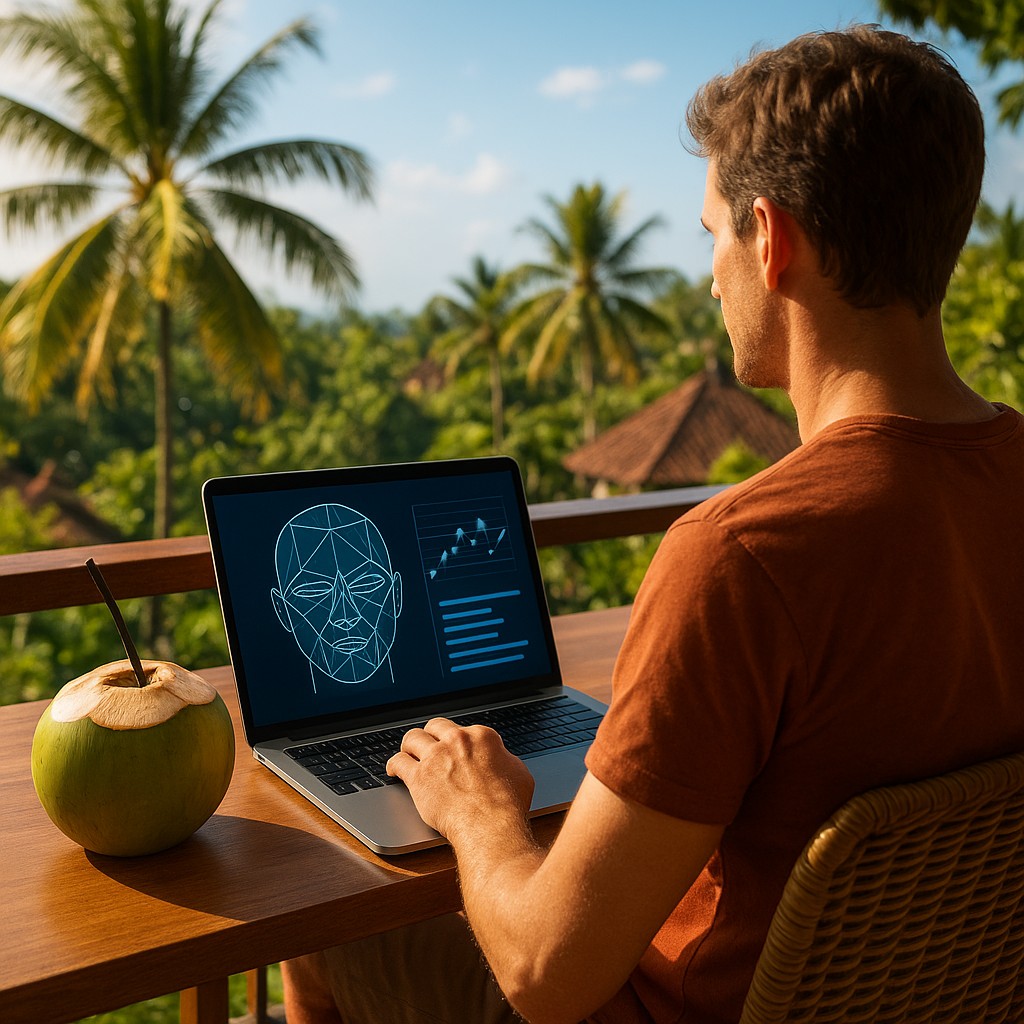
Imagine for a moment that you are sitting on a sun-drenched balcony in Bali. You sip from a fresh coconut while your laptop hums with the steady rhythm of a productive Tuesday. To the rest of the world, or at least to your Instagram followers, you are living the ultimate digital nomad dream. However, to the tax authorities back in your cold, rainy home country, you are a ghost. For decades, the global tax system has operated on a "trust but verify" model, where the government assumes you spent most of your year within their borders unless you prove otherwise. But as the world shifts toward remote work, a quiet revolution is brewing in finance ministries. The old way of counting days on a physical calendar is being replaced by something much more personal and permanent.
This new era of oversight revolves around "biometric residency." Instead of relying on flight receipts or handwritten logs, tax collectors are looking at the unique geometry of your face, your fingerprints, and the precise GPS coordinates of your smartphone to determine exactly where you are when you earn a living. This isn't just about catching a few freelancers on a beach; it represents a fundamental shift in how we define what it means to be a "resident" of a nation. If you use the high-speed internet, the paved roads, and the emergency services of a city, governments argue you should pay for them, regardless of where your employer is based. This move from paper-based proof to biological signatures is changing the social contract between the citizen and the state.
The Cracking Foundation of the 183-Day Rule
For nearly a century, the gold standard for determining tax residency has been the 183-day rule. Put simply, if you spent more than half a year in a country, you were considered a resident for tax purposes. This rule worked perfectly when people were tied to factories, offices, and specific physical addresses. If you worked in London, you lived in London, and your movements were easy to track through your lease and landline phone bills. Today, that foundation is crumbling. A digital nomad might spend two months in Portugal, three months in Mexico, and the rest of the year hopping between short-term rentals, never crossing the 183-day threshold in any single country.
This "stateless" earning power creates a massive headache for tax authorities who see their revenue disappearing. When workers earn high salaries using local infrastructure without contributing to the local tax base, it creates a financial imbalance. To counter this, governments are moving toward "economic presence" models. They are less interested in where your mailbox is and more interested in where your body is while you are hitting the "send" button on an invoice. By using biometric check-ins, tax authorities can create a digital trail that is almost impossible to forge, effectively ending the era of tax-free global wandering through clever calendar management.
Biological Signatures as the Ultimate Proof
The transition to biometric residency relies on the fact that while you can lose a passport or lie about a travel date, you cannot easily outsource your own biology. Biometric systems use unique physical traits, such as iris patterns, facial recognition, or fingerprint scans, to verify identity. When integrated with a tax app, these markers prove that the person claiming to be in a low-tax area is actually the person sitting at that specific GPS coordinate. This creates a high-integrity data point that replaces the easily manipulated paper trail of the past. It moves the burden of proof from the government to the citizen in a way that is automated and instantaneous.
Consider the complexity of modern tax audits. Currently, an auditor might have to cross-reference credit card statements, utility bills, and immigration stamps to prove a taxpayer spent too much time in a specific country. With biometric residency laws, the data is collected ahead of time. A worker might be required to perform a "liveness check" once a week on their mobile device. This check-in links their biometric ID with an encrypted location stamp, providing a verified record of their physical presence. While this sounds like science fiction, many countries are already experimenting with similar identity systems for government services, and moving into tax enforcement is a logical, if controversial, next step.
Comparing Traditional and Biometric Residency Models
To understand the magnitude of this shift, it helps to look at how the old system stacks up against the proposed biometric future. The differences are not just technological; they are philosophical, changing the way we interact with the concept of "belonging" to a country.
| Feature |
Traditional Residency Model |
Biometric Residency Model |
| Primary Metric |
Calendar days (physical stamps) |
Real-time biological verification |
| Data Source |
Passports, leases, utility bills |
Biometrics, GPS, device ID |
| Verification |
Periodic, manual audits |
Continuous, automated check-ins |
| Forgery Risk |
High (missing stamps, dual passports) |
Very low (unique biological markers) |
| Compliance |
Reactive (after the tax year ends) |
Proactive (during the tax year) |
| Privacy Level |
High (large gaps in movement data) |
Low (requires detailed location tracking) |
The Privacy Paradox and the Golden Cage
While the benefits to the national treasury are clear, biometric residency laws bring us face-to-face with a significant privacy paradox. To ensure everyone pays their fair share, the state essentially requires a "digital shadow" of its citizens. This level of surveillance is unprecedented in democratic societies. If a government knows exactly where you are every Tuesday at 10:00 AM to collect income tax, they also know who you are meeting with, which protests you might be near, and what your daily habits look like. This "function creep," where a tool designed for taxes is used for broader surveillance, is a primary concern for civil liberties advocates.
Furthermore, the storage of biometric data creates a high-value target for hackers. If a password is stolen, you can change it; if your facial geometry or fingerprint data is leaked from a government database, you cannot simply change your face. This makes the security of biometric residency laws just as important as the laws themselves. Governments must balance their need for revenue with their duty to protect the most sensitive data a human being possesses. We are entering a period where "being a resident" might mean giving up a degree of anonymity in exchange for the right to move freely across borders.
Misconceptions About the Digital Nomad Lifestyle
There is a common myth that digital nomads are all "tax dodgers" trying to cheat the system. In reality, many remote workers find themselves in a state of "tax paralysis," where they are unsure which country they owe money to and are terrified of being taxed twice for the same income. The current system is so fragmented and old-fashioned that even a well-intentioned worker can accidentally break the law. Biometric residency laws could, ironically, provide a layer of protection for these workers. By having a verified, unchangeable record of their location, a nomad could use that data to prove they do not owe taxes in a high-tax country, stopping aggressive tax authorities from claiming money they aren't entitled to.
Another misconception is that these laws will only affect the "laptop class" or wealthy influencers. Over time, these systems tend to trickle down. As more industries adopt remote or hybrid models, the definition of a "commuter" changes. Someone living in a low-tax state but working remotely for a company in a high-tax state might find themselves subject to these biometric verifications to prove they are actually working where they say they are. This isn't just about tropical islands; it's about the fundamental way we tax labor in an era where the office is wherever there is a Wi-Fi signal.
Navigating the Frontier of Digital Sovereignty
As we look toward the future, the concept of a "border" is becoming increasingly digital. We are used to borders being physical walls or checkpoints at airports, but biometric residency laws turn the border into a personal, portable boundary defined by our own bodies. This change requires a new kind of digital literacy. Citizens will need to understand not only their tax obligations but also how their data is being used, where it is stored, and who has the right to access it. The conversation is moving away from "How much do I owe?" toward "How much of myself must I share to prove where I am?"
This shift shows that our legal and financial systems are finally catching up to the internet. We can send money across the world in seconds and hold meetings with people on three different continents at once; it was only a matter of time before the tax collector found a way to follow us into the digital mist. While the transition may be bumpy and filled with debates over privacy, the goal is a more sustainable system where the services we use are supported by the people using them. Embrace the change, stay informed, and perhaps take a moment to appreciate the incredible complexity behind that "check-in" button on your next remote work adventure. You aren't just a worker in a digital world; you are a living, breathing data point in the evolution of the modern state.