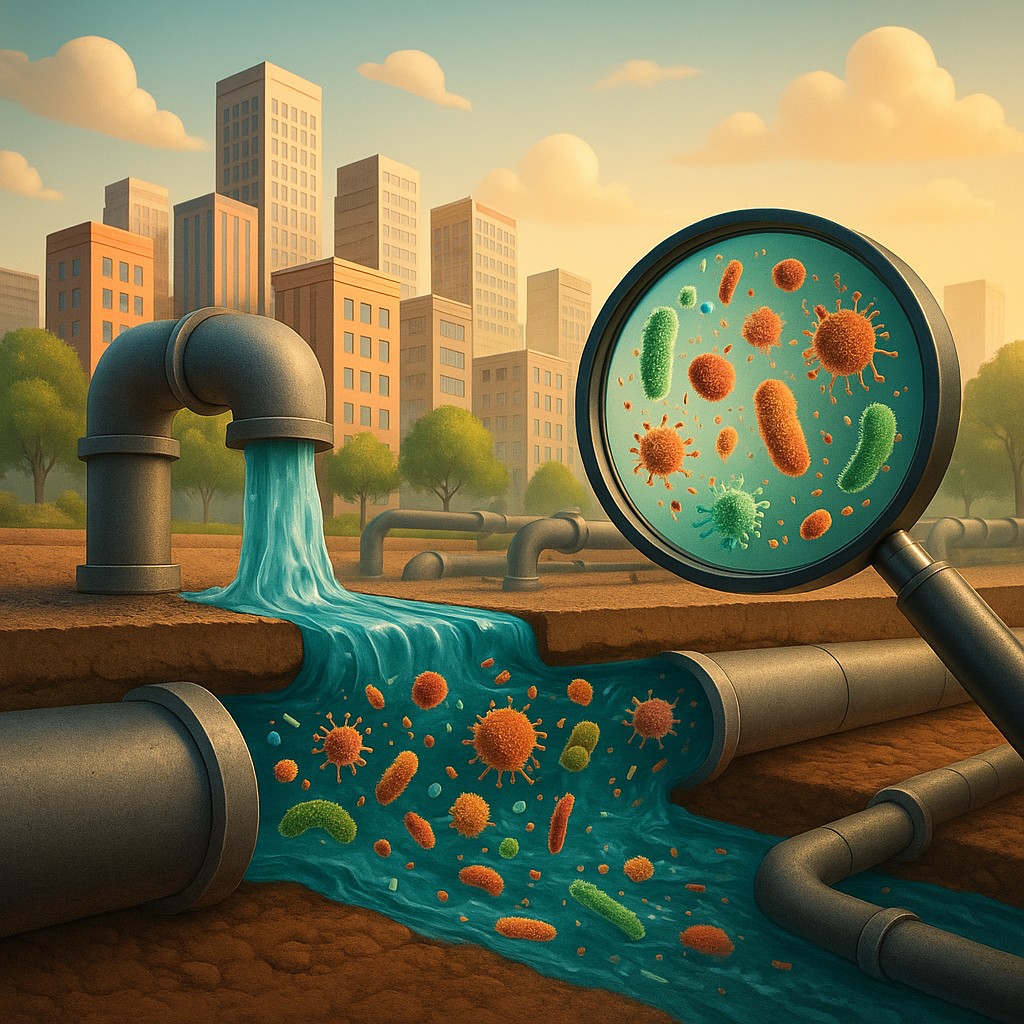
Imagine for a moment that a modern city's infrastructure is more than just a grid of concrete and steel. Instead, think of it as a massive, shared biological diary. Every time you flush a toilet, you add a small data point to a giant underground archive of community health. This is no longer just about managing waste; we are transforming our sewers into a sophisticated early warning system. By monitoring this flow, scientists are uncovering secrets about our collective physical well-being. They can often spot health trends long before we even realize we are starting to feel under the weather.
Traditionally, public health has been reactive. We wait for people to get sick, wait for them to see a doctor, and then wait for lab results to reach a national database. This delay is a virus’s best friend. It allows a bug to hop from person to person while officials are stuck looking at data that is essentially last week's news. However, the rise of wastewater sequencing is flipping the script. We are moving from a "wait and see" model to a "search and detect" strategy, using the microscopic traces left in our plumbing to catch outbreaks while they are still small.
The Invisible Ledger of Community Health
To understand how this works, we have to look at the biology of an infection. When a virus like the flu or SARS-CoV-2 enters the body, it doesn't just stay in the lungs or throat. It replicates throughout the entire system. Quite often, fragments of the virus's genetic material - its RNA or DNA - end up in the digestive tract. These fragments are "shed" into the sewer system. Crucially, this happens almost immediately after infection, often several days before a person develops a cough, a fever, or the urge to stay in bed.
Because the pipes of an entire neighborhood eventually merge into large main lines leading to a treatment plant, a single sample of raw sewage can represent the health of thousands of people at once. In this liquid mix, scientists aren't looking for live, infectious viruses, which usually don't survive long in a sewer's harsh environment anyway. Instead, they look for "genetic ghosts." Using a process called high-throughput genomic sequencing, researchers read these genetic fragments like a supermarket barcode to identify exactly which germs are circulating in a specific area.
This method provides a "bird's-eye view" that traditional testing cannot match. Clinical tests are often biased toward people who have health insurance, those with severe symptoms, or those who have the time to visit a clinic. Wastewater, by contrast, is the ultimate democratic data source. It does not care if you have no symptoms or if you prefer to treat your cold at home with chicken soup. If you live in the city and use the bathroom, your data is in the mix. This provides a true picture of the population's health without requiring a single needle poke or nasal swab.
From Dirty Water to Genetic Code
The journey from a murky sewage sample to high-tech data visualization is a masterpiece of modern science. It begins at a treatment plant with an "autosampler." This device sips small amounts of water over 24 hours to ensure the sample reflects more than just one or two random flushes. Once in the lab, the water is thoroughly cleaned. Using high-speed spinners called centrifuges and special filters, scientists separate the "trash" from microscopic organic material to isolate the genetic instructions left behind by viruses and bacteria.
The real magic happens during the sequencing phase. Using machines that look more like high-end computer hardware than lab equipment, researchers read millions of tiny genetic fragments at the same time. This is the "high-throughput" part of the process. It is a bit like trying to solve a thousand different jigsaw puzzles that have been dumped into the same box and put through a paper shredder. Advanced software then takes these shredded pieces and lines them up against libraries of known viral codes.
| Feature |
Clinical Testing |
Wastewater Sequencing |
| Timing |
Triggered by symptoms |
Detected during incubation |
| Participation |
Requires active cooperation |
Automatic and passive |
| Scope |
Individual diagnosis |
Population-level trends |
| Bias |
Favors those seeking care |
Covers entire geographic areas |
| Privacy |
Identifies specific patients |
Anonymous and grouped |
| Cost |
High per-person cost |
Low per-person cost |
This comparison shows why cities are so excited about this technology. It isn't a replacement for traditional medicine - you still need a doctor to treat a patient - but it is an incredible tool for "situational awareness." If data shows a sudden spike in a specific flu strain downtown, the city can move masks, vaccines, or medications to local clinics before the waiting rooms even get crowded.
Privacy in the Pipes
Whenever we talk about tracking data for a whole population, "Big Brother" concerns often come to mind. It is natural to worry if a city official can tell what is happening inside your private bathroom. However, wastewater surveillance has a built-in "anonymity filter." By the time your individual contribution reaches a sampling point, it has been diluted by millions of gallons of water and mixed with the waste of thousands of neighbors.
The goal isn't to find one sick person, but to monitor the "viral load" of a whole community. Think of it like a weather report. A meteorologist can tell you it is raining across the entire north side of town without knowing which specific houses have leaky roofs. Similarly, health officials can see a specific germ rising in a district without any way to trace it back to a specific address or person. The genetic fragments are so broken down and blended that identifying an individual is biologically and mathematically impossible.
This anonymity is actually a major strength. Because the data is anonymous by its very nature, it avoids the ethical and legal hurdles that often slow down the sharing of hospital records. It allows information to flow quickly between labs and the public without compromising the "right to be sick in private." In many ways, the sewer is the safest place to conduct a massive health census.
An Early Warning in Action
This "sewer intelligence" is already proving its worth. During the emergence of new variants like Omicron, wastewater sequencing often detected the variant’s unique genetic signature in cities days or even weeks before the first patient tested positive at a hospital. This head start is the ultimate goal for disease experts. In the world of infections, time is the only currency that matters. A four-day lead might not sound like much, but it is the difference between a hospital being blindsided and one being prepared with extra staff and open beds.
Beyond COVID-19 and the flu, this technology is expanding to track other threats. Scientists are now looking for markers of antibiotic resistance - a "silent pandemic" where bacteria evolve to ignore our best medicines. By monitoring water, officials can see where these resistant bacteria are gaining a foothold and step in with public education. There is even potential to track foodborne illnesses like Salmonella, identifying a tainted batch of food in a city’s supply chain before a full-blown crisis erupts.
This shift represents a new era of "passive defense." We are learning that our environment is constantly whispering to us about our health, and we finally have the tools to listen. Instead of waiting for the smoke of a fire, we are learning to smell the very first hint of something burning. It turns out the secret to a safer future was right beneath our feet all along, waiting for us to learn how to read the flow.
In the future, genomic sequencing in our urban infrastructure will likely be as standard as trash collection or water treatment. It is a subtle but profound shift in how we live in our cities. There is a sense of empowerment in knowing that our everyday actions contribute to a shield that protects the most vulnerable. By turning "waste" into "wisdom," we are building a world where the next pandemic might not be a catastrophe, but a headline about an outbreak that was caught and extinguished before it ever changed our lives.