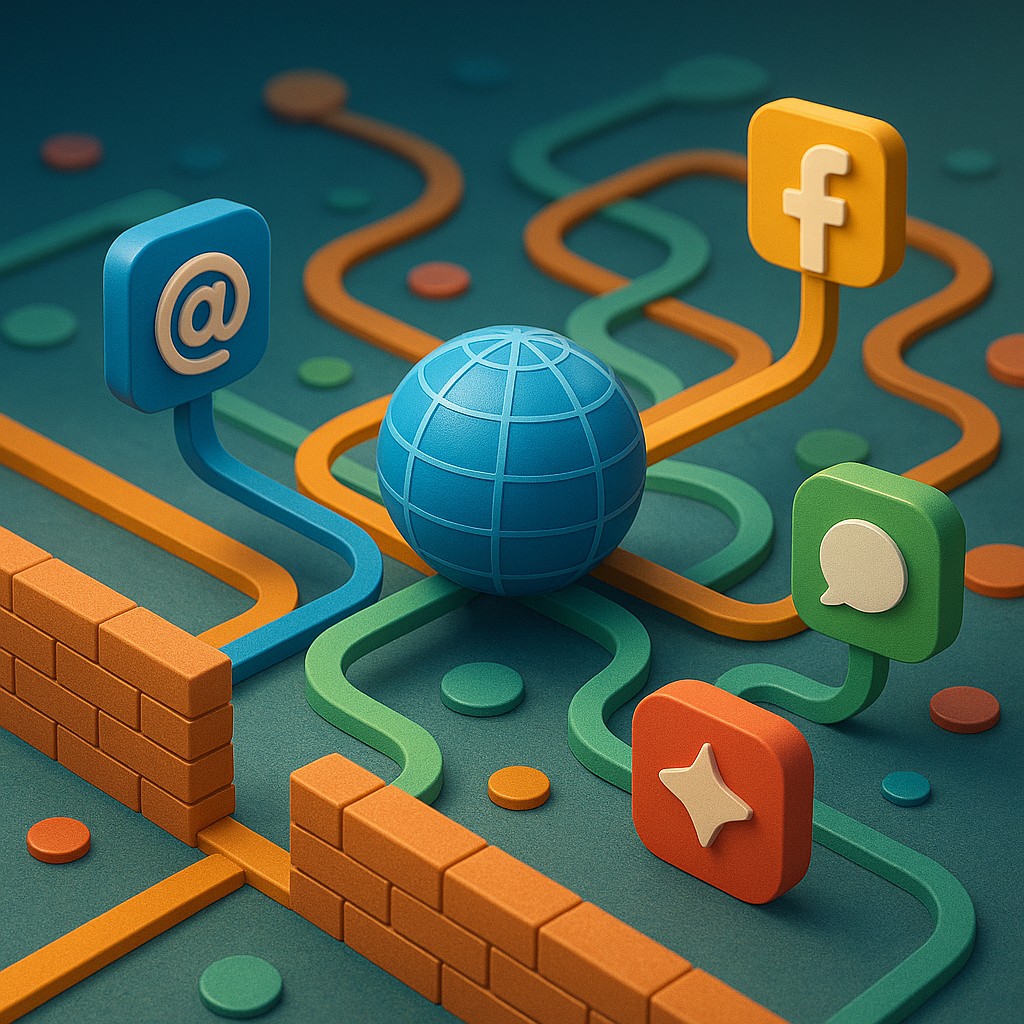
Imagine for a moment that every time you wanted to email a friend who used Outlook, you had to open an Outlook account yourself because your Gmail account simply couldn't "talk" to theirs. Or, picture a world where your AT&T cell phone could only call other AT&T customers, leaving your friends on Verizon or T-Mobile in permanent radio silence. We would find such a system absurdly inefficient and hopelessly broken. Yet, this is exactly how we have lived our digital social lives for the last twenty years. we have spent our time within "walled gardens" - those high-fenced ecosystems where our data, our friends, and our conversations are held captive by the company that owns the platform.
The shift toward "Interoperable Social Protocols" is the wrecking ball aimed at these digital walls. For years, the internet has trended toward centralization, where a few massive companies act as the gatekeepers of human interaction. But a new wave of technology, powered by standards like ActivityPub, is changing the fundamental physics of the web. This isn't just a minor update to an app; it is a complete redesign of how people connect online. By separating the app you look at from the server where your information lives, we are entering an era where social media looks less like a private club and more like a public utility, much like open roads or the electricity grid.
The Invisible Architecture of Digital Sovereignty
To understand why this shift is so revolutionary, we first have to look at the hidden structure of the current internet. Most social media platforms operate as "silos." In a silo, the user interface (the app you see), the database (where your posts live), and the social graph (the list of people you follow) are all bundled together in one inseparable package. If you decide you don't like the way a certain billionaire runs his platform, you can't just leave and take your two thousand followers with you. You have to start from scratch elsewhere, effectively abandoning your digital history and your community. This "lock-in" effect is the primary reason social media giants have maintained their dominance despite various scandals or unpopular policy changes.
Interoperable protocols break this bundle apart. Imagine a world where your social identity is portable. In this new framework, the "protocol" serves as a universal language that allows different servers to communicate. If you are on Server A and your best friend is on Server B, you can still follow their posts, leave comments, and share their content without ever leaving your preferred environment. This works through a technical "handshake" where servers agree to exchange data in a standard format. Instead of a winner-take-all competition for our attention, platforms must compete on the quality of their service and features, because they no longer "own" the users.
This architectural shift is often called the "re-decentralization" of the web. The early internet was built on open protocols like HTTP for websites and SMTP for email, which allowed anyone to build a site or send a message without asking for permission. Over time, we traded that freedom for the convenience and sleek design of giant platforms. Now, the pendulum is swinging back. We are moving toward a "fediverse" - a blend of "federation" and "universe" - where thousands of independent servers connect to form a giant, seamless social network that no single entity controls.
Learning the Universal Language of ActivityPub
At the heart of this movement is a specific technical standard called ActivityPub. While the name sounds like something a dry committee would come up with (and it was, specifically the World Wide Web Consortium), its function is incredibly elegant. Think of ActivityPub as a postal service for the digital age. In this system, every user has an "Actor" profile, which acts like a digital mailbox. When you post a photo or a status update, you are essentially "publishing" a message to your outbox. The protocol then ensures this message is delivered to the inboxes of all your followers, regardless of which server or app they use.
The beauty of this system is its flexibility. It doesn't care if you are posting a short text update, a long article, a video, or even a professional portfolio. Because the language is standardized, a photo-sharing site like Pixelfed can communicate with a microblogging site like Mastodon. If you follow a photographer on Pixelfed from your Mastodon account, their photos will show up in your feed just like any other post. This cross-pollination creates a rich, diverse ecosystem where users can curate their own experience. You are no longer forced to use five different apps to keep up with five different types of media; you can choose the one interface that works best for you and pull in the content you care about from across the web.
This "client-server" separation is the secret sauce of interoperability. In the old model, the company provided both the "client" (the app) and the "server" (the storage). In the new model, you can use a high-end app developed by an independent coder to access data stored on a community-run server. This creates a vibrant marketplace for innovation. Developers can build "readers" for the social web that focus on accessibility, minimalist design, or heavy-duty research tools, all tapping into the same global stream of information. It turns social media from a monologue controlled by a corporation into a symphony of diverse voices and tools.
Comparing the Walled Garden to the Open Forest
To see how profound this change is, it helps to compare the experience of a traditional, centralized platform with a federated, interoperable one. The differences aren't just technical; they change how we perceive ownership, community, and competition.
| Feature |
Centralized Platforms (Walled Gardens) |
Interoperable Protocols (The Fediverse) |
| Data Ownership |
The company owns your data and can sell or restrict it. |
You own your data; you can move it to a different server at any time. |
| Identity |
Your identity is tied to a specific app (e.g., your @handle). |
Your identity is portable, similar to an email address (user@server). |
| Network Effect |
You can only talk to users on the same platform. |
You can communicate with anyone on any server using the same protocol. |
| Innovation |
Only the company can add new features or change the UI. |
Anyone can build a new app to access the network. |
| Moderation |
One central authority decides what is allowed for everyone. |
Each server sets its own rules; users choose servers that match their values. |
| Durability |
If the company goes bankrupt, your content vanishes. |
If a server shuts down, you can migrate your profile to a new one. |
As the table suggests, the "walled garden" approach favors the platform owner by making it hard to leave and maximizing ad revenue through data harvesting. The "open forest" approach favors the user by highlighting agency and resilience. If a particular server develops toxic community standards or fails to handle harassment, you don't have to quit social media entirely. You simply pack your digital bags and move to a server with better moderation without losing your connection to the people you follow. This puts power back into the hands of the community rather than a boardroom of executives.
The Complicated Quest for Global Moderation
However, we must be honest about the trade-offs. While interoperability sounds like a digital utopia, it introduces a massive, thorny challenge: moderation. In a centralized system, if a platform decides to ban harmful content, they can flip a switch and delete it from their entire ecosystem. In a decentralized world, there is no "Delete" button for the whole network. If one server allows hate speech or misinformation, other servers in the network have to decide whether to "defederate" (cut ties) with that server. It becomes a localized, community-driven effort rather than a top-down mandate.
This lack of central control is exactly what makes the protocol resilient to censorship, but it also means the burden of safety shifts. On one hand, this allows niche communities to exist with their own unique norms. A group of scientists might have very different rules for "allowable content" than a group of digital artists or political activists. On the other hand, there is no "supreme court" of the internet to appeal to. Each server administrator becomes a digital sheriff, responsible for the safety of their sub-community. This requires a much higher level of digital literacy and engagement from users, who must choose their communities wisely.
Furthermore, "discovery" is a significant hurdle. On a centralized app, a sophisticated algorithm suggests new people to follow and content you might like. In a federated system, there is no single algorithm. This can make the fediverse feel quiet or difficult to navigate for newcomers. Recently, platforms like Mastodon have introduced "Starter Packs" and curated discovery tools to help bridge this gap, but the experience remains more manual and intentional than the passive scrolling of mainstream apps. We are essentially trading the convenience of being fed content by an algorithm for the autonomy of seeking out our own digital neighbors.
Building Bridges Between the Titans and the Rebels
The most fascinating part of this story is that the "walled gardens" are starting to open their gates, albeit slowly and with some hesitation. We are currently witnessing a massive real-world trial of these interoperable protocols. Meta, the parent company of Instagram and Facebook, has begun integrating its new platform, Threads, with the ActivityPub protocol. This means that, for the first time, a user on a massive corporate platform can technically interact with a user on a small, independent Mastodon server. It is a tectonic shift in the industry, signaling that even the giants recognize the future of the social web might be open.
Other established players are joining the fray as well. Flipboard, the popular news app, has begun federating its users' accounts, allowing them to follow and interact with content from across the fediverse. The blogging platform Ghost has also announced deep integration with ActivityPub, turning every newsletter and blog post into a "social" object that can be liked, boosted, and commented on from different apps. This is the "bridge-building" phase of the experiment. We are moving from a set of isolated islands to a connected archipelago. The question is no longer if these platforms will talk to each other, but how they will manage the flow of information without compromising user privacy or safety.
This transition isn't just for developers and tech enthusiasts; it's a fundamental change in how we consume information. Imagine writing a blog post on your personal website and having it automatically appear in the feeds of your friends on Mastodon, your professional colleagues on a news app, and your family on a private server. You write once, and the protocol handles the delivery across the globe. This reduces the friction of the modern web and lets us focus on the content and the connection rather than the constraints of the app we happen to be using at that moment.
Turning the Social Web into a Shared Public Utility
As we look toward the horizon, the ultimate goal of interoperable protocols is to turn social media into a public utility, much like the water we drink or the airwaves that carry television signals. In this vision, social media isn't a "product" we consume, but a "service" that facilitates human society. By standardizing the underlying protocol, we make it nearly impossible for any single company to hold a monopoly on public discourse. This creates a more robust, democratic, and resilient internet that can survive the whims of any single CEO or the collapse of any single corporation.
There is a deep sense of empowerment that comes from knowing your digital life isn't at the mercy of a Terms of Service agreement you never read. When we use interoperable tools, we are casting a vote for a web that is open by default and closed only by necessity, rather than the other way around. It encourages us to be more than just "users" or "consumers"; it invites us to be citizens of the digital world. This move toward interoperability is a return to the original promise of the World Wide Web - a universal space where information flows freely and everyone has a seat at the table.
The journey toward a fully interoperable social web is still in its early chapters. There will be bugs to fix, moderation battles to fight, and new habits to learn. But the "walled garden" model, for all its convenience, has shown its cracks. As more of our daily lives migrate online, the need for an infrastructure that respects our autonomy and preserves our connections becomes more urgent. By embracing these new protocols, we aren't just changing how we send messages; we are reclaiming the digital commons for everyone. The walls are coming down, and the view from the bridge is expansive, diverse, and incredibly exciting.