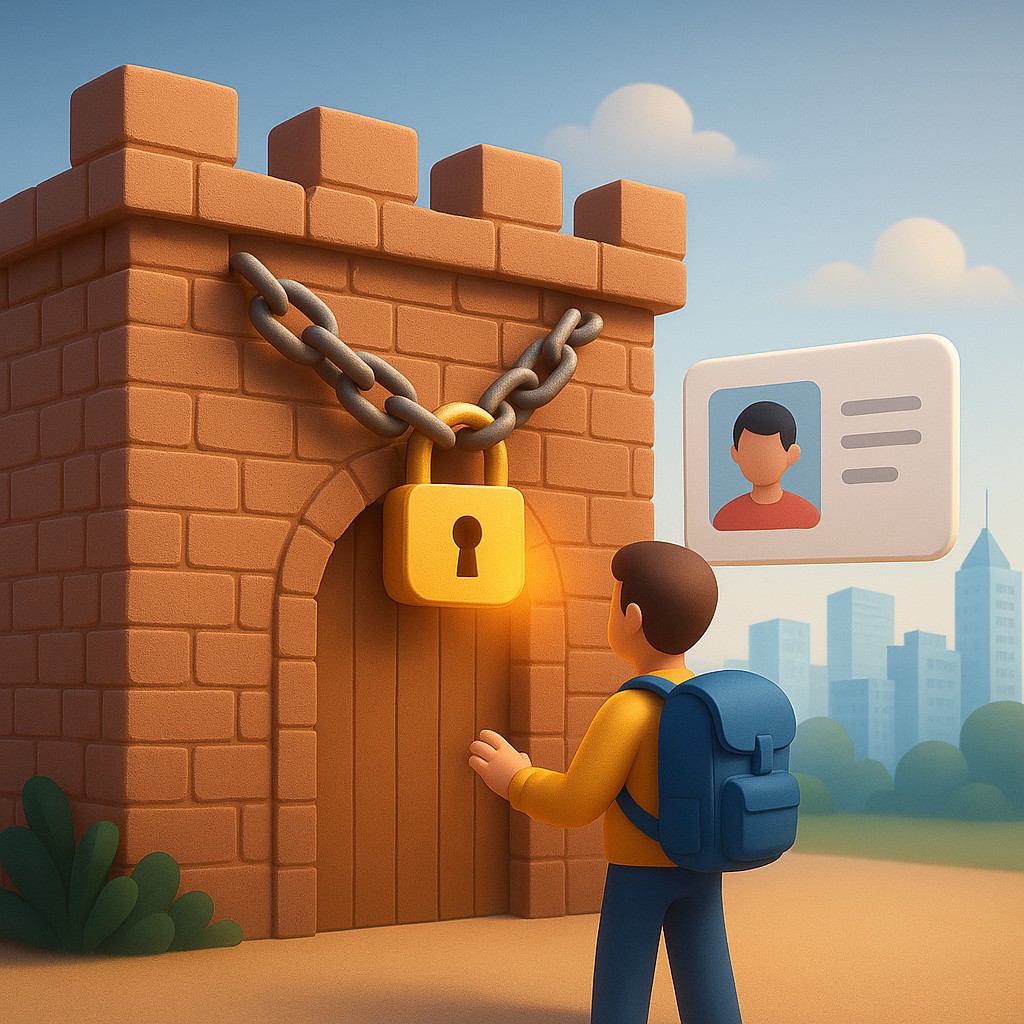
Imagine moving to a new city with a bizarre, invisible catch: you aren't allowed to bring your friends, your family, or even your reputation. To live in this neighborhood, you must agree never to speak to anyone from your old life again, unless they happen to move into your exact apartment complex. You cannot bring your photo albums, your diary, or your professional credentials. You start over at age zero - a stranger in a strange land - simply hoping the local baker believes you are an honest person because you have no way to prove you were well-liked back home.
This sounds like a dystopian nightmare, yet it is exactly how we have lived online for the last twenty years. Every time a new social media platform gets popular, we face the "Cold Start" problem. We spend years carefully building a network, sharing our thoughts, and creating a digital "vibe," only to realize we don't actually own any of it. We are digital sharecroppers, tilling the soil for a landlord who can change the rules, charge us rent, or evict us at any moment, leaving us with nothing but memories. However, a fundamental shift in how the internet is built is now underway, promising to turn us from temporary tenants into permanent owners of our digital selves.
The Invisible Walls of the Gated Garden
To understand the solution, we first have to look at the bars of the cage. Traditional social media platforms use a "silo" model. In this setup, your identity, your friend list (your social graph), and your posts are all bundled together in one private database. When you log into a legacy platform, you aren't just using an app; you are entering a closed loop where the company acts as the final judge of truth. They decide who you are, who you can see, and what you are allowed to say. This creates a massive "switching cost." Even if you grow tired of a platform’s privacy policies or invasive ads, you stay because your entire social life is held hostage on their servers.
This phenomenon is known as platform lock-in. It isn't an accident; it is a business strategy. By making it impossible to move your followers elsewhere, platforms ensure that competition is smothered. A brilliant developer could build a much better social network tomorrow, but it would likely fail because users aren't willing to abandon the years of "social capital" they have built up elsewhere. In this model, the platform is the center of the universe, and the users are just data points orbiting a corporate center of gravity.
Your Identity as a Digital Suitcase
Enter the concept of Portable Identity. Instead of your account being a single row in a private company’s database, your identity becomes something you actually carry with you using cryptographic keys - essentially digital passwords that prove you are who you say you are. Think of these keys as a digital passport recognized by any country you visit, rather than a membership card that only works at one specific gym. In modern systems like the AT Protocol (which runs Bluesky) or ActivityPub (which runs Mastodon), your username is basically a pointer to a set of data that you control.
When you use a portable identity, you aren't "signing up" for an app in the usual way. Instead, you are "connecting" your identity to it. The app becomes a lens through which you view your data, not the warehouse where the data lives. If you decide you don’t like the look or feel of App A, you simply take your keys over to App B. Because your social graph - the map of who you follow and who follows you - is stored independently of any single company, App B can see your entire network instantly. You walk into the new digital room, and all your friends are already there, sitting at the same table, because the table moves with you.
How the Social Map Becomes Public Ground
The "social graph" is just a formal way of describing the web of connections between people. In the old world, if you followed a famous chef on one site, that connection lived and died inside that site’s database. In a decentralized world, that connection is recorded as a verified statement in an open space. This moves the power from the platform's private servers to the "protocol" itself. A protocol is simply a set of rules everyone agrees to use - like the rules of the English language or the way email works.
Because these connections are portable, developers no longer have to worry about the "Cold Start" problem. They can focus on building the best possible experience, knowing users can bring their friends along. This creates a more competitive and creative environment. One app might focus on high-quality photography, another on long essays, and a third on private group chats. You could use all three to talk to the same group of friends, and your likes or comments could be visible across all of them depending on how the rules are set.
| Feature |
Traditional Social Media (Siloed) |
Decentralized Social Media (Portable) |
| Data Ownership |
Owned by the corporation |
Owned by the individual user |
| Social Graph |
Private and locked to the platform |
Portable across many different apps |
| Switching Cost |
Extremely high (start from zero) |
Near zero (bring your friends) |
| Identity Proof |
Controlled by email, phone, or admin |
Controlled by private digital keys |
| Censorship |
Managed by a central authority |
Controlled by your choice of apps |
| Innovation |
Closed; developers need permission |
Open; anyone can build a new "lens" |
How You Take the Wheel
You might wonder how this works technically without requiring everyone to have a computer science degree. The magic happens through "relays" and "indexing." In a portable system, your posts aren't just sitting in one spot; they are broadcast to a network. Apps (often called "clients") act as filters. They scan the network for the people you follow and show their content in a way that looks familiar. This is very similar to how email works. You might use Gmail while your friend uses Outlook, but you can still talk to each other because you both use the underlying email rules.
A key part of this is the "Signer." When you post a photo or an update, your device uses your private key to "sign" that data. This signature proves to the world that you were the one who posted it, not an imposter. Because this signature is mathematically linked to your identity, no platform can claim you didn't say it, and no platform can fake a post from you. This authenticity is built into the very foundation of the network, making it much harder for bots to impersonate real people once a web of trust is established.
Clearing Up the "Delete" Myth
One of the biggest myths about decentralized social media is that it provides a "magic eraser" for your digital footprint. It is vital to understand that while portability lets you choose where you go next, it doesn't necessarily erase where you have been. If you post a controversial opinion on a decentralized app, that data is broadcast to the network. Even if you "delete" it and move your identity to a new app, the old servers might have already saved (or "cached") a copy.
Decentralization is about sovereignty - having final say over yourself - not necessarily anonymity or total erasure. It gives you the power to leave, but it doesn't stop the world from remembering you were there. Think of it like moving houses: you can pack up your furniture and move to a new neighborhood, but the person who bought your old house might still have a photo of you in the backyard. The advantage of a portable identity is that the "old landlord" can no longer stop you from seeing your friends or prevent you from opening a new shop in a different part of town.
From Data Mining to Real Value
In the traditional model, you are the product. Platforms harvest your data to sell your attention to advertisers. Because you are locked in, they don't have to care much about your happiness, as long as you aren't angry enough to leave all your connections behind. However, when your identity is portable, the power dynamic flips. Platforms must now compete to keep you. They have to provide real value - better moderation, a nicer look, or more useful features - because they know you can leave at any moment with the click of a button.
This creates a "market of experiences." We are moving away from the era of the "Mega-App" that tries to do everything poorly, and entering an era of specialized tools. You might use one service to filter out harassment, another to find local news, and a third to see the best cat videos, all while staying connected to the same core group of people. This modular approach means the community - not the corporation - defines the culture of the space.
The transition to portable identity is more than a technical upgrade; it is a declaration of digital independence. It marks the end of the era where our memories and relationships were treated as the private property of a few billionaires. By reclaiming our social maps and securing our identities with the same logic that protects global finance, we are building a more resilient, creative, and human internet. You are no longer just a guest in someone else's digital empire; you are the architect of your own online world, and for the first time, you hold the keys to the front door. Stay curious, keep exploring, and remember: in this new landscape, you are the most valuable part of the network.