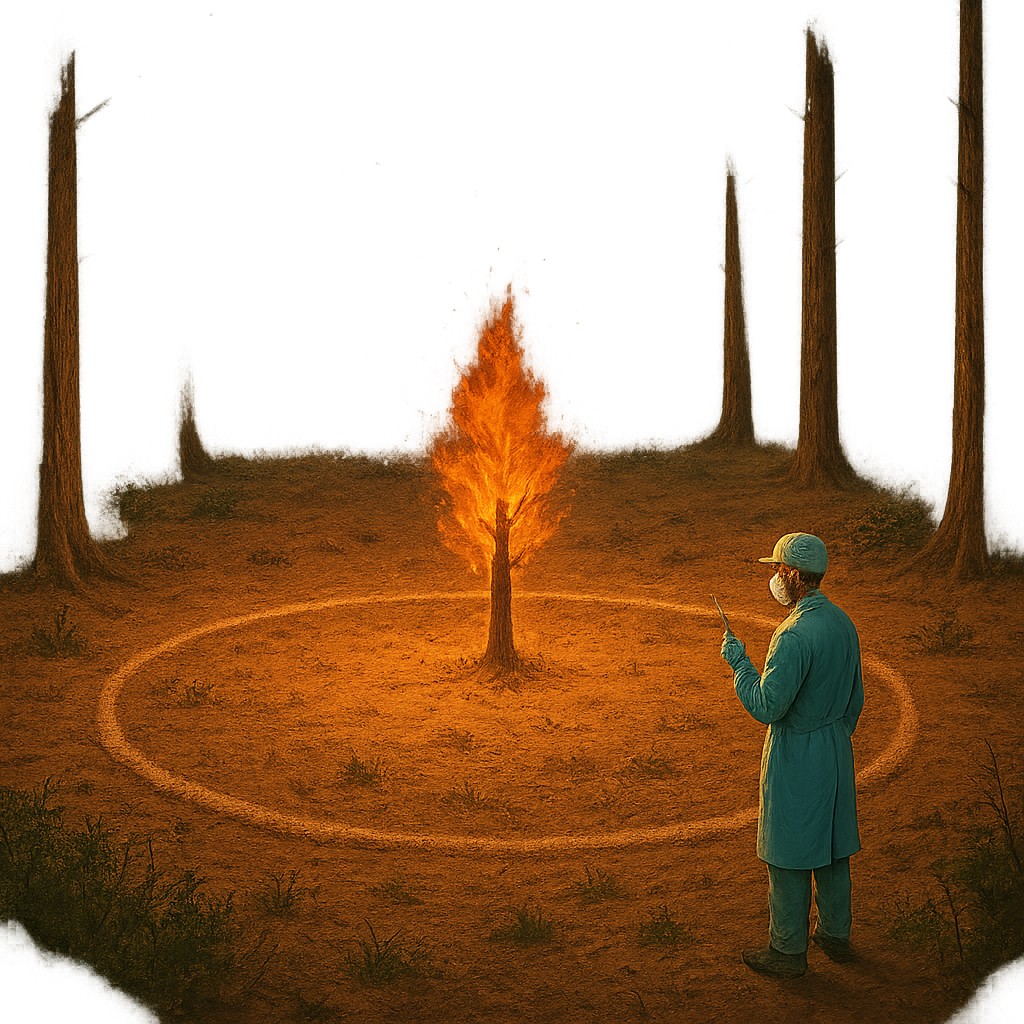
Imagine you are standing in a thick, dry forest when a single tree catches fire. If you decide to soak the entire woodland in water, you might eventually put out the flames, but you will waste a massive amount of resources. Worse, you will likely arrive too late to save the trees already burning. Instead, forestry experts often use a different tactic. They cut down a circle of healthy trees around the blaze to create a gap of empty space that the fire cannot jump across. By removing the fuel in the path of the flames, the fire is forced to burn itself out, trapped within a sacrificial zone while the rest of the forest remains safe.
In the world of infectious diseases, public health officials use a very similar strategy called ring vaccination. Rather than attempting to vaccinate eight billion people every time a new germ appears, they treat the infected person as the center of a target. They identify everyone who has been in close contact with that person and vaccinate them, forming a protective human barrier. This method does not just protect the individuals who get the shot; it builds a biological wall that prevents the virus from finding its next host. This surgical precision stops an outbreak by focusing on the local connections that drive the spread, rather than the global population.
The Geometry of Infection and Defense
At its heart, ring vaccination is a game of strategy and geometry. When an individual tests positive for a high-risk germ, such as Ebola or Mpox, they are called the "index case." Health experts immediately begin "contact tracing," which is essentially a medical investigation. They ask, "Who did you sit with at lunch? Who do you live with? Who did you shake hands with yesterday?" These people form the primary ring, the inner circle of the target. These individuals have the highest chance of already carrying the virus or catching it in the coming days.
The strategy then expands to a second ring, often called "contacts of contacts." If the first patient’s brother was near the infected person, the medical team will also look at the brother's coworkers and friends. By vaccinating this second layer, the team creates a buffer zone. Even if the brother is already infected but isn't showing symptoms yet, the virus will hit a dead end when it tries to move from him to his coworkers because those coworkers are already immune. It is a proactive strike that predicts the movement of the virus before it even takes its next step.
This approach is different from mass vaccination, which is the public health version of "carpet bombing." While mass vaccination is necessary to control common diseases like polio or measles, it is often too slow and logistically impossible for sudden, local outbreaks of rare but deadly germs. In an emergency, time is the scarcest resource. Ring vaccination allows authorities to use a limited supply of vaccines exactly where they are needed most.
The Historical Triumph over Smallpox
To understand why this method is the gold standard for certain diseases, we have to look back at the greatest victory in medical history: the total elimination of smallpox. For centuries, smallpox was a global nightmare that killed hundreds of millions of people. In the mid-twentieth century, the World Health Organization realized that trying to vaccinate every person on Earth was a logistical disaster that might take decades to finish. They needed a faster way to hunt down the final pockets of the disease.
In the 1970s, workers shifted their focus toward "surveillance and containment." Whenever a case of smallpox was reported in a remote village, teams would rush to the site, isolate the patient, and vaccinate every single person nearby. This was the birth of modern ring vaccination. It allowed teams to snuff out the virus village by village, following the chains of human interaction. By 1980, smallpox became the first and only human disease to be completely wiped out through human effort. This success proved that you don't need to win every battle at once; you just need to win the right battles at the right time.
The reason this worked so well for smallpox, and why it works for Ebola today, is because of how these viruses behave. These germs typically have a clear waiting period before symptoms start (incubation) and require close contact to spread. They aren't "stealthy" like some respiratory viruses. Because the symptoms are usually obvious and the spread is direct, health workers can actually see the "fire" they are trying to contain.
Comparing Containment Strategies
Not all diseases are the same, so no single vaccination strategy works for every situation. To see where ring vaccination excels and where it struggles, we can compare it to other common health responses.
| Strategy |
Primary Goal |
Best Use |
Main Drawback |
| Ring Vaccination |
Containment |
Small, local outbreaks with clear spread |
Very difficult to track every contact |
| Mass Vaccination |
Elimination |
Widespread diseases (e.g. Polio) |
Hard to manage; needs massive supply |
| Routine Immunization |
Prevention |
Keeping immunity high (e.g. Tetanus) |
Needs a stable, long-term health system |
| Post-Exposure Care |
Individual Protection |
Someone already exposed (e.g. Rabies) |
Does not stop spread in the community |
As the table shows, ring vaccination is like a "special forces" operation. It is highly effective but requires specific conditions to work. It relies on health workers finding every single person in the "ring." If even one contact is missed and travels to a new city, the ring is broken and a new fire starts elsewhere. This makes the method very labor-intensive, requiring hundreds of interviews and deep community trust to ensure people are honest about who they have met.
The Shadow of the Invisible Threat
Despite its strengths, ring vaccination has one major weakness: it cannot easily stop what it cannot see. This is why the strategy was not the main tool used for COVID-19 or the seasonal flu. Highly contagious respiratory viruses spread through microscopic droplets in the air. They can be shared by strangers who never even speak to one another. If you catch a virus on a crowded subway or at a concert, you cannot name the "contacts" you were near. There is no ring to build because the connections are anonymous.
For a ring to work, the virus must move relatively slowly and the transmission must be traceable. In the case of Ebola, which spreads through contact with bodily fluids, the "ring" is usually limited to family, friends, and doctors. This group is manageable. However, if a virus can jump between strangers in a grocery store, the "ring" becomes the entire city. In those cases, officials must move from the precision of ring vaccination to the broader tools of mass vaccination and social distancing.
Furthermore, ring vaccination requires people to cooperate. If people fear the vaccine or distrust the government, they may hide their contacts. This shows that public health is about more than just biology; it is also about how people act. To build a human firebreak, you need the consent of the people involved. Without trust, the ring is full of gaps and the virus will find its way through.
The Future of Precision Outbreak Control
As global travel makes it easier for new germs to cross borders, our containment tools must become even sharper. Scientists are currently looking at how digital tools, such as location data and genetic testing, can make ring vaccination even faster. By analyzing the genetic fingerprint of a virus, researchers can determine if two cases in different parts of a country are actually part of the same "ring," even if the patients themselves don't realize they are connected.
In recent years, we have seen this strategy tested during Ebola outbreaks in the Democratic Republic of the Congo and Uganda. In these high-stakes environments where every hour counts, vaccinating the "ring" has saved thousands of lives. It has turned potential global catastrophes into manageable, local events. Recent trials, such as those launched in Uganda in early 2025, continue to improve the process so that when the next case appears, the response is even faster.
These strategies remind us that fighting disease is not always a war of numbers. Often, it is a game of intelligence and focused energy. By understanding the networks that connect us, we can use those same connections to protect ourselves. Ring vaccination is a testament to human ingenuity, proving that with a little geometry and a lot of teamwork, we can save the world.