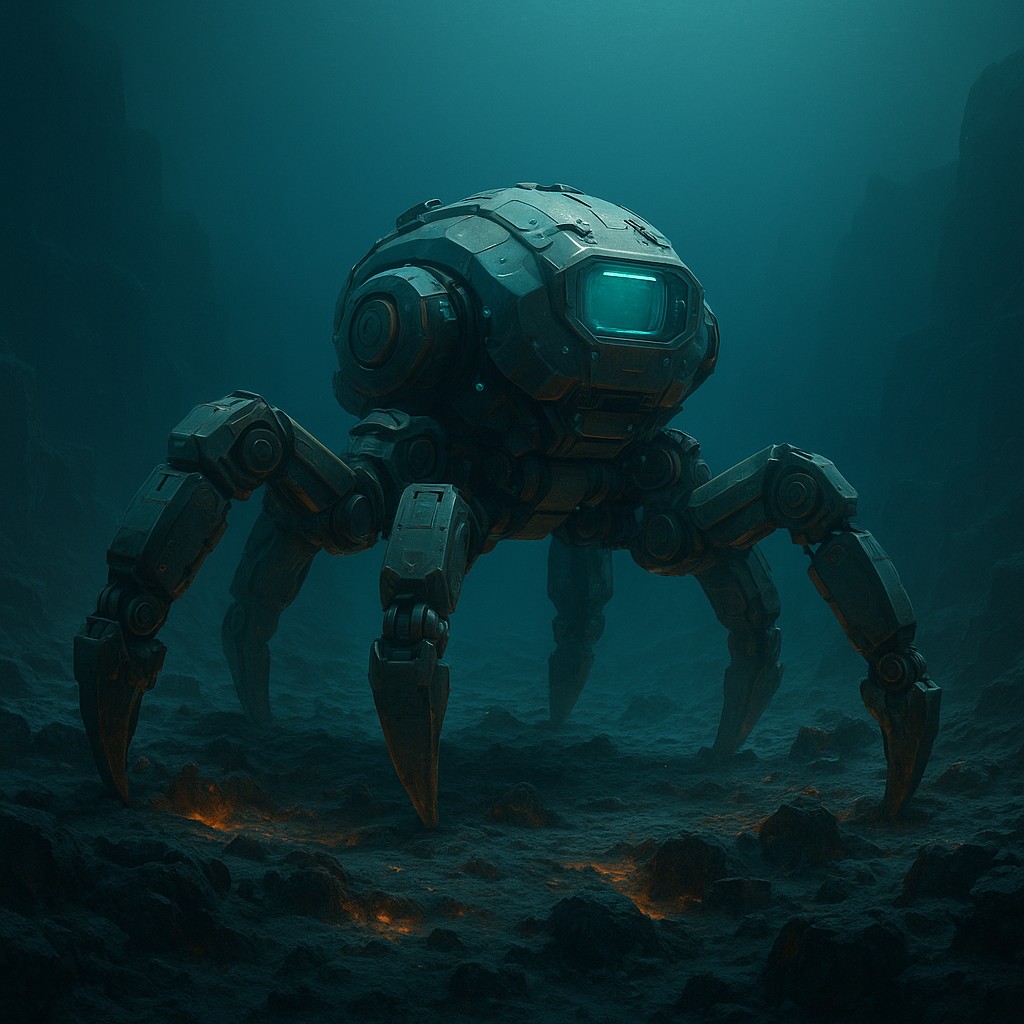
Imagine a massive, crab-like robot weighing several tons, crawling across a landscape of volcanic vents and jagged canyons four kilometers beneath the ocean surface. It is searching for polymetallic nodules: potato-sized rocks rich in cobalt and nickel that are essential for the world’s transition to green energy. At these depths, the sun is a distant memory, and the water pressure is high enough to crush a conventional submarine like a soda can. For decades, the primary hurdle for these mechanical explorers hasn't been the darkness or the pressure, but the "paradox of power." Carrying enough batteries to perform heavy labor for more than twenty-four hours makes the robot so heavy it sinks into the silt, while tethering it to a ship on the surface requires miles of expensive, fragile cabling that can snap in a storm.
Engineers are now flipping the script by turning the hostile environment of the abyss into a design advantage. Instead of fighting the crushing weight of the ocean, they are designing Small Modular Reactors (SMRs) that treat the deep sea as a high-tech component of the power plant itself. These nuclear units are being reimagined not as shrunken versions of land-based giants, but as specialized "extremophiles" of the machine world. By using the unique physics of the deep ocean, these reactors can provide steady, carbon-free energy for years without human help, effectively turning a mining robot or a scientific outpost into a permanent resident of the seafloor.
The Architecture of Extreme Pressure
To understand why these reactors are revolutionary, we first have to look at how a standard nuclear plant works on land. In a typical Pressurized Water Reactor (PWR), engineers fight a constant battle against physics. They need to keep the water touching the nuclear fuel extremely hot so it can transfer energy, but they also need to keep it in a liquid state so it can flow through the pipes. Water naturally turns into steam at 100 degrees Celsius, so land-based plants use massive, thick-walled steel tanks and high-powered pumps to create huge amounts of internal pressure. This prevents the water from boiling, allowing it to reach temperatures of over 300 degrees Celsius while remaining a liquid.
In the deep ocean, that artificial pressure is no longer necessary. At a depth of 3,000 meters, the weight of the water above creates a natural pressure about 300 times greater than at the surface. By placing a reactor at these depths, engineers can allow the ocean to provide the "squeeze." Instead of building a massive, heavy containment dome to hold the pressure in, they build a much thinner, more elegant vessel where the external pressure of the sea balances the internal pressure of the reactor. It is a brilliant example of "passive design," where the environment does the heavy lifting. This reduces the number of complex mechanical parts that could break down kilometers below the waves.
A Natural Heat Sink the Size of a Planet
One of the greatest challenges for any power plant, nuclear or otherwise, is getting rid of waste heat. On land, this requires those iconic, hourglass-shaped cooling towers or massive intake pipes that draw in water from a nearby river or lake. These systems are "active," meaning they require pumps, filters, and constant maintenance. If the pumps fail, the reactor can overheat, leading to the kind of safety crises that keep engineers awake at night. In the deep ocean, however, the entire environment is a heat sink that stays at a constant, near-freezing temperature regardless of the season or the weather on the surface.
Undersea SMRs use a process called natural convection. Because the reactor is surrounded by an endless supply of 2-degree Celsius seawater, the heat from the core naturally flows outward toward the cold. As the water inside the reactor’s cooling loops warms up, it becomes less dense and rises, while the cooler, denser water falls. This creates a "convection cell," a continuous loop of moving fluid that circulates without a single mechanical pump. By removing the need for active pumping systems, engineers eliminate the most common point of failure in nuclear design. The ocean itself becomes the radiator, pulling heat away with effortless, silent efficiency.
Comparing Land-Based and Deep-Sea Nuclear Designs
While both systems rely on the same fundamental physics of nuclear fission, their structural requirements and operational limits are worlds apart. The following table highlights how the deep-sea environment fundamentally alters the design of these power units.
| Feature |
Land-Based SMR |
Deep-Sea Modular Reactor |
| Pressure Regulation |
Heavy steel pressure vessels and active pumps |
External water pressure from the ocean |
| Cooling Method |
Cooling towers or mechanical water intake |
Passive circulation using seawater heat sink |
| Containment |
Massive concrete and steel domes |
Compact, pressure-balanced hulls |
| Coolant State |
Risks boiling if pressure is lost |
High sea pressure prevents boiling naturally |
| Mobility |
Stationary or moved by truck |
Built directly into autonomous sea vehicles |
| Environmental Risk |
Risk of leaks into the air |
Contained by extreme pressure and water density |
The Specialized Physics of the Abyss
One of the most fascinating aspects of these deep-sea reactors is that they are "hard-coded" for the abyss. In the world of engineering, we often prize versatility, we want a tool that works anywhere. However, these reactors are designed to be safe specifically because they are specialized. If you were to bring one of these units to the surface or place it in a shallow harbor, it would immediately become unstable. Without the crushing weight of several kilometers of water to hold the coolant in a liquid state, the internal fluids would flash into steam. The heat exchange systems would also stop working because the temperature difference between the core and the "warm" surface water wouldn't be dramatic enough.
This creates a built-in safety mechanism that acts as a geographic tether. These reactors cannot "escape" the deep ocean. If a mining robot were to malfunction and float to the surface, the reactor would effectively shut itself down because the physics required for its operation simply vanish as the pressure drops. This prevents the possibility of a "runaway" reactor reaching a populated coastline. It also means that maintenance must be done in place, or the reactor must be emptied of fuel before being brought up. This ensures that the radioactive core is never exposed to the low-pressure environment of our atmosphere.
Powering the Autonomous Deep-Sea Economy
The shift toward deep-sea nuclear power marks a change in how we view the "frontier." For a long time, the ocean floor was treated like the moon: a place where you go for a short visit, take some photos, and leave as quickly as possible before you run out of power. With reliable energy from SMRs that can last for decades, we are moving toward a model of permanent presence. This isn't just about mining for battery metals like manganese and cobalt; it’s about long-term scientific stations that can monitor climate change, tectonic shifts, and whale migrations for twenty years without needing a battery swap.
By building the reactor directly into the robot’s frame, we create a machine that is truly autonomous. These robots don't need a support ship hovering above them, burning thousands of gallons of diesel a day just to keep a cable tight. Instead, a fleet of nuclear-powered crawlers could operate independently, communicating with each other via sound-based underwater modems and returning to a central hub on the seafloor only to drop off collected minerals. It is a vision of industry that looks more like a biological ecosystem: slow, steady, and perfectly adapted to the crushing weight and freezing cold of its home.
The Future of Planetary Engineering
As we look toward the future, the lessons learned from building nuclear reactors that "breathe" the pressure of the ocean may eventually help us explore even further. The moons of Jupiter and Saturn, like Europa and Enceladus, are believed to have deep oceans hidden under miles of ice. The conditions there are remarkably similar to Earth's deep trenches: immense pressure, freezing temperatures, and no hope of solar power. The deep-sea SMRs being designed today are the prototypes for the power plants that might one day melt through those alien ice shells to explore the waters of another world.
The deep sea has always been a place where we felt like intruders, struggling against the weight of the world. But by embracing the pressure and the cold, we are learning that the most hostile environments can also be the most supportive, provided we have the curiosity to design with the environment rather than against it. This isn't just a leap in robotics or energy; it is a shift in our relationship with the planet. We are finding power in the very places we once thought were impossible to live. We are finally learning to use the weight of the ocean to lift our technological ambitions to new depths.