Imagine walking down a familiar street in your neighborhood, a place where cars dominate the pavement and pedestrians are squeezed onto narrow strips of cracked concrete. Usually, changing this layout would take a decade of red tape, five million dollars in taxpayer money, and a string of heated town hall meetings where neighbors argue over blueprints that are hard to visualize. By the time the first jackhammer hits the ground, the original problem might have changed, or the community might have lost interest entirely. It is a slow, rigid, and incredibly expensive way to design a world that is supposedly built for the people living in it.
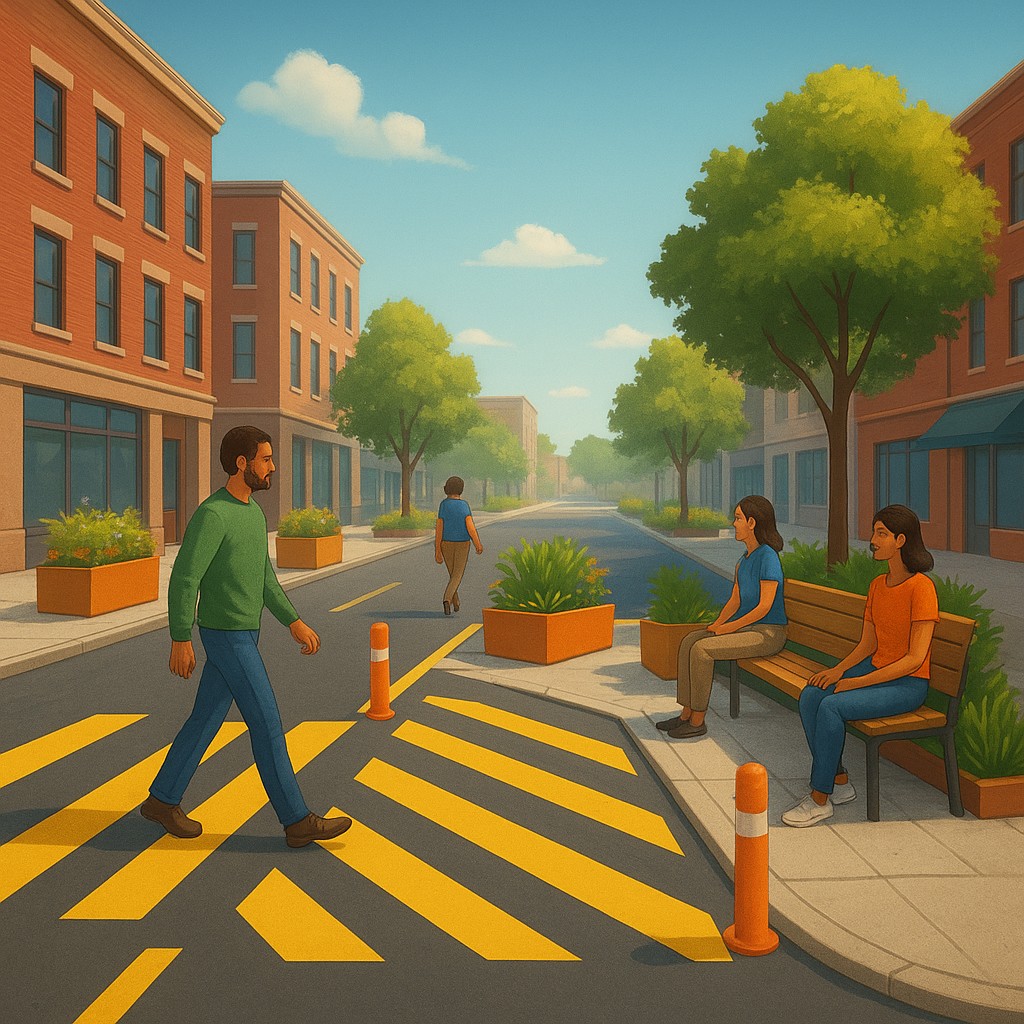
Now, imagine a different path. One Saturday morning, you wake up to find a new pedestrian plaza has appeared overnight. There are no massive construction crews, just a row of colorful planters, some bright high-visibility paint, and a line of sturdy plastic posts. This transformation cost less than a mid-range SUV and was set up in a few hours. This is "tactical urbanism" in action. It is a "build, measure, and learn" philosophy borrowed from software startups and applied to the physical, often sluggish world of city planning. It is the art of the pilot project, a way to test-drive a better city before committing to the heavy cost of permanent concrete.
Flipping the Script on Traditional Infrastructure
The standard model for city development follows a "Design-Fund-Build" sequence. In this old framework, every decision is high-stakes because mistakes are permanent. If a city spends two years and three million dollars building a bike lane that accidentally causes traffic jams or blocks fire trucks, fixing it is a political and financial disaster. This fear of failure leads to "paralysis by analysis," where planners spend years on hypothetical traffic studies before moving a single pebble. Tactical urbanism replaces this with a "Build-Measure-Refine" loop. Here, the barrier to entry is so low that failure is actually allowed, provided it happens quickly and cheaply.
By using temporary materials, cities can move past the stifling fear of making an irreversible mistake. If a pop-up curb extension creates a blind spot for bus drivers, the city can simply pick up the plastic markers and move them six feet to the left the next morning. This flexibility allows for experimentation that used to be unthinkable in civil engineering. It moves the conversation from "What might happen if we change this?" to "Look at what is actually happening now that we have changed it." This shift from guessing to observing is what makes these modern interventions so powerful.
The Toolkit of the Temporary City
Tactical urbanism relies on a specific set of low-cost, high-impact materials. These are not meant to last twenty years; they are meant to stay just long enough to gather data and change habits. For example, "flexible delineator posts" (those bendy orange or white sticks) act as a visual barrier that mentally separates cyclists from cars. While they won't physically stop a speeding truck, they make the lane look narrower to drivers, which naturally encourages them to slow down. The beauty of these tools is that they are portable and can be set up by small crews without heavy machinery.
| Project Type |
Materials Used |
Primary Goal |
| Curb Extensions |
Large planters or paint |
Shortens the distance for people crossing the street |
| Parklets |
Wooden platforms and benches |
Turns street parking into public seating |
| Protected Bike Lanes |
Plastic posts or traffic cones |
Physically separates bikes from car traffic |
| Pavement to Plazas |
Gravel and epoxy or bright paint |
Reclaims asphalt for community gatherings |
| Chicanes |
Staggered barriers |
Forces cars to zig-zag to reduce speed |
Beyond the plastic and paint, the most important tools in this kit are the stopwatch and the camera. Because these projects are experiments, documentation is vital. Planners often count foot traffic, track average vehicle speeds, and even check local business sales to see if the change is working. In many cases, shop owners who feared that losing a parking spot would hurt business find that an attractive plaza actually keeps people in the area longer. This leads to more customers and higher sales. The data gathered during this trial phase becomes the strongest argument for making a project permanent.
Easing Public Friction and Pushback
One of the biggest hurdles in urban design is not engineering, but psychology. People generally dislike change, especially when it affects their daily commute. When a resident looks at a flat map of a proposed street change, they usually focus on what they are losing, such as a driving lane or a few parking spots. Tactical urbanism solves this by providing a full-scale prototype that people can actually experience. It turns an abstract debate into a tangible reality. Instead of arguing over a drawing, neighbors can walk through the new plaza, sit on the benches, and see for themselves that the world didn't end when the street narrowed.
This approach also makes the planning process more democratic. In many "quick-build" projects, community members are invited to help paint murals on the ground or pick out plants for the mobile containers. This creates a sense of "psychological ownership." When people feel they helped build something for their neighborhood, they are more likely to protect it and ask for it to stay. It moves the planner out of an office and onto the pavement, creating a collaborative atmosphere where the city feels like a shared living room rather than just a transit corridor.
The Science of Narrow Lanes and Calm Traffic
There is a fascinating psychological trick at play when we change street layouts. Traffic engineers have long known about "risk compensation." When a road is wide, straight, and clear, drivers subconsciously feel safer and naturally speed up. This is why a neighborhood street designed like a highway will always have speeding problems, no matter what the signs say. Tactical urbanism uses "visual friction" to reset this subconscious habit. By placing planters at corners or creating "chicanes" (slight curves in the road), planners create a more complex environment for the driver.
This complexity forces the human brain to switch from "autopilot" to "active thinking." When the street feels narrower or busier, drivers naturally slow down to process all the information. This usually creates a safer environment for everyone without significantly increasing travel times. Studies show that while top speeds drop, the overall flow of traffic often becomes more consistent because there is less "stop-and-go" movement. It is a win for everyone: by prioritizing the safety of a person walking, the whole system becomes more predictable.
Beyond the Paint: Understanding the Limits
While tactical urbanism is a brilliant "hack" for modern bureaucracy, it is not a magic wand. A coat of paint and some plastic sticks cannot fix a burst water main or a crumbling bridge. There is also the danger of "experimental fatigue," where a city starts dozens of temporary projects but never finds the funding to make the successful ones permanent. If the plastic posts get covered in grime and the paint begins to peel, a community asset can quickly turn into an eyesore that causes resentment.
Furthermore, there are valid concerns about accessibility and maintenance. A "pop-up" park made of wood might not be as easy for someone in a wheelchair to navigate as a properly sloped concrete sidewalk. Temporary materials also need more frequent upkeep than stone or asphalt. The goal of tactical urbanism should always be to serve as a bridge to high-quality, permanent infrastructure, not a cheap excuse to stop investing in the city's foundation. It is a way to test ideas, not a replacement for long-term care of public spaces.
The Future of the Agile City
As our climate changes and our cities grow, the ability to adapt our streets quickly will become a necessity. Tactical urbanism provides a blueprint for the "agile city," a place that can improve in months rather than decades. It allows us to respond to immediate needs, such as creating more outdoor space during a health emergency or cooling down "heat islands" with temporary trees. By lowering the cost of trying something new, we invite more voices into the conversation and allow our cities to grow like living organisms rather than stiff monuments.
The next time you see a row of planters blocking off a corner or a bright mural painted across a gray intersection, look closer. You aren't just looking at a cheap project; you are looking at a hypothesis being tested in real time. You are witnessing a shift in how we manage our most complex invention: the city. Tactical urbanism teaches us that we don't need a billion dollars to improve a neighborhood; we just need a little paint, a few brave ideas, and the willingness to learn from what happens next. It is a reminder that the streets belong to us, and we have the power to reshape them, one planter at a time.