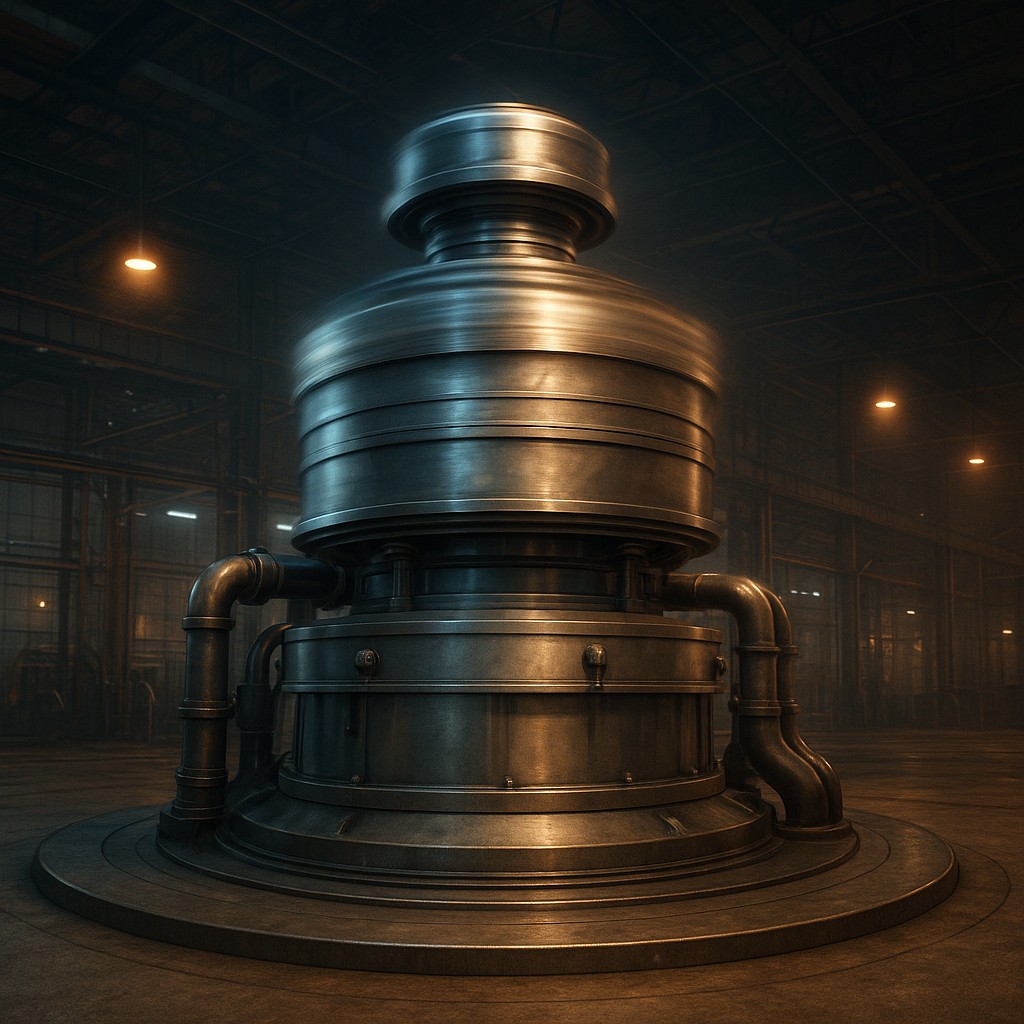
Imagine you are standing in a massive industrial hall where the floor hums with a deep, low vibration. In the center of the room sits a piece of machinery the size of a school bus. Encased in gleaming steel, it spins at thousands of revolutions per minute. You might assume this machine is churning out enough electricity to power an entire city, but here is the surprise: it isn’t plugged into a fuel source, and it isn't actually "producing" any power at all. It is simply spinning - a giant metallic top kept in motion by the grid itself. This is a synchronous condenser. While it might look like a useless mechanical ornament, it is quickly becoming the hidden bodyguard of the green energy revolution.
For over a century, our power grids were built on the backs of giants. Coal, gas, and nuclear plants used massive, heavy turbines to physically push electricity through the wires. These spinning masses provided "inertia," a mechanical resistance to change that kept the electrical heartbeat of our world steady at exactly 60 hertz in North America (or 50 hertz in Europe). However, as we dismantle these old plants to save the planet and replace them with silent solar panels and wind turbines, we are accidentally removing the very weights that keep the grid stable. Without that physical momentum, the grid becomes jittery and prone to sudden crashes if even a single cloud passes over a solar farm. To fix this, engineers are reviving an old technology to act as a bridge between our mechanical past and our digital future.
The Invisible Weight That Holds the World Together
To understand why a spinning piece of metal matters, we first need to understand grid frequency. Think of the entire electrical grid as a massive, synchronized dance floor. Every generator in the country is a dancer, and they must all move their feet in perfect unison, hitting the floor at the exact same micro-second. This rhythm is the frequency. If the rhythm speeds up or slows down even slightly, sensitive electronics can fry, motors can burn out, and the entire system can go dark in what engineers call a "frequency collapse."
In the old days, this rhythm was maintained by sheer physical bulk. A 100-ton steel rotor spinning inside a coal plant has an immense amount of "kinetic energy," or the energy of motion. If a million people suddenly turn on their kettles at the same time, the grid feels a sudden "drag." Because those massive rotors have so much momentum, they don't just stop. They keep spinning, using their stored physical energy to "ride through" the sudden demand. This gives plant operators a few precious seconds to turn up the heat and catch up. This physical buffer is known as inertia; it works like a heavy flywheel in a luxury car engine that keeps the ride smooth even when you shift gears.
The challenge today is that solar panels and wind turbines are "inverter-based" resources. Solar panels turn sunlight into direct current (DC) electricity, which a computer chip - an inverter - then converts into the alternating current (AC) our homes use. These inverters are incredibly fast and efficient, but they have zero weight. They are digital, not mechanical. If the grid hits a sudden snag, a solar farm cannot "lean into" its own momentum to help because it doesn't have any. It is like trying to keep a heavy door open with a feather instead of a brick. As we add more solar and wind, the "weight" of our grid drops, making the electrical frequency as twitchy as a caffeinated kitten.
The Mechanical Ghost in the Machine
This brings us to the hero of our story: the synchronous condenser. Despite the futuristic name, the technology actually dates back to the early 20th century. A synchronous condenser is essentially a large electric motor that spins freely without being attached to a "load" like a pump or a mill. Once it reaches the same speed as the grid, it locks into the grid's frequency and just sits there, spinning in its specialized housing. It consumes a tiny bit of electricity just to overcome friction, but its primary job is purely defensive.
Because the rotor of a synchronous condenser is a massive hunk of solid metal, it provides the same physical inertia that old coal plants did. If there is a sudden drop in grid frequency, the condenser "feels" the drag and naturally pushes back. It converts its own motion into electrical energy instantly, without needing a computer to tell it to do so. This is a law of physics, not a programmed response. This provides the "instantaneous" reaction needed to stabilize the grid before digital systems even realize something is wrong.
Beyond just providing weight, these machines manage "reactive power." In a complex grid, voltage can sag or swell based on how far electricity has to travel or the types of heavy machinery used in factories nearby. A synchronous condenser can adjust its magnetic field to "inhale" or "exhale" reactive power, acting like a shock absorber for voltage levels. This keeps the electrical "pressure" in the lines consistent, preventing the brownouts that can plague regions relying on long-distance renewable energy.
Comparing the New Guard and the Old Guard
As energy operators decide how to stabilize their systems, they must choose between traditional mechanical solutions and modern digital ones. While batteries are often called the ultimate solution for everything, they serve a very different purpose than synchronous condensers. Below is a breakdown of how these different stabilizers compare.
| Feature |
Coal/Gas Turbines |
Synchronous Condensers |
Big Battery Arrays |
Solar/Wind Inverters |
| Primary Job |
Generate Power |
Stabilize Voltage/Inertia |
Store/Release Energy |
Generate Clean Power |
| Physical Inertia |
Very High |
Very High |
Zero |
Zero |
| Response Time |
Physical (Instant) |
Physical (Instant) |
Digital (Millisecond) |
Digital (Millisecond) |
| Carbon Footprint |
High |
Near Zero |
Low (Lifespan dependent) |
Near Zero |
| Fuel Required |
Constant |
None (Uses minor grid power) |
None |
None (Sun/Wind) |
| Grid "Weight" |
Provides massive stability |
Provides massive stability |
Virtual stability only |
Relies on others for stability |
As the table shows, the synchronous condenser is the "Goldilocks" solution for a greening grid. It provides the mechanical stability of a coal plant without the smoke, and it offers a physical "substance" that batteries and solar panels simply cannot replicate with software alone. It is the missing link that allows us to retire old fossil fuel plants without making the grid fragile.
Repurposing the Relics of the Industrial Age
One of the most poetic aspects of the rise of synchronous condensers is how they are being built. In many cases, we don't even have to build them from scratch. When a massive coal plant is shut down, the grid operators are left with a site that is already connected to the high-voltage network. More importantly, they still have the massive generators that used to produce the power. Instead of scrapping these multi-ton machines, engineers are performing "generator surgery."
By disconnecting the generator from the steam turbine (the part that burned the coal) and adding a small "pony motor" to get it spinning, engineers can turn a dirty power plant generator into a clean synchronous condenser. This is happening at sites across the world, from Australia to the United Kingdom. It is a form of industrial reincarnation. The machine that once contributed to climate change is stripped of its fiery heart and reborn as a silent, spinning guardian that supports the wind and solar farms that replaced it.
This repurposing also makes financial sense. Building a new stability plant from scratch is expensive, but modifying an existing one can save millions of dollars. Furthermore, since these machines are already located at "weak points" in the grid where large plants used to be, they are perfectly positioned to reinforce local voltage. It turns out that the legacy of the 20th century - massive, heavy, spinning machinery - is exactly what the 21st century needs to hold its digital energy dreams together.
The Limits of Software in a Physical World
There is a growing debate in the engineering community about whether we even need these physical spinners. Some proponents of "grid-forming inverters" argue that we can program solar and wind systems to mimic inertia using software. These smart inverters can detect a change in frequency and almost instantly dump a burst of power from a battery to compensate. In theory, if you have enough batteries and fast enough code, you could create "virtual inertia" that removes the need for heavy flywheels.
However, the "physics-first" crowd points out a critical flaw: software always has a delay, no matter how small. A synchronous condenser reacts at the speed of light because it is physically bound to the grid by magnetism. If the frequency drops, the metal slows down, and energy is released as a direct consequence of the laws of motion. There is no sensor to fail, no code to bug out, and no cybersecurity risk that can stop a spinning mass from obeying Newton’s laws. For grid operators, who are famously risk-averse, this "passive" safety is incredibly comforting.
Additionally, synchronous condensers provide "short-circuit current." This is a massive burst of energy released during a fault, such as when a tree falls on a power line. This burst is necessary to trigger the "fuses," or circuit breakers, that protect the rest of the grid. Inverters are generally quite "weak" in this regard; they tend to shut down to protect their own delicate circuits when a fault occurs. Synchronous condensers, being giant hunks of iron and copper, are much tougher. They provide the "grunt" needed to clear a fault and keep the system running, acting as the muscles of the grid while the inverters act as the nervous system.
Designing the Future with a Spinning Safety Net
As we move toward 100 percent renewable energy, the grid of the future will likely be a hybrid of these technologies. We will have vast arrays of solar panels and offshore wind farms providing raw energy, massive battery banks storing that energy for the night, and "pockets" of synchronous condensers strategically placed to keep the system’s "weight" balanced. This is a systems-level approach to energy, where we recognize that electricity is not just about the "stuff" (the electrons) but also about the "momentum" (the frequency).
The transition to clean energy is often framed as a purely digital or chemical shift - better panels, better batteries, better software. But the synchronous condenser reminds us that we live in a physical world governed by mass and motion. There is something deeply satisfying about the fact that the solution to our most modern energy challenges involves a technology that would have been familiar to Nikola Tesla. It suggests that progress is not always about discarding the past, but about finding the timeless principles of physics and applying them in a new context.
When you flip a light switch in ten years, the power might come from a gust of wind 100 miles away or a ray of sunlight captured that morning. But the reason the light does not flicker, your computer does not crash, and the grid remains rock-solid is likely due to a massive, silent, spinning steel ghost hidden away in a nearby station. These machines are the unsung anchors of our future, proving that even as we reach for the stars with new technology, we still need a little bit of old-fashioned heavy metal to keep our feet on the ground.
Entering this new era of energy management requires us to rethink what a "power plant" actually is. It is no longer just a place that makes energy; it is a place that provides "services" to the network. By valuing inertia and stability as much as we value the electricity itself, we create a more resilient world. Even as the old smokestacks vanish from the horizon, the spinning heart of the grid is still beating, faster and more purposefully than ever before, ensuring that the transition to a green future is a smooth, stable ride for everyone.