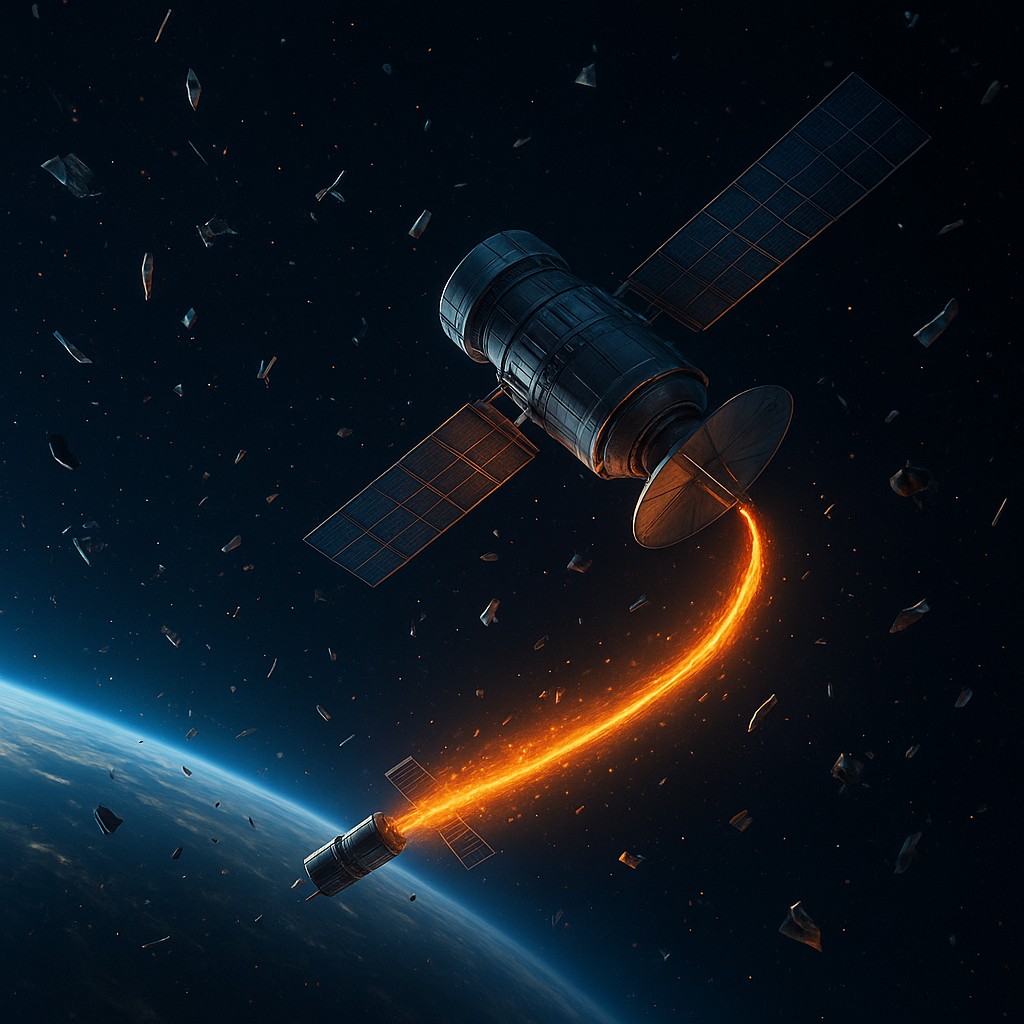
Imagine standing on a highway where every car travels at 17,000 miles per hour, but none have steering wheels or brakes. Even worse, if two cars collide, they don't just stop; they explode into thousands of jagged shards. These pieces keep flying at that same deadly speed, ready to puncture any other vehicle in their way. This is the current reality of Low Earth Orbit (LEO), the slice of space just above our atmosphere where thousands of satellites operate. When a satellite runs out of fuel or breaks down, it doesn't simply fall back to Earth. In the vacuum of space, there is almost no air resistance to slow it down. Instead, it stays in a high-speed lap around the planet for decades or even centuries.
As we launch more "mega-constellations" into the sky to provide global internet and monitoring services, the orbital traffic jam is becoming a serious threat. If we do not find a way to clean up our mess, we risk a scenario called the Kessler Syndrome. This is a chain reaction where one collision creates enough debris to cause another, eventually surrounding Earth in a cloud of shrapnel that makes space travel impossible. To fight this, engineers are developing an elegant solution that replaces heavy rocket fuel with the invisible force of electromagnetism. By using "plasma brakes," we are essentially dropping a high-tech anchor into the Earth’s magnetic field to drag dead spacecraft back home.
The Ghostly Grasp of Electromagnetic Drag
To understand how a plasma brake works, we first have to rethink the idea of "empty space." While the region where satellites fly is a vacuum, it isn't actually empty. It is filled with the Earth’s magnetic field and a thin, ghostly soup of charged particles called the ionosphere. This environment allows for physics tricks that would be impossible on the ground. A plasma brake works by unrolling a long, incredibly thin wire known as a tether. Often just a few micrometers thick but several miles long, this isn't a mechanical rope meant to tie onto something. Instead, it is a tool for interacting with the planet's natural forces.
As the satellite zips through space, the wire tether cuts through the Earth’s magnetic field lines. Just like a hand-crank flashlight or a power plant turbine generates electricity by moving a conductor through a magnetic field, the satellite's tether becomes a generator. By charging the tether, the satellite begins to interact with the ions and electrons floating in the upper atmosphere. This interaction creates a force that pushes back against the satellite’s motion. Essentially, it acts as a form of friction in a place where friction shouldn't exist.
Borrowing Power from the Planet
The genius of this system is how efficient it is compared to traditional engines. Normally, to move a satellite, you have to burn chemical fuel. Fuel is heavy, expensive to launch, and once it’s gone, the satellite is at the mercy of gravity and time. A plasma brake, however, is a hybrid system. it uses a tiny amount of electricity to keep the wire charged, but the actual braking force comes from the satellite's own motion being converted by the magnetic field. It is the ultimate regenerative braking system, similar to how an electric car recovers energy when you let off the gas.
The resulting force is quite small, often weighing no more than a few paperclips. However, in the frictionless environment of space, a tiny force applied consistently for months is incredibly powerful. Over time, this constant tugging by the magnetic field saps the satellite's speed. As it slows down, it loses the outward force needed to stay in orbit, and gravity begins to pull it lower. This process can reduce the time a dead satellite spends in orbit from a hundred years down to just a few months, ensuring it burns up safely in the atmosphere before it can hit anything else.
The Fine Art of Navigating the Ionosphere
Using a plasma brake isn't as simple as throwing a rope overboard. The system's success depends heavily on the satellite's position and the "weather" of the ionosphere. Because the braking force comes from the interaction between the tether and the magnetic field, the satellite must point in a specific direction relative to the Earth's magnetic poles. If the tether is tangled or pointing the wrong way, the effect drops to zero and the brake fails. This makes "attitude control," or managing the satellite's orientation, its most important final mission.
Furthermore, the ionosphere is its own changing environment. It shifts based on solar activity, day-night cycles, and geographic location. Engineers must use complex math to predict how much drag the tether will produce at any given moment. Below is a comparison of how plasma brakes stack up against traditional methods for removing satellites:
| Feature |
Chemical Thrusters |
Atmospheric Drag Sails |
Plasma Brakes |
| Mass Needed |
High (Requires heavy fuel) |
Medium (Large physical sail) |
Low (Thin wire tether) |
| Complexity |
High (Pumps, tanks, valves) |
Medium (Mechanical parts) |
High (Electrical systems) |
| Reliability |
Fails if fuel runs out |
Fails if torn by debris |
Fails if orientation is lost |
| Altitude Limit |
Low to Medium Earth Orbit |
Only Very Low Earth Orbit |
Low to Medium Earth Orbit |
| Mechanism |
Reverse thrust |
Physical air resistance |
Electromagnetic interaction |
Preventing the Chain Reaction of Chaos
The main reason to perfect plasma brakes is to prevent the Kessler Syndrome. This concept, proposed by NASA scientist Donald Kessler in 1978, describes a tipping point where Low Earth Orbit becomes so crowded that one collision could trigger a cascade. Each piece of debris becomes a projectile that destroys other satellites, creating even more junk. In a worst-case scenario, this could create a permanent belt of shrapnel so dense that we could no longer launch missions to the Moon or Mars, effectively trapping humanity on Earth for generations.
Plasma brakes offer a realistic solution because they are light enough to fit on almost every small satellite, or "CubeSat," launched today. By making it a standard requirement for satellites to "self-clean" at the end of their lives, we can keep space sustainable. Rather than waiting for a specialized "space garbage truck" to fetch every dead satellite, each spacecraft comes with its own built-in retirement plan. This shift from reactive cleaning to proactive disposal is essential as the number of active satellites grows from a few thousand to tens of thousands in the coming decade.
The Future of Invisible Anchors
Imagine a future where the night sky is a managed ecosystem, where every man-made object has a digital footprint and a scheduled expiration date. Plasma brakes represent a shift in how we think about technology and the environment. We have spent centuries treating our oceans and atmosphere as infinite trash cans, only to realize the consequences much later. With electromagnetic tools, we are attempting to learn from those mistakes before they become irreversible in space.
This technology also hints at even bigger possibilities. If a tether can generate drag to slow a satellite down, it can also be used in reverse. By pumping electricity into a tether, a spacecraft could theoretically "push" off the planet's magnetic field to raise its orbit without using any fuel at all. This would allow satellites to stay in space indefinitely, powered only by solar panels and the Earth's magnetic embrace. Whether we are slowing down to come home or pushing off to reach the stars, our mastery of orbital electromagnetics is turning the "emptiness" of space into a tool for exploration.
The next time you look up at the night sky and spot a moving point of light, you might be seeing a satellite providing your GPS or internet. Thanks to plasma brakes, that light is no longer a permanent piece of litter waiting to cause a disaster. Instead, it is a guest in the sky, destined to finish its job and quietly exit the stage, dissolving into a streak of fire as it returns its materials to the Earth. Keeping the "highway" clear is the only way to ensure the window to the universe stays open for whoever looks through it next.