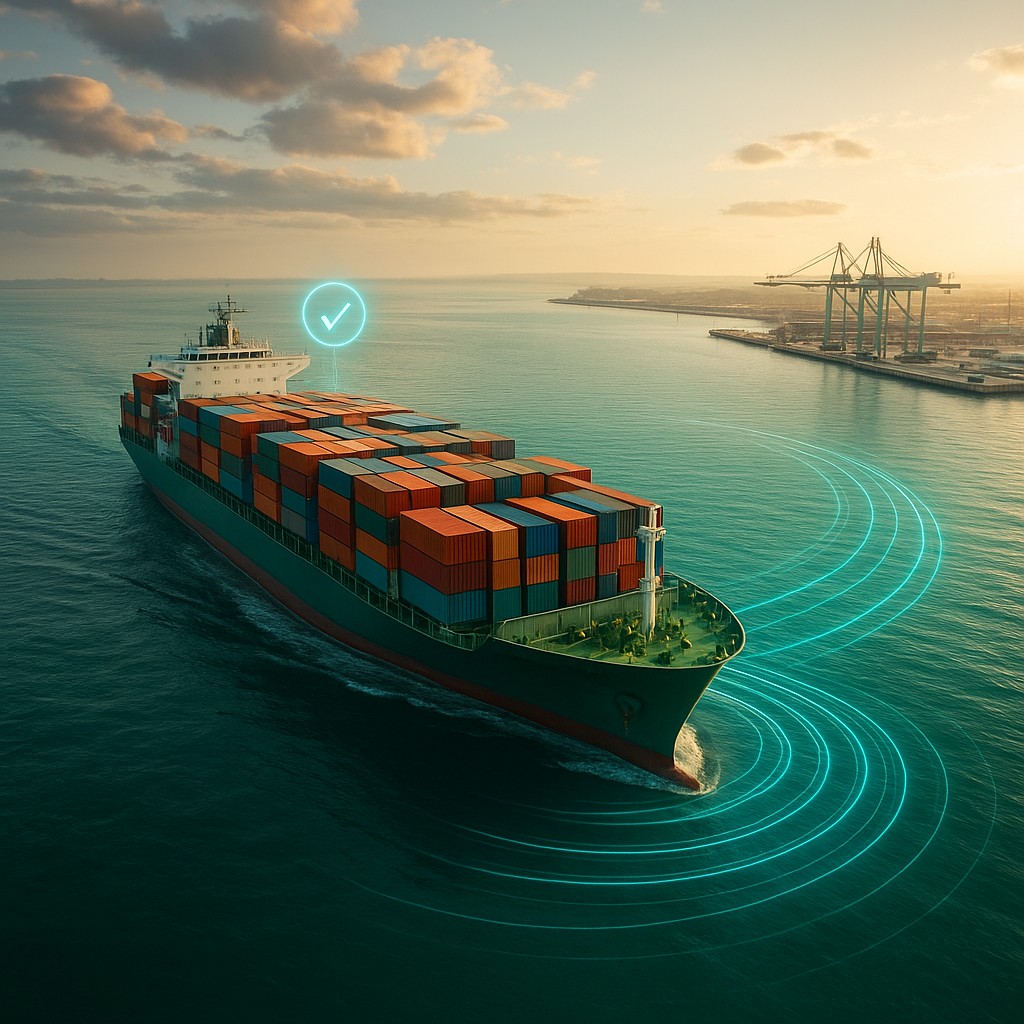
Imagine standing on the deck of a massive cargo ship, one of the steel giants that carries 90 percent of everything you own, from your smartphone to your coffee beans. For decades, the logic of the high seas was simple but wasteful: get to port as fast as possible. This created a frantic "hurry up and wait" culture. Captains would push their engines to the limit, burning mountains of thick bunker fuel to cross the ocean, only to drop anchor miles from the coast and sit idle for three days because the dock was full. It is an expensive, polluting cycle that helps no one, yet it remains the industry standard due to outdated contracts and poor communication between the shore and the sea.
Now, imagine a different world where that ship is part of a digital nervous system. Instead of racing into a traffic jam, the captain receives a notification while still a thousand miles away, informing them that their specific spot at the dock won't be ready for another twelve hours. The captain throttles back, the engine settles into a quiet, fuel-sipping hum, and the ship glides across the water with the grace of a marathon runner who knows exactly where the finish line is. This is the heart of Virtual Arrival, a logistical shift that uses data to turn a chaotic ocean into a synchronized green corridor. By replacing raw speed with precise timing, we can slash emissions and fuel costs without losing a single second of actual productivity.
The High Cost of the Ocean Sprint
To understand why we need Virtual Arrival, we have to look at the physics of moving objects through water. Ships face something called hull resistance, which increases drastically as they go faster. If a ship wants to go twice as fast, it doesn’t just use twice as much fuel; it might use eight times as much. For years, the shipping industry operated under "Sale and Proceed" contracts. These essentially forced a ship to travel at its highest possible speed to prove it was doing its job. If a ship arrived late, the company faced massive penalties; but if it arrived early and sat outside the harbor, it was usually seen as the port's problem, not the ship's.
This conflict of interest led to a "clogged drain" effect at major global ports. At any given time, hundreds of vessels are anchored outside hubs like Los Angeles or Rotterdam, spewing carbon dioxide, sulfur, and nitrogen oxides into the coastal air while their crews wait for a radio call. This is more than a logistical headache; it is an environmental disaster hidden in plain sight. These idling ships contribute significantly to the carbon footprint of global trade, all for the sake of a race that was already lost the moment the port became crowded.
How Virtual Arrival Works
Virtual Arrival is a clever legal and technological solution that creates the effect of a perfectly timed arrival without the ship needing to be there physically at the original deadline. It relies on a three-way agreement between the ship owner, the charterer (the person paying to move the cargo), and the port authority. When a delay at the port is spotted, the port issues a "Virtual Arrival" time. The ship then "virtually" arrives at its original deadline while physically slowing down to reach the harbor at the new, later time. The money saved from using less fuel is then shared between the parties, creating a win-win scenario that rewards efficiency instead of haste.
The technology powering this shift includes satellite tracking, real-time port management software, and advanced weather routing. By analyzing "berth occupancy" (how many ships are currently at the dock) and "crane productivity" (how fast they are unloading), port officials can predict exactly when a slot will open. They beam this data to the ship's navigation bridge, allowing the crew to adjust their engine speed to hit a "Just-in-Time" window. It is the difference between sprinting toward a red light and coasting slowly so you hit the green light just as it changes.
Comparing the Old Way and the New Wave
Moving from traditional maritime logistics to Virtual Arrival represents a fundamental change in how we value time and energy. We can see the impact clearly by looking at how a standard voyage changes when we stop treating the ocean like a drag strip.
| Feature |
Traditional "Hurry Up and Wait" |
Green Corridor "Virtual Arrival" |
| Speed Strategy |
Maintain maximum speed regardless of port status. |
Constant adjustment based on real-time port data. |
| Fuel Consumption |
High; exponential increase due to wasted speed. |
Low; optimized for engine efficiency and physics. |
| Port Congestion |
Clusters of idling ships at harbor entrances. |
Ships arrive exactly when the pier is empty. |
| Emissions Profile |
Heavy localized pollution at coastal cities. |
Distributed, lower emissions across the open ocean. |
| Financial Model |
Penalties for lateness; no reward for efficiency. |
Shared savings from reduced fuel spending. |
| Primary Tool |
High-horsepower diesel engines. |
Digital boundaries and real-time data streaming. |
Correcting the "Slow Boat" Myth
One common myth about Virtual Arrival is that it makes global trade slower. Critics often argue that in a world of "Amazon Prime" expectations, we cannot afford to have ships dragging their feet across the Pacific. However, this misses the point: the ship was going to wait anyway. If a ship arrives on Tuesday but cannot be unloaded until Thursday, the cargo hasn't "arrived" in any useful sense until Thursday regardless. Virtual Arrival does not change the unloading time; it simply changes the ship’s speed so that the "waiting" happens while the ship is still moving.
Another misconception is that this is just a "slow steaming" initiative. Slow steaming is when a company decides to lower the speed of its entire fleet to save money when fuel prices are high. Virtual Arrival is much more precise. It is a data-driven response to specific port conditions. On some trips, a ship might still need to go fast if the port is empty and waiting. The magic lies in the flexibility. By using "Just-in-Time" principles, we treat the ocean as a floating warehouse where timing is prioritized over raw speed, ensuring the supply chain stays fast without the environmental "tax" of wasted fuel.
Digital Boundaries and the Future of Green Corridors
To make this system work globally, ports are setting up "digital geofences." This is a virtual boundary around a port area that often extends hundreds of miles into the sea. When a ship crosses this line, it is automatically checked into the port's digital queue. Systems like those currently being tested in Rotterdam and Singapore use these geofences to give captains a definitive "Target Arrival Time." This removes the need for captains to "jockey" for a better position near the harbor, as their place in line is secured digitally the moment they enter the zone, even if they are still two days away from the coast.
This evolution is a key part of "Green Shipping Corridors." These are specific shipping routes between major ports that prioritize zero-emission technology and smart logistics. In these corridors, Virtual Arrival is becoming the standard way of doing business. When combined with alternative fuels like green ammonia or hydrogen, the efficiency gains from Virtual Arrival act as a force multiplier. Because green fuels are currently more expensive and hold less energy than traditional oil, using them efficiently is the only way to make the switch affordable. Virtual Arrival provides the foundation for these new technologies to succeed.
Overcoming Human and Legal Hurdles
If the science is so clear, why hasn't every ship adopted this yet? The answer lies in the complex web of maritime law. Ships are often governed by "Charter Party" agreements written in a different era. These contracts often require a ship to proceed with "all convenient speed," a legal term that has traditionally meant "as fast as possible." To use Virtual Arrival, lawyers have to rewrite these contracts to acknowledge that "optimal speed" is more valuable than "maximum speed." This requires trust between the buyer, the seller, and the ship owner, as they have to agree on how to split the fuel savings.
There is also a human element. Ship captains have spent their careers being judged on hitting deadlines. To many, slowing down feels like failing. Switching to a data-driven model requires retraining and a shift in culture. We are moving from a world where the captain is the lone master of their vessel to one where the captain is a key part of a global, interconnected network. It is a shift from "command and control" to "collaborate and optimize," and while the change takes time, the results are vital for the health of the planet.
Sailing Toward a Smarter Horizon
The beauty of Virtual Arrival lies in its simplicity: we are solving a massive environmental problem not by inventing a complex new engine or a sci-fi fuel, but by simply talking to each other. It is a victory of information over chaos. By sharing a few kilobytes of data between a port and a ship, we can prevent the burning of thousands of tons of fuel. This reminds us that in our modern world, sometimes the most high-tech solution is simply a better way of organizing the tools we already have.
As you look at the world around you, remember that almost everything you see likely spent time on a ship. When those ships move smarter, the entire world breathes a little easier. The shift toward "Just-in-Time" shipping is more than a logistical tweak; it is a commitment to a future where global trade doesn't have to come at the expense of the environment. By embracing Virtual Arrival, we are proving that we can keep the world moving forward without always having to move quite so fast.