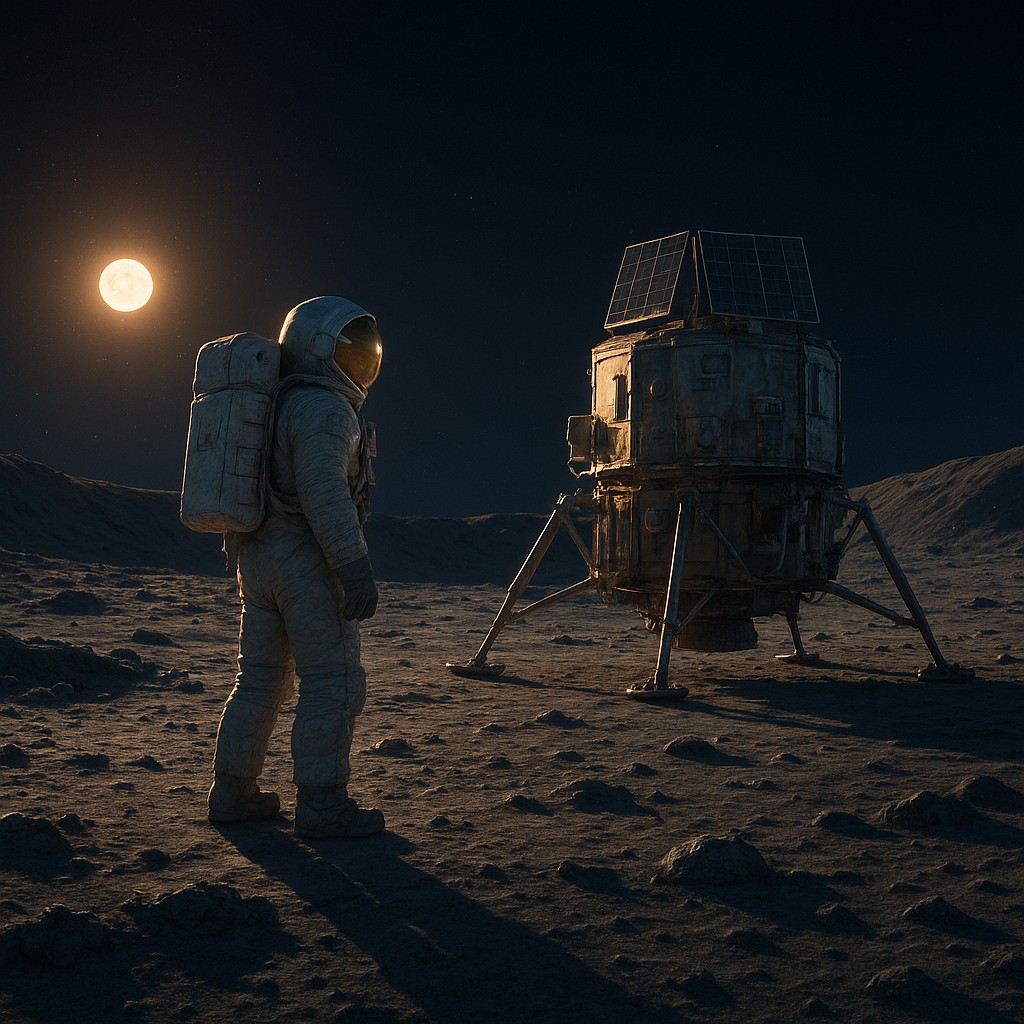
Imagine standing on the Moon just as the long shadows of twilight begin to stretch across the cratered floor. On Earth, a sunset is a gentle transition, lasting an hour or two before a manageable twilight sets in. On the Moon, however, the sun does not just set; it remains absent for 350 hours. This is the lunar night, a brutal, fourteen-day stretch of absolute cold where the thermometer does not just drop, it plummets to a staggering minus 170 degrees Celsius. For context, that is significantly colder than any natural temperature ever recorded on Earth, and it is cold enough to make steel as brittle as glass.
Most of our robotic explorers are essentially sophisticated computers wrapped in thin foil, and they are not built for this kind of punishment. In the early days of lunar exploration, a mission was often considered a success if it survived just a single lunar day. When the sun went down, the batteries would drain, the internal circuits would freeze, and the lander would become a permanent, frozen monument to human ambition. But as we look toward building permanent lunar bases and fueling a new era of space travel, "one and done" is no longer an option. Engineers are now perfecting the "lunar cold-box," a suite of thermal management technologies designed to breathe life back into frozen circuits when the sun finally returns.
The Physical Violence of Extreme Cold
To understand why a lunar night is so lethal, we have to look at the chemistry of a circuit board. A typical lander's brain is a complex sandwich of silicon, copper, gold, and various resins. On a pleasant spring day on Earth, these materials coexist peacefully. However, every material has what is called a coefficient of thermal expansion, which is a technical way of saying that things grow when they are hot and shrink when they are cold. The problem is that they do not do it at the same rate. Silicon is stubborn and barely moves, while the metals used for soldering and wiring react much more dramatically to temperature changes.
When the temperature hits minus 170 degrees, the metal traces on a circuit board begin to shrink with such force that they pull away from the silicon chips. It is a slow-motion mechanical tug-of-war that the silicon almost always wins. Solder joints, which hold the whole system together, can develop microscopic cracks. Eventually, the different layers of the circuit board peel apart or snap like dry twigs. Even if the electronics stayed "alive" in a low-power mode, the physical destruction caused by the contraction would render them useless by the time morning arrived. This is not just a matter of the battery dying; it is a matter of the machine's nervous system being torn to shreds by its own components.
Shifting from Batteries to Atomic Campfires
For decades, the standard way to keep a spacecraft warm was to use electric heaters powered by solar panels and batteries. This works well enough in orbit, where night lasts only 45 minutes, but the Moon's two-week night makes this approach mathematically impossible. To provide enough electrical heat to survive 14 days of darkness, a lander would need to be 90 percent battery by weight. You would essentially be launching a giant AA battery with a tiny camera attached to it. To solve this, space agencies like NASA and the ESA are turning back to a technology that feels a bit like science fiction: Radioisotope Heater Units, or RHUs.
An RHU is roughly the size of a C-cell battery and contains a small pellet of plutonium-238. It does not rely on a nuclear explosion or a complex reactor; it simply uses the natural decay of the isotope to generate constant, reliable heat. It is essentially a warm rock that stays hot for decades. By strategically placing these "atomic campfires" near sensitive instruments and using high-tech insulation, engineers can create a "warm electronics box," or cold-box. This allows the lander to go into a deep state of hibernation, turning off almost every system to save battery power while the RHU prevents the physical structure from shattering in the cold.
| Feature |
Electric Battery Heating |
Radioisotope Heater Units (RHU) |
| Energy Source |
Solar power stored in batteries |
Natural radioactive decay of Plutonium-238 |
| Duration Limit |
Limited by battery capacity (hours) |
Decades (based on half-life) |
| Weight Penalty |
Extremely high for long durations |
Very low and compact |
| Complexity |
High (requires sensors and switches) |
Passive (always "on," no moving parts) |
| Primary Risk |
Complete system failure if battery dies |
Handling of radioactive materials |
The Art of Lunar Hibernation
Surviving the night is not just about staying warm; it is about a coordinated, biological-like sleep cycle for the machine. When the sun begins to dip below the lunar horizon, the lander enters a phase called ingress. This is a delicate period where the robot must position its solar panels to catch the very last rays of light to top off its batteries, then tilt its body to minimize heat loss to the vacuum of space. The cold-box serves as the bedroom where the most critical components pull a thermal blanket over their heads.
The most fascinating part of this process is the wake-up sequence. If you have ever tried to start a car on a sub-zero morning, you know that machines hate the cold. On the Moon, the morning transition is just as dangerous as the night. As the sun rises, the exterior of the lander heats up rapidly, while the interior remains a frozen block. This creates a massive temperature gap that can warp the spacecraft's frame. Engineers use "passive thermal louvers," which are essentially shutters that open and close without electricity based on temperature, to regulate how much heat is allowed in. The goal is to bring the system back to operating temperature slowly enough that the expansion of the metals does not cause the very snapping and peeling they worked so hard to avoid.
Modern Successes and the Path Forward
Recent missions have proven that this cold-box philosophy is the key to our future on the Moon. While some missions are still designed as short-stay explorers, others have surprised their creators with their resilience. For example, the Japanese SLIM lander, which was not specifically designed to survive the harsh lunar night, managed to wake up after several cycles of 14-day darkness. This suggested that while electronics are fragile, clever engineering and a bit of luck in the landing orientation can sometimes allow hardware to beat the odds. However, relying on luck is not a strategy for a permanent base.
Current testing at facilities like NASA’s Lunar Environment Structural Test Rig (LESTR) allows scientists to simulate these conditions on Earth. They place circuit boards and structural materials inside a vacuum chamber and drop the temperature to minus 170 degrees Celsius over and over again to see where the "snap" happens. We are learning that by using new types of flexible glass circuits and specialized epoxy resins, we can build electronics that bend with the cold rather than breaking. These advancements do not just help us get to the Moon; they pave the way for missions to the icy moons of Jupiter and Saturn, where the cold is even more intense and the nights last much longer.
Building a Home in the Eternal Dark
The shift from surviving to thriving on the Moon requires us to think of thermal management as a utility, much like we think of water or electricity. In a future lunar colony, cold-box technology will likely scale up into large-scale thermal sheds. These structures might use lunar regolith (Moon dust) as a natural insulator, piled meters thick over living quarters to trap the heat provided by small modular reactors. By mastering the art of the lunar night, we are solving the single greatest logistical hurdle to becoming a multi-planetary species.
Understanding how to manage these extreme temperature swings is more than just a win for space agencies; it is a masterclass in material science and thermodynamics. It teaches us how to build things that last, how to respect the raw power of the environment, and how to use the laws of physics to carve out a pocket of warmth in a cold, indifferent universe. As we refine these lunar cold-boxes, we are not just sending robots to the Moon; we are building the foundations for the first humans who will look up at a distant, blue Earth and feel perfectly cozy in the middle of a 300-hour night.