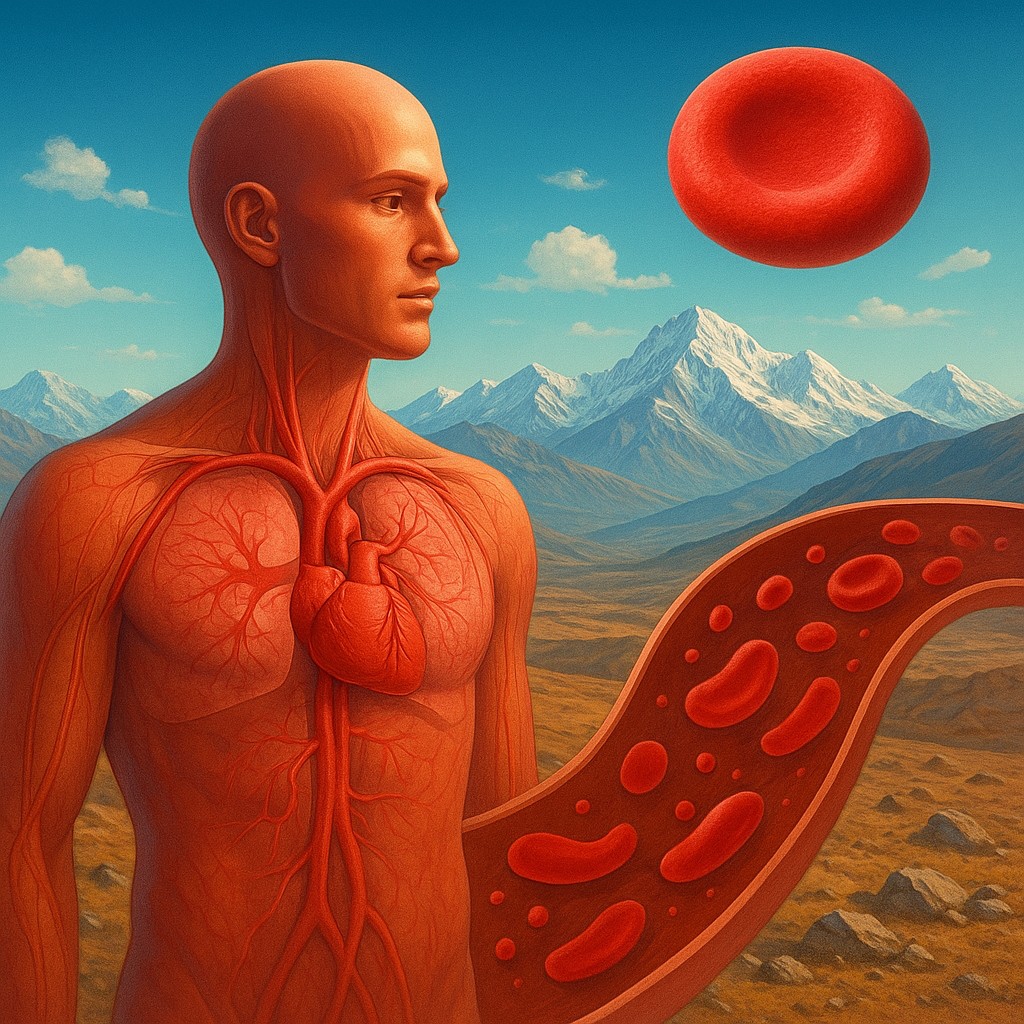
Imagine standing on the edge of the Tibetan Plateau, nearly three miles above sea level. For a visitor from the lowlands, this stunning view comes at a physical cost. Within minutes, your breathing quickens and your heart races as your body realizes the air holds about 40 percent less oxygen than the air at the beach. To make up for this, your kidneys start pumping out a hormone called erythropoietin, which tells your bone marrow to work overtime. Before long, your body is churning out millions of extra red blood cells, desperately trying to grab every available molecule of oxygen.
While this sounds like a helpful fix, it is actually a dangerous, panicked biological reaction. As your blood fills with these extra cells, it turns from a fluid like water into something more like maple syrup or motor oil. This thick, sticky blood forces your heart to work much harder, increasing the risk of blood clots, high blood pressure, and a soul-crushing condition known as chronic mountain sickness. Yet, for the millions of people who have lived in the Himalayas for generations, this crisis simply does not happen. They walk, run, and thrive in the "Death Zone" with blood that remains as thin and efficient as a marathon runner's at sea level. This isn't just a matter of fitness or getting used to the mountain air; it is one of the fastest and most elegant examples of natural selection in human history.
The Surprising Logic of Thin Blood
To understand why the Tibetan adaptation is so remarkable, we first have to look at the standard human "factory settings" for handling low oxygen. Most of us are born with a physical feedback loop that values quantity over quality. When sensors in our body detect low oxygen levels, also known as hypoxia, the response is to increase the number of red blood cells, which are the main vehicles for carrying oxygen. This works well enough for a short hiking trip, but as a long-term solution, it is fundamentally flawed. Thickening the blood creates immense friction within the narrow vessels of the lungs and brain, leading to heart and circulation problems that can shorten life expectancy and cause constant exhaustion.
The Tibetan population has evolved a way to skip this "quantity" trap entirely. Instead of making more blood cells, their bodies have learned to make their existing cells much more efficient. Genetic studies show that Tibetans possess unique versions of genes like EPAS1 and EGLN1, which act as the master controllers of the body's response to oxygen. These versions essentially "quiet" the panic signal. Even when the air is thin, the Tibetan body does not overproduce red blood cells. By keeping their hemoglobin levels low (the protein that carries oxygen), they avoid the dangerous thickening of the blood that plagues other high-altitude groups, such as those in the Andes.
This approach represents a "quality over quantity" shift in human biology. By maintaining a lower concentration of hemoglobin, Tibetans ensure their blood flows smoothly through their veins. This reduces the strain on the heart and prevents the lung damage usually caused by high-altitude living. It is a biological masterstroke that turns the standard human survival mechanism on its head. While the rest of us try to survive by stuffing more passengers into a crowded bus, Tibetans have simply built faster, sleeker cars that move through traffic with ease.
The Master Switch of Human Evolution
The specific gene responsible for much of this magic is called EPAS1, often nicknamed the "Super Athlete" gene. In most humans, EPAS1 detects when oxygen is low and kicks the red blood cell factory into high gear. However, the version of EPAS1 found in most Tibetans has a specific mutation that prevents this overreaction. Scientists were stunned to discover that this specific genetic code is almost identical to one found in Denisovans, an ancient and now-extinct group of humans who lived tens of thousands of years ago. It appears that ancient Tibetans interbred with Denisovans, inheriting this high-altitude "cheat code" and passing it down through generations.
The speed at which this gene spread through the population shows how vital it is for survival. Within just a few thousand years, which is a blink of an eye in evolutionary terms, the percentage of the Tibetan population carrying this gene jumped from nearly zero to almost 90 percent. This is one of the clearest examples of a "selective sweep," where a helpful trait is so beneficial that those without it are quickly outcompeted. In the harsh environment of the Himalayas, being able to carry a pregnancy to term without the complications of thick blood, or being able to work in the fields without heart failure, was the difference between life and death.
Beyond just blood chemistry, these genetic changes impact how the body uses oxygen at the cellular level. Along with EPAS1, the gene EGLN1 helps regulate the body’s metabolic furnace. Rather than just focusing on how oxygen is moved around, these adaptations influence how efficiently the mitochondria, the powerhouses of our cells, burn that oxygen to create energy. It is a total system upgrade that touches everything from the way the lungs expand to the way individual cells produce fuel.
A Tale of Three Mountains
While Tibetans provide the most famous example of high-altitude evolution, they are not the only ones to have conquered the peaks. Interestingly, different human populations have solved the oxygen problem in entirely different ways. This is a classic example of convergent evolution, where different groups arrive at similar results through different biological paths. By comparing Tibetans, Andeans, and Ethiopian highlanders, we can see the sheer variety of tools in the human evolutionary toolkit.
| Population |
Main Adaptation |
Hemoglobin Levels |
Physical Trade-off |
| Lowlanders (Visitors) |
Overproduction of red blood cells |
Very High (Thick Blood) |
High risk of stroke and heart strain. |
| Andean Highlanders |
Increased hemoglobin capacity |
High (Thickened) |
Adapted to handle thicker blood better than visitors. |
| Ethiopian Highlanders |
Unknown (Likely metabolic) |
Normal/Low |
Genetic paths differ from Tibetans; blood stays thin. |
| Tibetan Highlanders |
EPAS1 Gene (Efficient transport) |
Normal/Low |
Superior blood flow and delivery to tissues. |
The Andean people, living in the soaring mountains of South America, have lived at high altitudes for thousands of years, but their approach is different from that of the Tibetans. Andeans typically have very high hemoglobin levels, much like a visitor to the mountains. However, they have evolved a higher tolerance for this thick blood, with hearts and blood vessels that are better equipped to handle the heavy flow. They also have an increased ability to carry more oxygen per hemoglobin molecule. It is a "brute force" method compared to the Tibetan "finesse" method, proving there is more than one way to survive in thin air.
Meanwhile, the people of the Ethiopian Highlands represent a third, even more mysterious path. Like Tibetans, they maintain relatively normal hemoglobin levels despite the altitude. However, they do not carry the EPAS1 or EGLN1 mutations found in the Himalayas. Their adaptation seems to be written in entirely different parts of their DNA, suggesting their bodies might use oxygen more efficiently in their muscles or have different vessel structures entirely. This diversity shows that evolution is not a single path, but a series of experiments.
Misconceptions About Fitness and Training
A common myth is that high-altitude adaptation is just a more extreme version of what athletes do when they train in the mountains. We often hear about Olympic runners heading to Colorado or Kenya to "boost their red blood cell count" through a process called natural blood doping. While it is true that short-term exposure to high altitude can improve an athlete's performance once they return to sea level, this is a temporary physical adjustment, not an evolutionary one. This is known as acclimatization, and it is a temporary state that disappears once the person returns to lower ground.
The genetic adaptations of Tibetans are permanent and passed down to their children. A Tibetan living at sea level in London or New York still carries the EPAS1 mutation, and their body still manages oxygen differently than those around them. Unlike an athlete whose blood thickens significantly at altitude, a person with the Tibetan genetic profile maintains thin, efficient blood regardless of how much they train or where they live. They aren't just "fit"; they are biologically rewired. Training can improve your heart's strength or your lungs' capacity, but it cannot change the fundamental signals that dictate how your body reacts to a lack of oxygen.
Another misunderstanding is that these adaptations make someone "superhuman" in all environments. While the Tibetan genetic profile is incredibly helpful at 15,000 feet, it doesn't necessarily offer an edge at sea level. In fact, some studies suggest that these adaptations are specifically tuned for low-oxygen environments and might not provide any major benefit in oxygen-rich air. Evolution is rarely about creating the "perfect" organism; it is about creating the one best suited for a specific, often grueling, set of circumstances.
The Speed of Selective Change
One of the most important lessons from studying high-altitude populations is realizing how fast human evolution can actually move. Traditionally, we are taught that evolution takes hundreds of thousands or even millions of years to show major changes. The story of the Tibetan Plateau shatters that timeline. The shift in the EPAS1 gene occurred over roughly 3,000 to 4,000 years. In the grand timeline of human history, that is incredibly recent. It suggests that when the environmental pressure is high enough and the right genetic "raw material" is available, humans can adapt with surprising speed.
This speed is largely thanks to a process called introgression, which is the movement of genes from one species to another through interbreeding. By inheriting the EPAS1 variant from Denisovans, the ancestors of Tibetans didn't have to wait for a random, lucky mutation to happen. They essentially "borrowed" a pre-tested survival kit that had already been honed by another group of humans living in cold, high-altitude regions. This shortcut allowed them to settle one of the most difficult places on Earth while other groups struggled or failed to survive there.
Understanding these mechanisms is more than just a history lesson; it has modern medical uses. Many of the genes involved in high-altitude adaptation are the same genes that cause problems during heart attacks, strokes, or lung disease. By studying how a Tibetan's body stays healthy in a low-oxygen environment, doctors and researchers are finding new clues for treating patients who are deprived of oxygen due to illness. The "superpower" of the mountain people is becoming a roadmap for saving lives in hospitals around the world.
A Legacy Written in the Clouds
The story of high-altitude adaptation is a powerful reminder of the deep connection between our environment and our DNA. It shows us that we are not finished products, but works in progress, constantly being shaped by the air we breathe and the land we walk upon. These unique genetic variations are more than just biological curiosities; they are a testament to human ingenuity and the incredible resilience of our species. The people of the Tibetan Plateau carry within them a piece of ancient history, a gift from a long-lost cousin that allows them to thrive where others falter.
As you look at the world around you, remember that evolution is happening even now, in subtle and profound ways. Whether it is the ability to digest milk as an adult, the development of resistance to local diseases, or the ability to run at heights where a candle won't even stay lit, our bodies are remarkable canvases of adaptation. There is a certain beauty in knowing that our survival often depends on our ability to deviate from the norm, to find a path through the mountains that no one else saw. We are a species defined by our capacity to change, and the thin air of the Himalayas is perhaps the most glorious stage where that change has been performed.