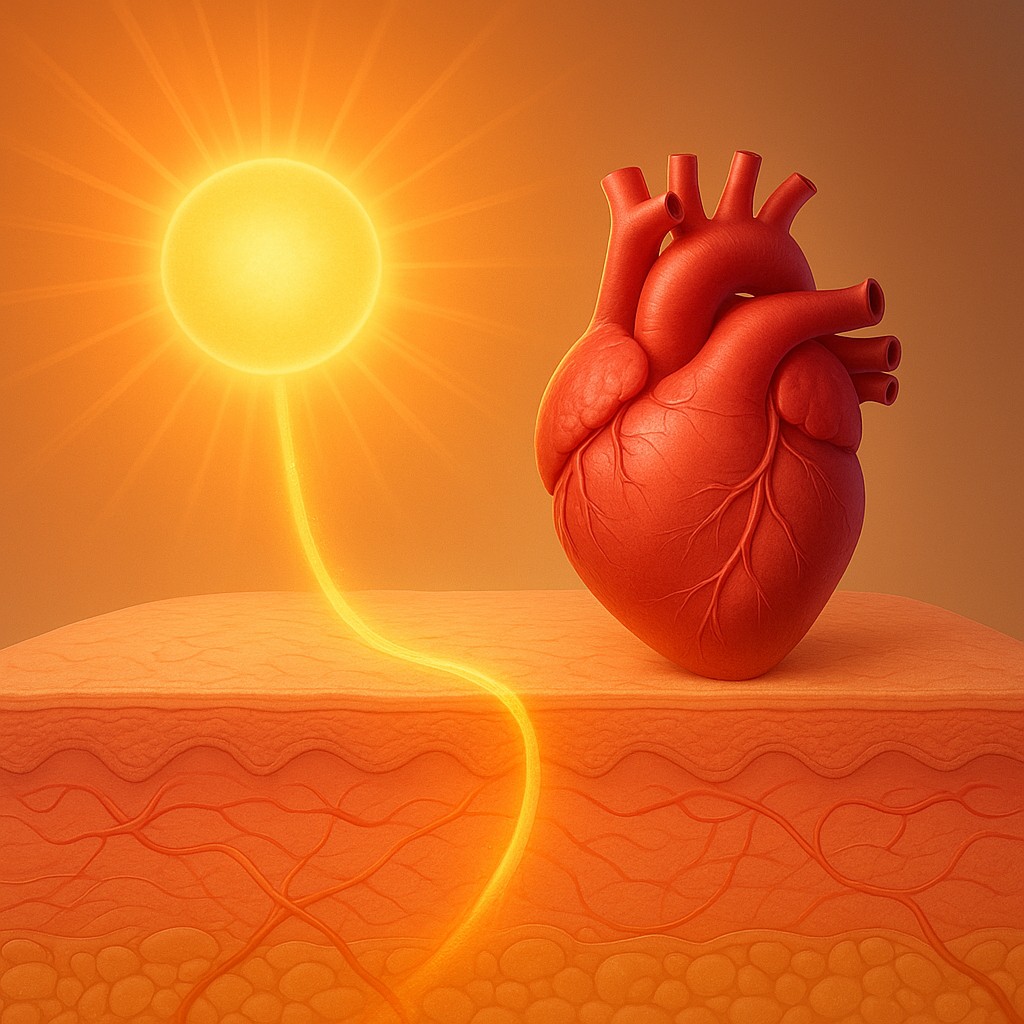
For decades, the public health message regarding the sun has been a tug-of-war between two heavyweights: Vitamin D and skin cancer. We are told to go outside to strengthen our bones through the miracle of UVB rays, but to hurry back inside or cover up in chemicals before those same rays damage our DNA. This choice is often framed as a simple trade-off between skeletal health and skin safety, leaving many of us stuck in a cycle of seasonal blues and supplement bottles. However, a fascinating shortcut exists right at the surface of your skin, suggesting the sun does much more for your heart than your doctor might have mentioned.
Deep within the layers of your skin lies an untapped reservoir of nitrogen compounds, quietly waiting for a specific solar trigger. While we have long focused on how the sun helps us build vitamins, it turns out our skin also acts as a sophisticated storage unit for blood pressure regulation. When a specific wavelength of light touches the skin, it sets off a chemical reaction that bypasses the digestive system entirely. It sends a signal directly to your blood vessels to relax. This is not just about feeling "warm and fuzzy" on a summer day; it is a hardwired biological mechanism that changes how we think about heart health and the environment.
Beyond the Bone Synthesis Myth
To understand this process, we first have to separate it from the Vitamin D story. Vitamin D is created when UVB rays hit the skin, eventually helping the body absorb calcium for strong bones. But the heart health benefits of sunshine seem to follow a different path involving UVA radiation. While UVB is strongest at midday, UVA is present consistently throughout the day and can even pass through clouds and glass. This means your body is constantly interacting with a light source that manages more than just your vitamin levels; it is actively communicating with your circulatory system.
The nitrogen compounds stored in your skin, specifically nitrates and nitrites, are the leftovers of your body's natural chemistry. For a long time, scientists thought these were just waste products. It turns out they are actually sensitive to light. When UVA hits these stores, it converts them into a gas called nitric oxide. This gas does not stay in the skin; it spreads into the surrounding tissue and seeps into the tiny blood vessels near the surface. From there, it enters the bloodstream, acting as a powerful messenger that tells the muscular walls of your arteries to stop gripping so tightly.
The Molecular Handshake of Vasodilation
When nitric oxide enters the bloodstream, it triggers a process called vasodilation, or the widening of blood vessels. Think of your vessels like a garden hose. If you squeeze the hose, the pressure inside increases significantly. If you release your grip, the water flows more easily and the pressure against the walls of the hose drops. Nitric oxide is the signal that tells the body to "stop squeezing." It instructs the smooth muscle cells surrounding your blood vessels to relax, widening the "lumen," which is the open space through which blood flows.
This widening happens within minutes of exposure. Unlike Vitamin D, which can take days or weeks to reach helpful levels in the blood, the nitric oxide response is nearly instant. This suggests that humans evolved to use the sun as an external dial for internal pressure. In regions closer to the equator where sun exposure is steady, people often have lower average blood pressure and fewer heart problems compared to those in cloudy, northern regions. While diet and lifestyle play a role, the direct chemical influence of light on the skin's nitrogen stores provides a clear biological explanation for these trends.
Weighing the Solar Trade-off
Of course, biology rarely gives us a free lunch. The very same UVA rays that release nitric oxide and protect our hearts can also cause cell stress and DNA damage. This creates a physiological trade-off that researchers are still trying to map. We need the light to keep our pipes clear and our pressure low, but too much of it speeds up skin aging and increases the risk of cancer. The challenge lies in finding the "Goldilocks Zone" where the body-wide benefits of lower blood pressure outweigh the local risks to skin cells.
To see how these two sides of sun exposure compare, look at how the body processes these different inputs:
| Feature |
Vitamin D Synthesis |
Nitric Oxide Release |
| Primary Trigger |
UVB Radiation |
UVA Radiation |
| Storage Location |
Fat tissues (after it is made) |
Skin layers (as nitrogen stores) |
| Main Benefit |
Bone health and immunity |
Lower blood pressure and heart health |
| Response Time |
Hours to days |
Minutes |
| Systemic Risk |
Low (overdose is rare) |
High (UV risks DNA damage) |
This table highlights why modern health advice is becoming more specific. It is no longer enough to simply say "avoid the sun" or "get more sun." Instead, we have to consider the specific types of light and our specific health goals. For someone with high blood pressure, a few minutes of sun might be a legitimate medical tool, provided they do not stay out long enough to burn.
The Geography of Heart Health
This nitric oxide mechanism might explain a long-standing medical mystery: why do people in northern climates have higher rates of heart disease even when they eat well and exercise? Deaths from heart disease are higher in the winter and in places far from the equator. While we used to blame this entirely on the lack of Vitamin D, clinical trials where people were given Vitamin D supplements often failed to lower blood pressure. This suggested that something else in the sunlight was doing the heavy lifting for the heart.
When researchers exposed volunteers to UVA lamps, they saw a drop in blood pressure that acted like pharmaceutical medication. Crucially, they saw this drop even when they blocked the skin's ability to produce Vitamin D. This confirmed that the skin is effectively a "solar battery" for nitric oxide. In the winter months in the north, this battery runs dry. Without light to trigger the release of those nitrogen stores, blood vessels stay tighter, the heart has to pump harder, and blood pressure creeps upward.
Practical Wisdom for the Modern Human
Understanding this mechanism does not mean you should go out and get a sunburn for the sake of your heart. Rather, it suggests that we need to rethink our "indoor-centric" lifestyle. Most of us spend 90 percent of our time inside under artificial lights that lack the specific UVA wavelengths needed for this process. We have effectively disconnected our biology from the environmental cues that helped regulate our bodies for thousands of years. Small, frequent doses of natural light may be more beneficial for our hearts than a single, high-intensity vacation in the tropics.
To make the most of this knowledge without taking on too much risk, consider the timing and duration of your "light snacks." The goal isn't to tan; it is to send a signal. Brief periods of exposure on the forearms or face during the morning or late afternoon can be enough to turn nitrogen into nitric oxide without reaching the point of DNA damage. It is a matter of treating sunlight like a precision-dosed medication rather than an all-you-can-eat buffet.
As our understanding of human biology grows, we are realizing that the skin is not just a protective bag; it is a giant, light-sensitive organ that regulates our internal chemistry. By respecting the sun as a vital regulator of our heart's rhythm, we can move past a narrative of fear and toward a better view of how our environment shapes our lives. Your heart, quite literally, feels the light long before you ever see your shadow.