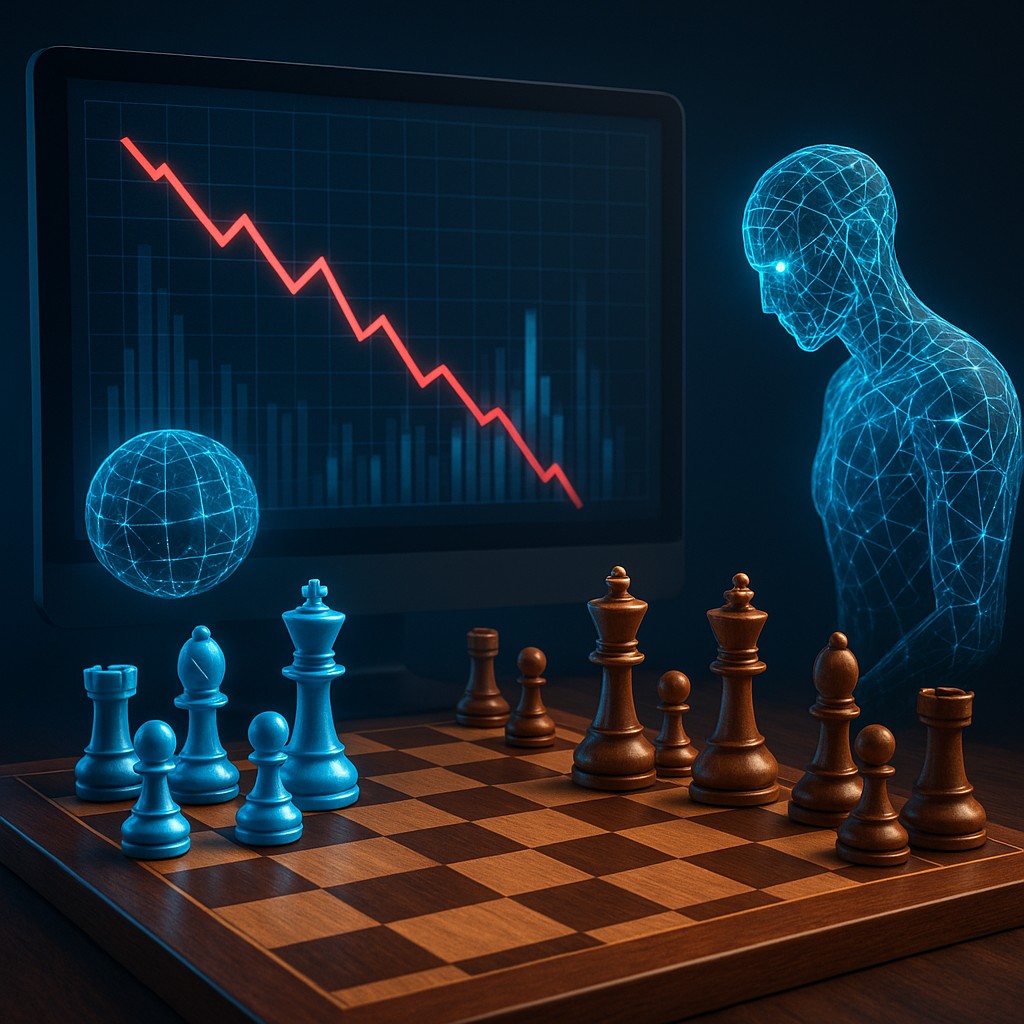
Imagine a high-stakes chess match where the players are not people, but advanced digital programs designed to find the exact sequence of moves to bankrupt their opponent. In traditional banking, regulators have historically relied on static spreadsheets, which are essentially lists of "what if" scenarios carved in stone. These old models might ask what happens if unemployment rises by 2 percent or if housing prices dip, but they are remarkably bad at predicting the chaotic, circular logic of a panic. They assume the world is a series of independent parts rather than a living, breathing ecosystem of fear and opportunity.
Today, the financial world is undergoing a quiet but radical change by turning the bank itself into a digital battlefield. Instead of just filling out forms, major institutions are now deploying swarms of autonomous AI agents programmed with one goal: to find "liquidity holes," or the hidden gaps in cash flow that could cause the system to collapse. These are not simple scripts; they are reinforcement learning models that "play" the market like a video game. By simulating thousands of aggressive short-sellers and panicked depositors, banks are finally moving away from the fiction of stable math and toward the reality of a modern security challenge.
From Static Checklists to Digital War Games
In the past, a bank’s "health check" was often a backward-looking exercise. Regulators would provide a set of economic conditions, and the bank’s analysts would plug those numbers into a model to see if their cash reserves held up. The problem with this approach is that it treats the market like a machine where Part A always leads to Part B. In reality, the financial system is more like a forest fire, where the wind, the dryness of the wood, and how close the trees are to each other all influence the outcome at the same time. The static model fails because it does not account for "reflexivity," the way human markets work where a small problem becomes a catastrophe simply because people believe it will.
Adversarial stress testing replaces the checklist with a simulation. By populating a digital twin of the financial system with thousands of independent AI agents, researchers can watch a crisis evolve in real time. These agents are not told to follow a specific path; instead, they are given financial incentives. Some agents act as corporate treasurers trying to protect their cash, while others act as hedge funds looking to profit from a bank's weakness. When these agents start interacting, they often discover "hidden chain reactions" that no human analyst could have predicted. it turns the boring task of compliance into a dynamic war game where the bank is constantly trying to survive its own digital demons.
The Architecture of a Managed Bank Run
To understand how these AI agents work, we have to look at the concept of reinforcement learning. Unlike standard AI that tries to recognize a cat in a photo, reinforcement learning is about trial and error. An AI agent is dropped into the simulation and told to maximize its "utility," which usually means keeping its money safe or making a profit. At first, the agents might act randomly, but after millions of attempts, they become terrifyingly efficient at spotting vulnerability. They might notice that if a certain asset drops by just 3 percent, it triggers a mandatory sell-off for a specific group of pension funds, which then creates a "hole" in the market they can exploit.
These simulations focus heavily on liquidity, which is the financial equivalent of oxygen. A bank can be "wealthy" on paper because it owns billions in real estate, but if it doesn't have enough actual cash in the vault to satisfy a crowd of people at the ATM, it dies. The AI agents act as "stressors" by coordinating their behavior. They don't just pull money out; they pull it out at the exact moment when the bank is most vulnerable, such as during a holiday weekend or just after a bad earnings report. This allows the bank to see exactly where its "oxygen tank" might run dry and adjust its reserves before a real-world predator finds the pipe.
| Testing Method |
Core Philosophy |
Primary Tools |
Handling of Contagion |
| Traditional Stress Test |
Compliance and buffers |
Static Spreadsheets |
Predicted through fixed math |
| Adversarial Simulation |
Red-teaming and survival |
Reinforcement Learning |
Observed through agent behavior |
| Historical Analysis |
Learning from the past |
Archive records |
Limited to previous patterns |
| Agent-Based Modeling |
Systems and complexity |
Emerging AI swarms |
High, accounts for circular logic |
Hunting for Liquidity Holes and Hidden Loops
One of the most fascinating things about letting AI agents attack a bank is that they often uncover "emergent behavior." This is a phenomenon where simple rules followed by many individuals lead to a complex and unexpected outcome for the whole group. For example, in a simulation, a group of medium-sized banks might all decide to sell the same type of bond to raise cash at the same time. Individually, these actions are logical. Collectively, they crash the price of those bonds, which then lowers the value of assets held by the largest banks, triggering a global crisis. These "hidden loops" are the ghosts in the machine that traditional models almost always miss.
By identifying these liquidity holes, banks can engage in "pre-emptive shoring." This might involve changing the terms of certain loans, diversifying where they keep their emergency cash, or setting up new credit lines with other institutions. It shifts the focus from "Do we have enough money?" to "How will the system respond when everyone starts running for the exit at once?" This move toward systems thinking treats the bank not as an isolated mountain of gold, but as a node in a constantly shifting web of information and panic. The goal is to build a structure that is not just strong, but flexible enough to withstand a coordinated digital assault.
The Human Element and the Limits of Logic
Despite the incredible power of these AI simulations, they face a significant hurdle: the sheer unpredictability of human emotion. AI agents are excellent at being "rationally aggressive." They calculate the odds, look at the price gaps, and strike when the math says a bank run is the most profitable or safest course of action. However, humans often act based on what psychologists call "social contagion" or "animal spirits." A real-world bank run can be started by a single viral tweet that is factually incorrect but emotionally powerful. Humans are prone to "herding," where they do what everyone else is doing specifically because everyone else is doing it, ignoring the math entirely.
Current digital models are beginning to incorporate "noise" and "irrationality" into their agents to mirror this behavior, but it remains an imperfect science. An AI might struggle to understand why a group of people would keep their money in a failing bank out of loyalty, or why they might suddenly pull it out based on a rumor about the CEO’s personal life. The security challenge of financial stability is a race between the cold logic of the machines and the hot, messy reality of human biology. Designers are working to bridge this gap by using Large Language Models (LLMs) to simulate the flow of public mood and news, trying to create "digital crowds" that can feel fear just like we do.
Building a More Resilient Financial Future
The shift toward adversarial stress testing represents a "maturation" of how we view our global economy. We are finally admitting that the financial system is too complex for any single person or spreadsheet to fully grasp. By using AI agents as a digital "blue team" to defend and a "red team" to attack, we are creating a more robust immune system for the world’s money. This technology doesn't just benefit the banks; it protects the average person’s savings by ensuring that the institutions holding them have survived millions of "practice panics" before a real one ever arrives.
As we look toward the future, it is helpful to think of financial stability as a journey rather than a destination. Just as computer software requires constant updates to fix vulnerabilities discovered by hackers, a bank requires constant simulation to uncover weaknesses discovered by AI. By embracing the chaos of the simulation, we create a reality that is far more stable. The next time you see a headline about market volatility, remember that behind the scenes, there are likely thousands of digital agents fighting a war of numbers to make sure your world stays upright. Understanding how these simulations work gives us a glimpse into a world where we don't just hope for the best, but actively train for the worst.