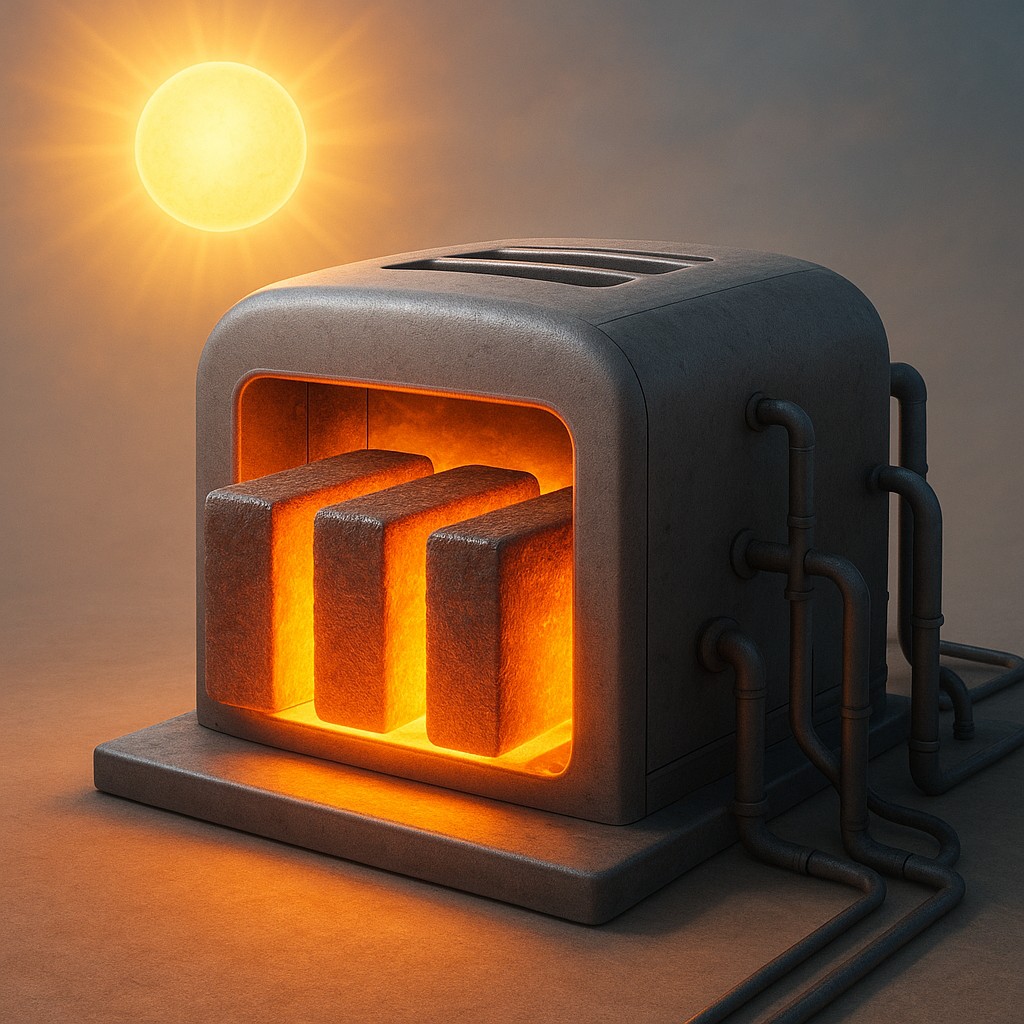
Imagine you are standing in front of a giant toaster. Instead of narrow slots for bread, this machine is the size of a warehouse, and the "bread" inside consists of enormous, dense blocks of solid carbon. When the sun is bright or the wind howls across the plains, we often have more electricity than the power grid can use. Rather than letting that green energy go to waste, we can pump it into these carbon blocks. This heats them until they are no longer just warm, but literally glowing with a blinding, white-hot intensity. This is a thermal battery, a technology designed to solve the biggest headache of the renewable energy age: the sun doesn’t shine at night, and the wind doesn’t blow on command.
Standard batteries, like the lithium-ion cells in your phone or electric car, are chemical marvels. However, they have a dirty little secret when scaled up to power an entire city: they are incredibly expensive to build at that size and rely on rare minerals that are difficult to mine. Thermal batteries take a different path, swapping complex chemistry for raw physics. By storing energy as heat in abundant materials like graphite, we can create an electricity "bank" that is cheaper, more durable, and capable of holding power for days at a time. It is a shift from the world of sparks and liquid chemicals to a world of radiant light and glowing stone.
The Problem of the Renewable Mismatch
To understand why we need to turn carbon blocks into artificial suns, we first have to look at the "duck curve," which represents the instability of a green power grid. Solar panels are overachievers in the middle of the day. They often produce so much power that prices actually turn negative, meaning the grid pays people to take the electricity away. However, as soon as the sun dips below the horizon, demand for electricity spikes just as production crashes to zero. This gap is currently filled by "peaker" plants, which usually burn natural gas and release significant amounts of carbon dioxide. We need a way to move that midday sun into the midnight hours.
The current gold standard for storage is lithium-ion, but for industrial needs, using it is like trying to power a steel mill with thousands of AA batteries. It works, but the cost is astronomical, and the batteries wear out every time you charge them. Furthermore, heavy industries like cement, glass, and steel production require much more than just a little electricity. These sectors need massive amounts of heat, often exceeding 1,000 degrees Celsius (about 1,800 degrees Fahrenheit), to melt raw materials. If we want to stop burning coal and gas for these processes, we need a system that doesn't just store electrons, but stores the actual vibration of atoms.
Thermal batteries solve this by functioning as high-density energy warehouses. Instead of relying on chemical reactions that fail after a few thousand uses, a thermal battery uses the physical mass of solid blocks. Think of a cast-iron skillet that stays hot long after you turn off the burner, but scaled up to the size of a building. Because graphite can withstand temperatures that would melt most metals, we can cram an incredible amount of energy into a small space. These blocks don't catch fire, they don't leak toxic chemicals, and they can be used tens of thousands of times over decades without losing their "charge."
Turning Graphite Into a Glowing Reservoir
The core of this system is graphite, the same material found in pencil lead, but pressed into massive, high-density blocks. Graphite is ideal for this job because it holds heat well and has a melting point so high it seems to defy logic. In an environment without oxygen, you can heat graphite to over 3,000 degrees Celsius without it melting or breaking down. For a thermal battery, we typically "charge" it to about 2,000 to 2,400 degrees Celsius. At this temperature, the blocks are no longer black; they glow with a brilliant light that mimics the surface of a star.
To get the heat into the blocks, we use "resistive heating," which is exactly how a toaster or a space heater works. Electricity from wind or solar farms passes through heating elements that convert electrical energy into heat with nearly 100 percent efficiency. These blocks sit inside a heavily insulated container built with layers of specialized firebricks and vacuum seals to keep the heat from leaking out. Because the blocks are so dense and the insulation is so thick, the energy can stay trapped inside for days, waiting for a factory or the grid to need it.
The beauty of using carbon is that it is one of the most common elements on Earth. Unlike cobalt or nickel, which are found in only a few places and have volatile prices, carbon is everywhere. We can manufacture these blocks using existing industrial processes, making the "raw material" cost of a thermal battery a fraction of a lithium-ion equivalent. This move from rare chemicals to common building materials is why thermal batteries are the top candidate for cleaning up the heavy-duty parts of the global economy.
Catching Light with Thermophotovoltaics
How do we get the energy back out once it is trapped as heat? If a factory just needs heat, we can blow a gas like nitrogen through the hot blocks and pipe that hot gas into a furnace. But if we want to put electricity back onto the grid, we need a way to turn that heat back into power. Traditionally, we would use a steam turbine, where heat boils water to spin a giant fan. However, turbines have moving parts that break, require constant upkeep, and are inefficient at smaller scales. Thermal batteries use a more elegant, solid-state solution called thermophotovoltaics, or TPVs.
Most people know about photovoltaics, the "PV" in solar panels. Those cells catch high-energy light particles from the sun and turn them into electricity. Thermophotovoltaics do the same thing, but they are tuned to catch the lower-energy infrared light given off by the glowing, white-hot carbon blocks. Instead of pointing the panel at the sky, we point it at the inside of the thermal battery. As the blocks glow, the TPV cells nearby capture that light and convert it directly back into an electric current without using a single moving part.
This "heat engine" is silent, needs almost no maintenance, and can be switched on or off almost instantly. For years, TPV cells weren't efficient enough to be useful, but recent breakthroughs have pushed them past 40 percent efficiency, which is better than many traditional steam turbines. Because the system has no moving parts, it can be built in sections. Power companies can add more capacity simply by stacking more blocks and more cells together. It is a clean, quiet, and simple way to turn a hot block of carbon back into the electricity that powers your laptop.
Comparing Energy Storage Technologies
To see how thermal batteries fit into the future, it helps to compare them to the tools we already use. No single storage method is perfect for every job, but for a city-wide grid or a massive factory, heat-based storage has clear advantages.
| Feature |
Lithium-Ion Batteries |
Thermal (Graphite) Batteries |
Pumped Hydro Power |
| Primary Use |
Phones, Cars, Short-term Grid |
Heavy Industry, Multi-day Grid |
Long-term Grid Storage |
| Main Material |
Lithium, Cobalt, Nickel |
Carbon/Graphite |
Water and Gravity |
| Lifespan |
5-10 years (Wears out) |
20-30+ years (Durable) |
50+ years |
| Energy Density |
High |
Very High (by volume) |
Very Low (Needs mountains) |
| Response Time |
Milliseconds |
Seconds to Minutes |
Minutes |
| Cost Scale |
High per unit of energy |
Low for large scale |
Low, but limited by terrain |
As the table shows, lithium-ion is great when you need a lot of power quickly in a small package, like a car. But for a factory that runs 24/7 or a town that needs to store three days' worth of wind power, the durability and low cost of graphite blocks are much more attractive. Pumped hydro, which involves moving water uphill to a reservoir, is also cheap, but it only works if you have two large ponds and a mountain between them. Thermal batteries can be placed anywhere, from a desert to a snowy industrial park.
Decarbonizing the Hardest Industries
While we often focus on electric cars and home solar panels, the "hidden" part of the climate problem is heavy industry. Making glass, steel, and cement requires temperatures that standard electric heaters often can't reach. Historically, the only way to get things that hot was to burn fossil fuels. This created an "either-or" choice: use dirty energy for high heat, or use clean energy and accept that you can't run a foundry.
Thermal batteries bridge this gap by treating heat as the main product, not a waste byproduct. A steel mill could have a massive installation of graphite blocks charged by solar panels during the day. At night, instead of turning the heat back into electricity, the mill could use the "raw" heat directly from the blocks to keep its furnaces hot. This cuts out the energy lost when converting heat to electricity and back again. By providing "green heat," these systems may finally help us clean up industries that were once thought impossible to run on electricity.
This technology also acts as a safety net for the grid. Because these systems are so large, they function like a massive shock absorber. If a power line goes down or a wind farm stops during a storm, the thermal battery can keep providing power for days. This provides the kind of long-term storage that prevents blackouts. It turns unpredictable weather into a steady, reliable flow of power that acts like a traditional coal plant, but without the smokestacks.
A Future Forged in Graphite and Light
We often think of the future of energy as something complex and futuristic, involving mysterious new particles. Yet, the thermal battery reminds us that the best solutions often take a simple, ancient concept and apply modern precision to it. We have known that hot things stay hot and glowing things give off light since the dawn of humanity. By combining that instinct with high-purity graphite and efficient TPV cells, we are building a bridge between the age of fire and the age of light.
As these systems are set up around the world, they will likely sit quietly on the edges of our industrial zones, looking like simple, windowless warehouses. But inside, they will hold the power of a summer's day, trapped in a white-hot glow that can be used whenever we need it. This technology is a giant step toward an energy economy where the abundance of the sun and wind is no longer a problem to be managed, but a resource to be saved. The future of energy isn't just about moving faster; sometimes, it is about having the strength and simplicity to hold onto the heat.