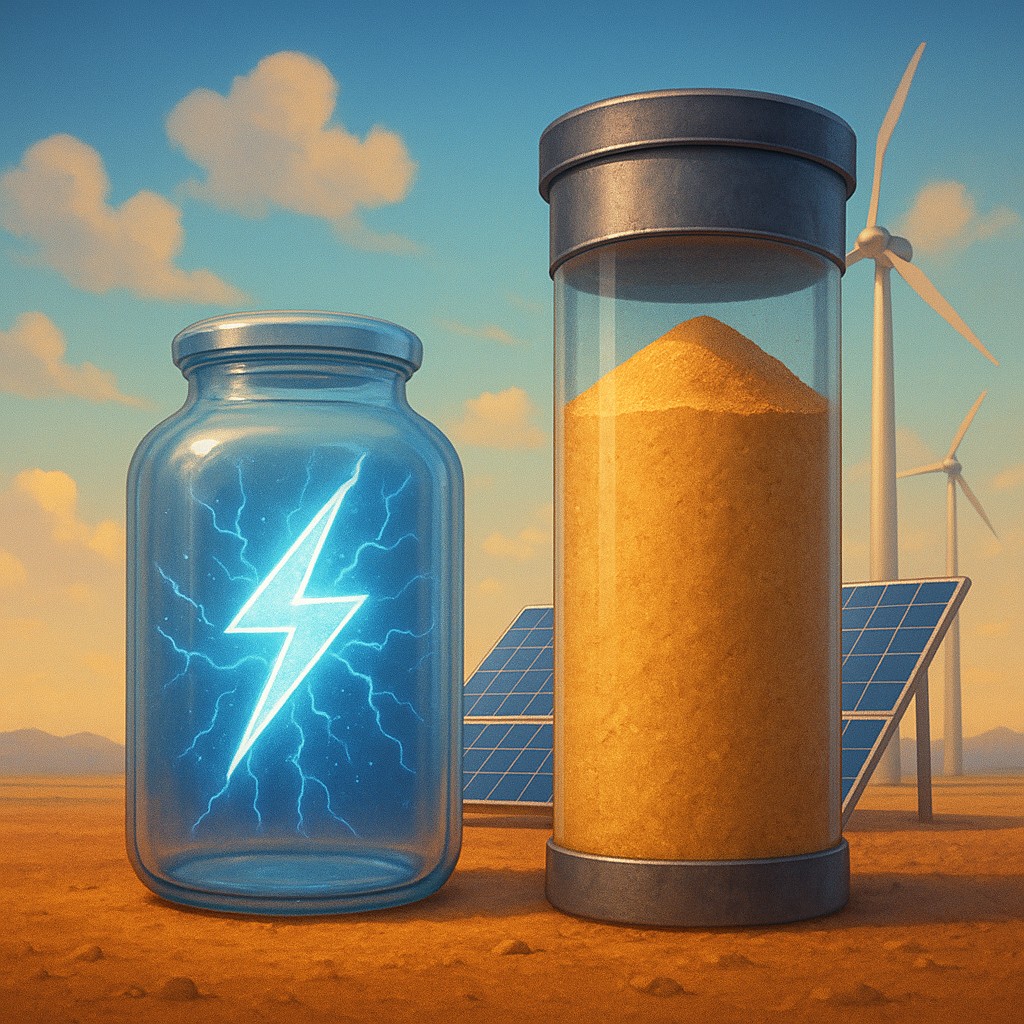
Imagine for a moment that you are trying to catch a lightning bolt and keep it in a jar for a rainy day. This is the core challenge of today's green energy revolution. We have become incredibly good at catching wind and sunlight, but these power sources are famously unreliable. The wind might stop blowing exactly when you want to toast a bagel, and the sun sets just as you turn on the lights for the evening. To truly quit our fossil fuel habit, we do not just need better solar panels; we need a way to bottle up the extra energy we make during the day so we can use it during the long, cold night.
For years, the best way to "bottle" power has been the lithium-ion battery, the same technology in your smartphone. But lithium-ion batteries are like high-maintenance sports cars: they are expensive to build, they rely on rare minerals dug from deep underground, and they eventually lose their ability to hold a charge. While they are perfect for a phone, trying to power an entire city with them is a logistical and financial nightmare. This has led scientists to look past high-tech gadgets toward something humble, ancient, and everywhere. As it turns out, the secret to the future of energy may not be in a rare-earth mine, but inside a giant, insulated silo filled with common construction sand.
Beyond the Limits of Chemical Storage
To understand why engineers are suddenly filling massive steel towers with dirt, we first have to look at the "Efficiency-Cost Paradox" of traditional storage. When you charge a battery, you use electricity to trigger a chemical reaction inside a cell. This process is very efficient, often returning over 90 percent of the energy you put in. However, the materials needed for this, like lithium, cobalt, and nickel, are limited and harmful to the environment to extract. Furthermore, chemical batteries have a "use it or lose it" lifespan. They naturally break down over time, meaning that as years pass, your expensive battery bank becomes less and less capable of doing its job.
Thermal energy storage, or the "sand battery," takes a different path by ignoring chemistry and focusing on heat. Instead of trying to store electricity directly, these systems turn it into heat. Think of it like a giant, industrial-strength toaster. When a wind farm produces more electricity than the power grid can handle, that "extra" energy is sent through heating coils buried deep inside a massive pile of low-grade sand. The sand absorbs this energy, its atoms vibrating faster and faster until the entire mass glows at temperatures over 500 degrees Celsius (about 930 degrees Fahrenheit). In this state, the sand acts as a thermal reservoir, holding onto vast amounts of energy for months at a time.
This approach changes the economics of storage. While a lithium-ion battery might cost hundreds of dollars for every kilowatt-hour of capacity, sand is practically free. You can find it in deserts, riverbeds, and construction sites all over the world. By using a material that is cheap and nearly indestructible, engineers are creating "batteries" that can last for decades with very little maintenance. They do not catch fire like lithium can, they do not leak toxic chemicals into the soil, and they never lose their ability to get hot. It is a solution that values long life and massive scale over the raw speed of chemical reactions.
The Secret Life of a Silica Silo
The mechanics of a sand battery are simple, but the engineering required to make it work for an entire city is a masterclass in insulation. Imagine a silo about the size of a mid-sized office building. Inside, thousands of tons of sand are packed tight. When the "charging" phase begins, electric coils powered by renewable energy heat up the air. This scorching hot air is circulated through a network of pipes snaking through the sand. Because sand is a natural insulator that holds heat well, it hangs onto that energy with surprising strength.
Getting the energy back out is where the real work happens. When the community needs heat or power, the process goes into reverse. Cold air is pumped into the silo, where it soaks up heat from the sand and carries it back out. This superheated air can be used in different ways depending on what the local area needs. In places like Finland, where the first commercial sand batteries already exist, this heat is piped directly into "district heating" systems. These are massive networks of underground pipes that provide warmth to thousands of homes and offices, removing the need for individual gas boilers or coal plants.
This system works so well because sand is not "fussy." Unlike many other materials, it does not melt, expand dangerously, or break down when heated to 500 or 600 degrees Celsius. It simply sits there and stays hot. Because the silo is wrapped in thick layers of high-efficiency insulation, very little energy leaks out. Even in a brutal Nordic winter, the sand inside can stay hot enough to boil water for weeks after it was first heated. It is, essentially, a giant thermal thermos.
Comparing Storage Giants: Sand vs. Lithium
When we talk about energy storage, it is important to know the difference between "power" and "energy." Power is how fast you can get energy out (like a short sprint), while energy is how much total work you can do (like a long marathon). Lithium batteries are the sprinters, capable of dumping a huge amount of electricity into the grid in a fraction of a second. Sand batteries are the marathon runners; they provide a steady, reliable flow of energy over a much longer time. To see how they compare, look at their core differences.
| Feature |
Lithium-Ion Battery |
Sand Battery (Thermal) |
| Main Material |
Lithium, Cobalt, Nickel |
Low-grade Silica Sand |
| How it Stores |
Chemical Reaction |
Thermal Mass (Heat) |
| Typical Lifespan |
10 to 15 years |
30 to 50+ years |
| Environmental Impact |
High (Mining and Recycling) |
Very Low (Common Materials) |
| Best Use Case |
EVs, Phones, Grid Balancing |
District Heating, Industrial Steam |
| Cost per kWh |
High (Approx. $150) |
Very Low (Approx. $10 - $20) |
| Energy Loss |
Very low when used |
Slow "leakage" over months |
As the table shows, the sand battery is not trying to replace the lithium-ion battery. Instead, it solves a different problem. Lithium-ion is vital for things that move, like cars and drones, where weight and high power are everything. Sand batteries are built for stationary uses where weight does not matter, but cost and long life do. If you have a giant pit of sand behind a factory, you do not care if it weighs 2,000 tons. You only care that it is the cheapest way to keep the factory's steam pipes running without burning natural gas.
Solving the Efficiency Hurdle
If sand batteries are so cheap and green, you might wonder why we are not using them for everything already. The "catch" is a concept called round-trip efficiency. When you turn electricity into heat and then use that heat for warmth, the efficiency is nearly 100 percent. Almost every bit of energy you put in comes out as useful heat. However, if you want to turn that heat back into electricity to power a TV or charge a phone, you run into the harsh laws of physics.
Turning heat back into motion (to spin a turbine) and then back into electricity is a process full of energy loss. In a typical cycle, you might lose 60 to 70 percent of the energy along the way. This is why sand batteries are most popular in cold climates where "heat" is what people actually need. In a city like Pornainen, Finland, the sand battery does not need to make electricity; it just needs to keep floors warm and showers hot. By skipping the step of turning heat back into power, the sand battery becomes a world-class way to clean up the heating sector, which accounts for nearly half of all energy used globally.
Engineers are currently working to close this efficiency gap. New projects are testing "combined heat and power" (CHP) setups. In these, the sand battery provides high-pressure steam to spin a small turbine for electricity, while the "waste" heat from that process is used to warm buildings. By using every bit of energy coming out of the sand, we can get more value out of every grain. Even if turning heat into electricity is less efficient than using chemical batteries, the low cost of sand still makes the math work in favor of the power grid.
The Future of "Dirt Cheap" Infrastructure
The move toward sand batteries signifies a change in how we think about technology. For the last century, we have been obsessed with "more" - more complexity, more rare materials, and more high-tech parts. But as we face the climate crisis, we are realizing that the most sustainable solutions are often those that use the least "extra" stuff. A sand battery is a high-tech way to use one of the oldest materials on Earth. It does not require a complex supply chain of rare minerals, and at the end of its 50-year life, the "waste" is just sand.
This technology is already growing. In Finland, a new sand battery ten times larger than the first pilot is being connected to the grid. This massive system will store 100 megawatt-hours of thermal energy, enough to heat a small town for days during the darkest weeks of winter. As other countries watch these tests, the potential for "thermal energy islands" is growing. Heavy industries like paper milling, food processing, and chemical manufacturing - which all need massive amounts of steady heat - are looking at sand to free their operations from the changing price of natural gas.
Imagine a world where every city has a few simple, well-designed towers filled with sand. During windy, sunny spring days, these towers drink up the extra power that would otherwise go to waste. During freezing winter nights, they breathe that warmth back into our homes. It is a vision of a circular economy that feels both futuristic and very practical. By looking at energy through the lens of heat rather than just electricity, we have found a way to store the sun's power using nothing more than the ground beneath our feet.
There is a simple beauty in the idea that the answer to our most complex problem - the climate crisis - can be found in sand. It reminds us that innovation does not always mean inventing something brand new; sometimes, it is about finding a clever new way to use what we have always had. As these silos rise across the landscape, they stand as monuments to a smarter, more patient way of living. We are finally learning how to store the sun's fire in a way that respects the Earth, ensuring that the transition to green energy is sustainable for generations to come.