Imagine you have packed for a road trip across the entire continent, but your car only has a five-gallon gas tank. To make matters worse, there are no gas stations between your driveway and your destination three thousand miles away. In the world of driving, this is an impossible situation that would leave you stranded on the shoulder within the first hour. In the world of space exploration, however, this is standard operating procedure. When we send a robotic explorer like Voyager or Juno to the far reaches of the solar system, we simply cannot carry enough fuel to fight the Sun's massive gravity or to reach the incredible speeds needed to cross billions of miles in a human lifetime.
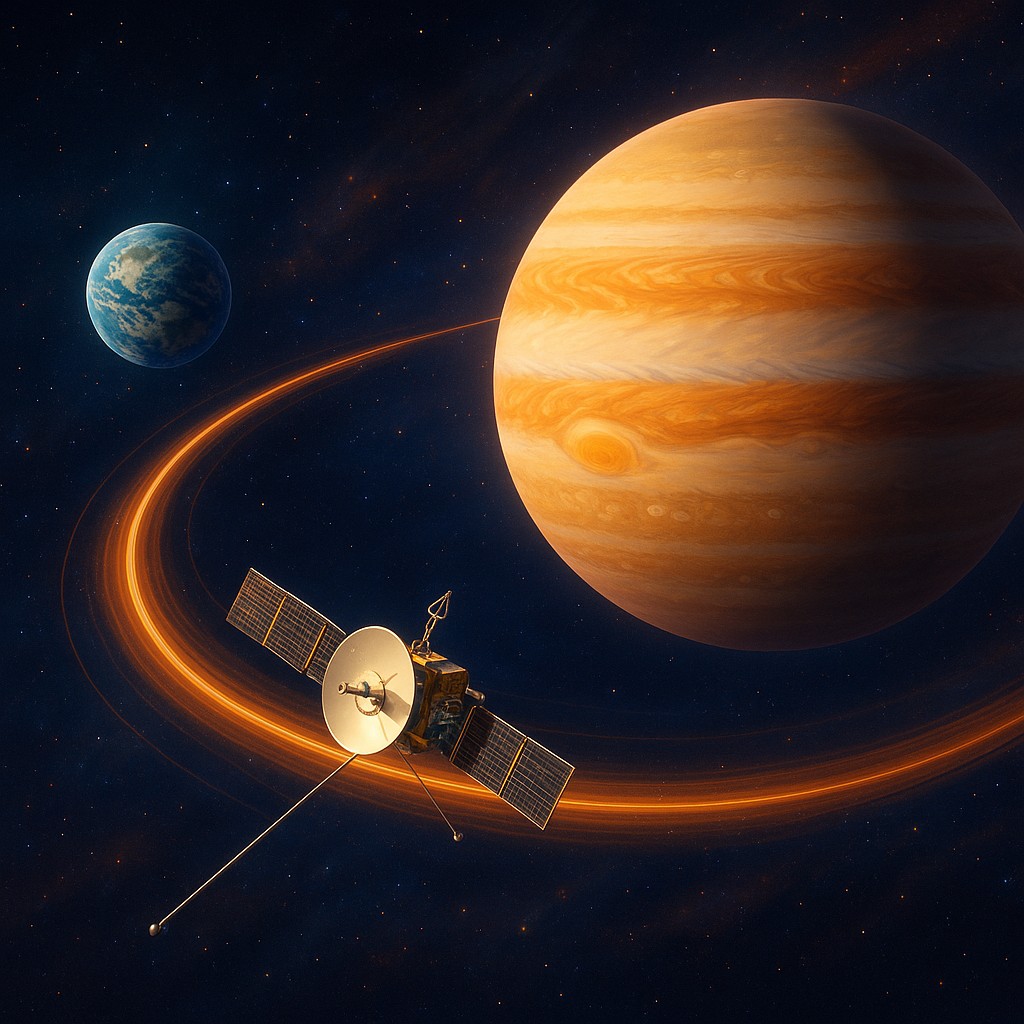
To solve this logistics nightmare, mission controllers don't look for more fuel; they look for a "push" from the neighbors. By carefully aiming a spacecraft to fly close to a massive planet like Venus, Earth, or Jupiter, engineers can pull off a cosmic heist. They effectively "steal" a tiny bit of the planet's momentum and give it to the spacecraft. This maneuver, known as a gravity assist or a planetary slingshot, allows us to bypass the usual limits of rocket science and turn the solar system into a series of free, high-speed refueling stations. It is a dance of physics that requires no engine power, only the invisible, irresistible pull of gravity and the clever use of orbital mechanics - the math governing how objects move in space.
The Invisible Tether of Planetary Motion
To understand how a spacecraft gains speed without an engine, we have to look at the solar system not as a fixed map, but as a collection of objects moving at blistering speeds. Everything is in motion. The Earth zips around the Sun at about 67,000 miles per hour, and Jupiter lumbers along at roughly 29,000 miles per hour. When a spacecraft approaches a planet, it isn't just entering a gravity field; it is entering the personal space of a massive object that is already rushing through the void.
Think of gravity as an invisible, stretchy tether. As the spacecraft enters the planet’s "sphere of influence," it begins to fall toward the planet, picking up speed as it gets closer. If the planet were standing still, the spacecraft would gain speed as it approached and then lose that exact same amount of speed as it climbed away, leaving with the same velocity it had at the start. It would be like a skateboarder rolling down one side of a U-shaped ramp and coming up the other side to the same height. However, because the planet is moving in its own orbit, it drags that "tether" along with it. As the spacecraft swings around the back of the planet, the planet’s forward motion pulls the spacecraft along, adding the planet’s own orbital speed to the craft’s path.
This is often compared to a tennis ball hitting a moving train. If you throw a ball at 30 miles per hour toward a parked train, it bounces back at 30 miles per hour. But if that train is moving toward you at 50 miles per hour, the ball doesn't just bounce; it is "carried" by the collision. The ball will fly off at its original speed plus twice the speed of the train. In space, there is no physical "thump," but gravity acts as the racket. The spacecraft ends the encounter moving much faster relative to the Sun than when it arrived, having "stolen" that extra velocity from the planet's own orbital energy.
The Great Energy Heist and the Law of Conservation
At this point, skeptics might wonder if we are getting something for nothing. Physics usually dislikes "free lunch" scenarios, which are governed by the Law of Conservation of Energy. This law states that energy cannot be created or destroyed, only moved from one place to another. When a spacecraft gains speed during a gravity assist, that energy has to come from somewhere. It comes from the planet. When the spacecraft is pulled forward by the planet's gravity, the spacecraft’s own gravity pulls backward on the planet with equal force.
Because the spacecraft gains velocity, the planet must lose an equivalent amount of orbital energy. In a very literal sense, we are slowing the planet down. However, the scale of the "theft" is so small that it is practically invisible in the grand scheme of the cosmos. To put this in perspective, think about a mosquito flying into the windshield of a speeding semi-truck. The impact technically slows the truck down, but you could never measure that change with a dashboard instrument. The mass of a planet like Jupiter is so huge compared to a probe like Voyager that the planet’s orbital speed might decrease by only a few centimeters over trillions of years. We are essentially taking a single drop of water from an ocean to fill our canteen; the ocean doesn't miss it, but for us, it is the difference between life and death.
This transfer of energy is what makes long-range exploration possible. Without these assists, the Galileo mission to Jupiter would have required a rocket so large it would have been impossible to build or launch. Instead, Galileo flew past Venus once and Earth twice, picking up enough speed at each "pit stop" to eventually reach the King of Planets. We aren't just using gravity to change speed; we also use it to change direction. By changing the angle at which a spacecraft approaches a planet, engineers can "bend" its path, steering the craft toward a new destination without using precious steering thrusters.
Navigating the Cosmic Billiards Table
Executing a gravity assist is not as simple as just "flying near" a planet. It requires mathematical precision that would make a master watchmaker dizzy. Navigators must calculate the approach angle, the altitude of the flyby, and the timing down to fractions of a second. If the spacecraft flies too close, it might hit the atmosphere and burn up or crash. If it stays too far away, the gravitational "tug" won't be strong enough to provide the necessary boost.
| Mission |
Primary Target |
Gravity Assist Planets |
Resulting Velocity Change |
| Voyager 1 |
Saturn & Beyond |
Jupiter, Saturn |
Huge speed increase for interstellar travel |
| Cassini |
Saturn |
Venus (twice), Earth, Jupiter |
Allowed a heavy probe to reach the outer solar system |
| New Horizons |
Pluto |
Jupiter |
Cut 3 years off the total travel time |
| BepiColombo |
Mercury |
Earth, Venus (twice), Mercury (six times) |
Used gravity to slow down to enter Mercury's orbit |
| Parker Solar Probe |
The Sun |
Venus (seven times) |
Used gravity to "drop" closer to the Sun at record speeds |
The table above shows the different ways we use this technique. While we usually think of "slingshots" as a way to speed up, they are just as useful for slowing down. Mercury, for example, is very close to the Sun. If you try to fly there directly, the Sun's gravity pulls you in so fast that you would zip right past the planet. To actually go into orbit around Mercury, the BepiColombo mission has to perform a series of "reverse gravity assists," flying past planets in a way that drags against its motion. This sheds speed so it can gently settle into its target's neighborhood. It is the same physics, just applied in the opposite direction to act as a cosmic brake.
Correcting the Slingshot Myth
A common misconception, often fueled by Hollywood movies, is that a gravity assist involves "firing the engines" at just the right moment while swinging around a planet to get a "turbo boost." In reality, the most elegant gravity assists involve no engine firing at all. The beauty of the move is that it is passive. The spacecraft is simply a passenger on a gravitational wave. While there is a specific move called an "Oberth maneuver" where you do fire engines at the closest point of the flyby to gain extra efficiency, a standard gravity assist is all about the natural geometry of the flight.
Another myth is that the "slingshot" works like a literal rubber band, where the spacecraft is "stretched" and then "snapped" forward. In truth, there is no tension or physical contact. It is purely about the exchange of momentum between two falling bodies. If you were standing on the spacecraft during a gravity assist, you wouldn't feel any "G-forces" pressing you into your seat. You would feel completely weightless. You and the spacecraft are both in freefall together, falling toward the planet and being carried by its movement. The "acceleration" you experience is only visible when you look at your speed relative to the Sun, not your speed relative to the floor of the cabin.
This distinction is important because it highlights why gravity assists are so efficient. Since the craft is in freefall, there is no structural stress on the vehicle. We can accelerate a multi-ton machine to tens of thousands of miles per hour without worrying about it snapping under the pressure of a massive engine burn. The planet does all the heavy lifting, and the spacecraft simply enjoys the ride.
The Legacy of the Grand Tour
The most famous use of this technique occurred in the late 1970s with the Voyager 1 and 2 missions. NASA scientists realized that once every 175 years, the outer planets (Jupiter, Saturn, Uranus, and Neptune) align in such a way that a single spacecraft could "hop" from one to the next using gravity assists. This "Grand Tour" was only possible because of the slingshot effect. Each planet passed the spacecraft to the next like a baton in a relay race.
Voyager 2, in particular, used Jupiter’s gravity to reach Saturn, Saturn’s gravity to reach Uranus, and Uranus’s gravity to reach Neptune. Without these assists, the journey to Neptune would have taken thirty years or more; with them, it took twelve. Those missions redefined our understanding of the solar system, giving us our first close-up looks at the "Great Red Spot" and the rings of Saturn, all powered by the same momentum that keeps the planets in their tracks. Today, these two probes are the most distant human-made objects in existence, still moving through the interstellar void thanks to the "kicks" they received decades ago from the gas giants.
The reach of our curiosity is no longer limited by how much fuel we can cram into a metal tube. As long as there are massive bodies orbiting the Sun, we have a network of cosmic batteries waiting to be used. We have learned to use the very laws of physics that keep planets trapped in their orbits to set ourselves free from our own.
As we look toward the future of exploration, from missions diving into the icy plumes of Europa to probes skimming the scorching atmosphere of the Sun, gravity assists remain our most vital tool. They remind us that space is not just a vast, empty vacuum to be crossed with brute force, but a complex, interconnected system of moving parts that can be navigated with grace and intelligence. By understanding the rhythm of the planets, we have turned the entire solar system into a springboard, allowing us to reach out and touch the stars using nothing more than the weight of the worlds themselves. Every time you see a stunning photo of a distant moon, remember that a tiny piece of a planet's momentum likely helped bring that image to your screen, proving that in the theater of the universe, even the smallest player can borrow the strength of a giant.