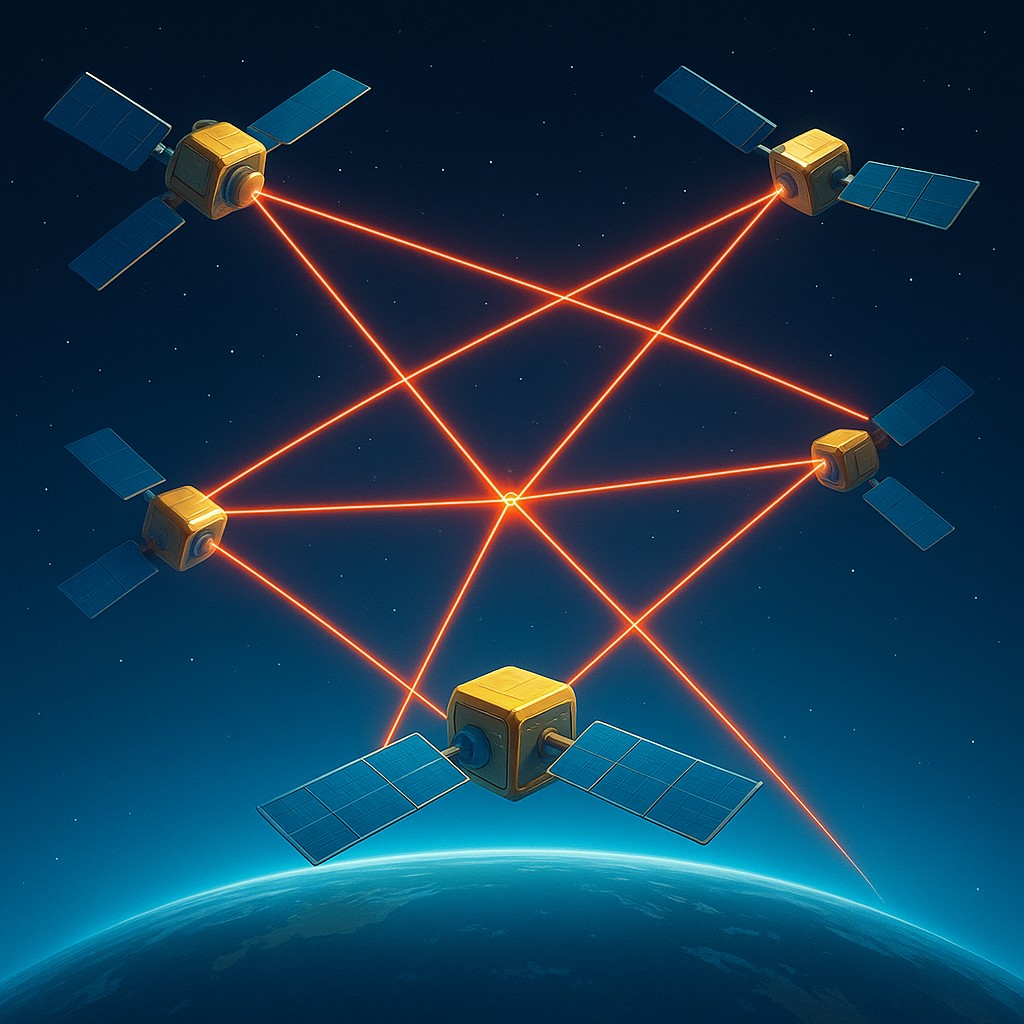
Imagine looking at the night sky and realizing that, far above the clouds, a silent conversation is unfolding at the speed of light. For decades, our global connection has relied on a series of invisible handshakes between high-flying satellites and massive concrete ground stations. This "bent-pipe" setup works like a relay race where the runner must always touch a base before passing the baton. If you are in the middle of the Pacific Ocean or trekking across the Antarctic tundra, the system fails because there is no "base" nearby to catch the signal. You are effectively shouting into a void with no one to listen.
But the way we build our planet's digital fabric is shifting. Instead of satellites acting as simple mirrors that reflect signals back to Earth, they are becoming independent, interconnected routers. This is done through Optical Inter-Satellite Links (OISLs). In plain terms, satellites are now shooting lasers at one another to move data through the vacuum of space. By skipping the middleman on the ground, we are creating a celestial mesh network that ignores borders, oceans, and geography. It is the start of a truly global internet that lives entirely in the atmosphere, operating with a level of precision and speed that once belonged only to science fiction.
The Flaw in the Bent Pipe
To understand why lasers are a revolution, we first have to look at the limits of the traditional "bent-pipe" model. In a standard satellite setup, when you click a link on a website, your dish sends a radio signal up to a satellite. That satellite immediately reflects the signal back down to a "gateway," or a ground station connected to the physical fiber-optic internet. The ground station finds the data and sends it back up to the satellite, which then beams it back down to you. This constant up-and-down motion creates "lag," also known as latency. This delay makes video calls glitchy and online gaming impossible in remote areas.
This model requires a ground station to be within a few hundred miles of the user. If you are on a ship in the middle of the Atlantic, the satellite might see you, but if it cannot also see a ground station on the coast, it has nowhere to send your request. It is essentially a bridge with a missing middle section. Because of this reliance on ground equipment, large parts of the planet remain disconnected. Data is forced to take a zigzag path that adds thousands of miles to its journey, even though light is fast.
Radio waves also come with baggage. Because many satellites and ground services use similar radio frequencies, the airwaves are incredibly crowded. To avoid interference, operators must navigate a maze of international laws and licenses. Furthermore, radio beams spread out as they travel, making them easier to intercept or block. While radio has served us well since the days of Sputnik, it is a blunt tool in an era that requires surgical precision.
Harnessing the Speed of the Vacuum
One of the most fascinating facts in physics is that light does not always travel at the same speed. While the "speed of light" is constant in a vacuum, it slows down when it passes through matter. When you send data through a traditional fiber-optic cable on Earth, the light travels through glass. This glass acts like a speed bump, slowing the light down by about 30 to 40 percent. In the vacuum of space, however, there is nothing in the way. Light can fly at its ultimate theoretical speed limit, roughly 186,282 miles per second.
By using lasers to move data from satellite to satellite in space, we are building a "freeway" where the speed limit is 40 percent higher than on Earth. Similarly, if you want to send a signal from London to New York, the fastest route is not through cables on the ocean floor. It is up into space, across a chain of satellites via laser, and back down. This is not just about moving more data at once; it is about moving it with less delay. For high-frequency traders, emergency responders, or surgeons operating remotely, those few milliseconds are the difference between success and failure.
The table below highlights the differences between the old way of moving data in space and the new laser-based mesh networks.
| Feature |
Traditional Bent-Pipe (Radio) |
Laser Mesh Network (OISL) |
| Transmission Medium |
Radio Waves |
Infrared Lasers |
| Signal Path |
Satellite to Ground to Satellite |
Satellite to Satellite (Direct) |
| Data Speed |
Slower (Glass/Atmosphere refraction) |
40% Faster (Vacuum of space) |
| Global Reach |
Requires nearby Ground Stations |
Works anywhere (Oceans/Poles) |
| Security |
Broad beams are easier to jam |
Narrow beams are highly secure |
| Precision Required |
Low (Wide broadcast area) |
Ultra-High (Hitting a moving target) |
The Impossible Geometry of Space Lasers
If the benefits of lasers are so obvious, why haven't we used them all along? The answer is the technical difficulty of the "pointing" problem. Imagine standing on top of a moving car and trying to hit a penny with a laser pointer. Now, imagine that penny is also on a moving car, 500 miles away, and both of you are traveling at 17,000 miles per hour through the darkness of space. That is the daily reality for a satellite operator using these links.
To connect, two satellites must find each other, align their optical telescopes with microscopic precision, and maintain that lock while moving in complex orbits. If the alignment is off by even a fraction of a degree, the laser beam, which might only be as wide as a dinner plate by the time it reaches its target, will miss entirely. This requires advanced motorized mounts called gimbals, systems to steady vibrations, and software that can predict the exact position of a neighboring satellite in real-time.
Once the link is established, it is not permanent. As satellites orbit the Earth, they constantly enter and leave each other’s line of sight. A single satellite might need to drop its connection with one unit behind it and instantly swivel its laser to pick up a new connection with a satellite appearing over the horizon. This "dynamic handoff" happens thousands of times across the network, creating a fluid, shifting web of light that must never break. It is a masterpiece of orbital choreography that keeps the network alive even while its parts are in constant motion.
Redefining Security and Privacy in Orbit
Beyond speed and reach, laser communication offers a massive leap in security. Radio signals are meant to be heard; they spread out in a wide cone, meaning anyone with the right antenna nearby can listen in or try to jam the signal with noise. In a world where cyber warfare and electronic interference are growing threats, the "loudness" of radio is a liability. It is like trying to have a private conversation by shouting across a crowded restaurant.
Lasers, by contrast, are like a private whisper sent through a very long, very thin tube. Because the beam is so narrow and focused, an intruder would have to physically place an intercepting satellite directly in the path of the laser beam to see the data. This is almost impossible to do without being caught. Furthermore, because lasers operate at much higher frequencies than radio, they are not affected by traditional radio jamming. If a bad actor tries to drown out the signal with radio noise, the laser simply keeps blinking its code to the receiver.
This built-in security is a game-changer for government and military use, but it is just as important for the future of the private internet. As we move more of our lives into the cloud, the physical "bottlenecks" on Earth, such as locations where cables enter a country or signals hit the ground, become prime targets for surveillance or censorship. A space-based mesh network bypasses these choke points entirely. It creates a decentralized internet where data stays in the "wild" of space until the moment it needs to reach the user, making it much harder for any single group to control or cut off.
The Future of Living in a Connected Shell
We are currently watching the construction of a technological shell around the Earth. As thousands of laser-equipped satellites start working, "dead zones" will simply cease to exist. A research station in the middle of a Greenland ice sheet will have the same fast connection as an apartment in Tokyo. This is not just about scrolling through social media faster; it is about the equal access to information and the synchronization of global systems.
This technology also paves the way for deep space exploration. The lessons we are learning about laser links between Earth-orbiting satellites are the blueprints for how we will talk to Mars. Future astronauts won't rely on the slow, grainy radio transmissions of the Apollo era. Instead, we are building the foundation for an "Interplanetary Internet" where high-definition video and massive datasets can be beamed across the solar system using the same optical principles we are perfecting today.
As you go about your day, remember that there is a frantic, beautiful, and incredibly precise dance happening 200 miles above your head. Thousands of small machines are playing a high-stakes game of "laser tag," catching and throwing beams of light to ensure the world stays connected. We have finally figured out how to use the "nothingness" of space to our advantage, turning the vacuum into the most efficient post office in human history. The stars used to be just points of light that guided our ancestors; now, we are creating our own "stars" to carry the sum of human knowledge at the fastest speed the universe allows.