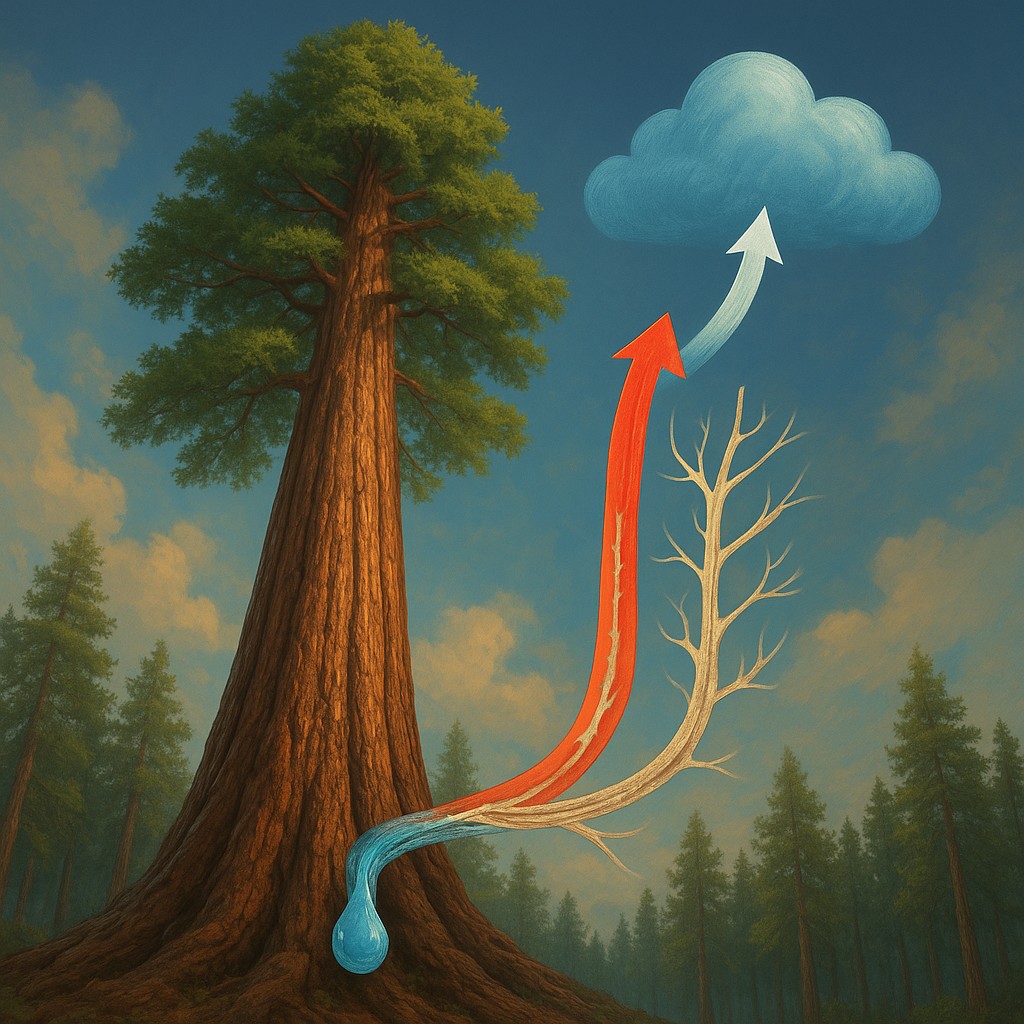
Standing at the base of a Coast Redwood in Northern California feels like looking up at a biological skyscraper that has been under construction for centuries. These giants can soar over 370 feet, dwarfing everything else in the forest. For a long time, we assumed trees only stopped growing because they reached a certain age, or perhaps because their heavy branches would eventually snap. We viewed them through a human lens, as organisms that simply run out of steam, wear out over time, or finish their biological checklist.
However, the truth about tree height is far more dramatic. It centers on a relentless, microscopic tug-of-war against the laws of physics. A tree does not stop growing because it is "old" in the way we experience aging. Instead, it stops because it hits a physiological ceiling. At a certain height, the cost of moving a single drop of water one inch higher becomes a life-threatening gamble. Eventually, the tree’s plumbing can no longer handle the pressure, and the risk of a total internal collapse outweighs the benefit of reaching for one more ray of sunlight.
The Invisible Engine of Transpiration
To understand why trees have a height limit, we first have to understand how they drink. Unlike animals, trees do not have a muscular heart to pump fluids. Instead, they rely on a passive system called transpiration, which acts like a solar-powered suction pump. When the sun hits the leaves, water evaporates through tiny pores called stomata. Because water molecules are cohesive, they stick together like a long, invisible chain. As one molecule evaporates into the air, it pulls on the one below it, which pulls the next, all the way down the trunk to the roots.
This chain of water is under immense tension. Imagine trying to pull a very long rope up a cliff while standing at the top. The longer the rope, the heavier it feels and the more it strains your grip. In a tree, this tension is measured in negative pressure. The taller the tree grows, the harder it must pull to overcome gravity and the friction of the wood. This system is incredibly efficient because it costs the tree almost no energy, but it is also fragile. The water inside the tree's vascular tissue, known as the xylem, is stretched so tight that it is physically unstable.
The Threat of a Vascular Heart Attack
As a tree pushes higher into the canopy, the tension required to lift water becomes extreme. When the suction grows too strong, the water column faces a danger called cavitation. This happens when the tension snaps the "rope" of water molecules, causing a tiny air bubble to expand rapidly inside the xylem vessel. Scientists often call this a "vascular heart attack" or an embolism. Just as a blood clot blocks oxygen in a human, an embolism blocks the flow of water and nutrients to the leaves above it.
An air-blocked pipe is essentially a dead end. While trees have evolved ways to route water around these blockages, there is a limit to how many "blown fuses" a tree can handle. If a tree keeps growing taller, the pressure needed to reach the top leaves will eventually hit a breaking point where these blockages become frequent and uncontrollable. At this stage, the tree’s safety margin vanishes. To survive, the tree must stop growing upward. It chooses the health of its existing plumbing over the vanity of a few extra feet. If it ignored this limit, it would suck air into its veins and die from the top down.
Engineering the Perfect Pipe
A tree’s primary defense against these "heart attacks" is the architecture of its wood. The xylem is more than just a hollow straw; it is a sophisticated network of pipes and valves. In many trees, especially conifers, these pipes are connected by microscopic structures called pit membranes. These act as safety valves. If one tube suffers a blockage, the membrane closes to keep the air bubble from spreading. However, plant engineering involves a frustrating trade-off: a pipe that is safe against air bubbles is usually very narrow and slow at moving water.
| Feature |
Large Conduits (Fast Growth) |
Small Conduits (Hydraulic Safety) |
| Water Flow Speed |
Very high; allows for rapid growth. |
Slow and steady; limits growth speed. |
| Embolism Risk |
High; the water column snaps easily under tension. |
Low; can withstand extreme negative pressure. |
| Structural Cost |
Higher risk of collapse during drought. |
Very resilient; common in desert or high-altitude trees. |
| Height Potential |
Reaches for the sky quickly, but hits the limit sooner. |
Slow and steady; allows for survival in harsh conditions. |
As a tree nears its maximum height, it begins to produce wood focused on safety rather than speed. The pipes at the very top of a 300-foot Redwood are much smaller and more reinforced than those at the base. This changes the chemistry of the top leaves as well. Because water is so hard to get to those heights, the leaves become thick, waxy, and stunted. They look more like desert succulents than lush forest leaves. These "top-tier" leaves live in a state of permanent, height-induced drought, even if the ground below is soaking wet.
Choosing Between Height and Health
A common myth suggests that trees are immortal and would grow to the moon if they had enough fertilizer. In reality, every tree is constantly running a cost-benefit analysis. Growing taller helps a tree beat its neighbors to the sunlight, which is the main currency of the forest. However, the higher it goes, the more "expensive" it becomes to keep those top leaves hydrated. To breathe in carbon dioxide, a tree must open its pores, but opening those pores lets water escape. If the internal tension is already at the breaking point, the tree cannot afford to open up.
When a tree hits its hydraulic limit, its growth slows down significantly. It simply cannot get enough water to the top to justify keeping its "solar panels" fully open. At this point, the tree reaches a balance. It stops putting energy into height and begins to invest in its thickness, root system, and seeds. A tree at its maximum height isn't "finished"; it is simply shifting its strategy. It moves from an expansion phase to a maintenance phase, focusing on producing offspring and reinforcing its trunk to survive wind and storms.
A Balanced View of Biological Boundaries
Understanding these limits changes how we look at the natural world. It reminds us that even the most impressive living things are governed by the cold, hard rules of physics. A tree is a masterclass in engineering, balancing the need for height against the pull of gravity and the tension of water. This explains why the tallest trees on Earth are found in fog-drenched coastal regions. In places like the Pacific Northwest, the high humidity slows down evaporation. This eases the tension on the water column, allowing trees to push just a few feet further than they could in a drier climate.
The next time you walk through a forest and look up, remember that you aren't just seeing wood and leaves. You are looking at a living hydraulic system stretched to its absolute limit. Those towering branches are monuments to a successful struggle against the vacuum of the sky. While we often think of growth as something that should never end, the tree teaches a deeper lesson: true strength comes from knowing your limits and building a resilient life within them. There is a quiet wisdom in a giant that decides it is finally tall enough.