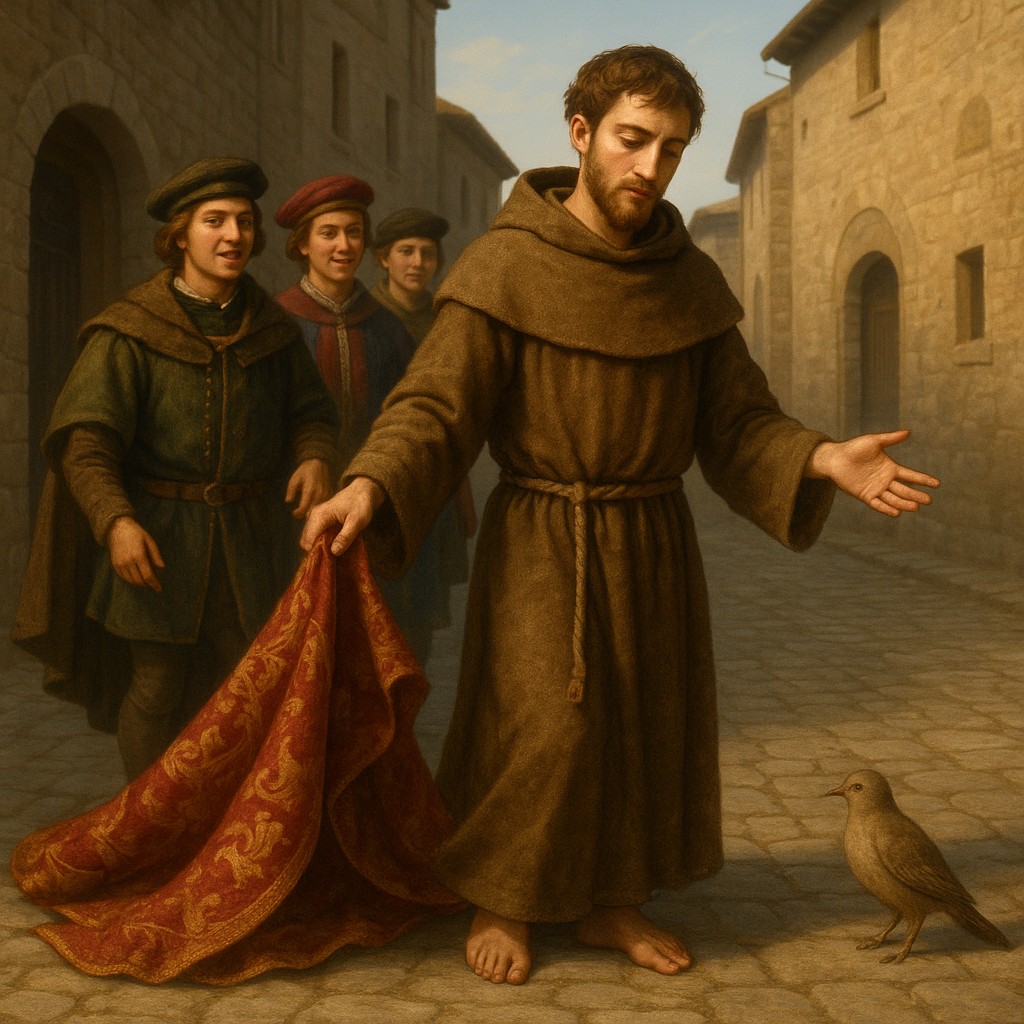
If you could hop into a time machine and travel back to the late 1100s in Umbria, Italy, you would likely find a young man named Giovanni di Pietro di Bernardone leading a rowdy parade of friends through the streets of Assisi. He was the ultimate "cool kid" of his day, draped in the finest silks and spending his father’s fortune on lavish banquets. He dreamed of the glory that only a knight’s armor could provide. Charismatic and fashionable, he seemed destined to become just another wealthy cloth merchant in a society obsessed with climbing the social ladder. Yet, this same man would eventually strip off his expensive tunics in a public square, choose a life of total poverty, and become one of the most beloved figures in history.
Today, we know him as Saint Francis of Assisi. He is remembered as the man who talked to birds, brokered peace during the Crusades, and changed how the world views the bond between spirituality and nature. While he is often boxed in as a mere garden statue surrounded by stone sparrows, the real Francis was a gritty, complex, and radical revolutionary. He didn't just love animals; he challenged the entire medieval power structure. He insisted that true power lies in humility and that the greatest wealth comes from owning nothing at all. To understand Francis is to understand a shift in human perspective that still influences modern environmentalism, social justice, and dialogue between different faiths.
The Transformation of a Golden Boy
The journey from a wealthy socialite to a barefoot mystic did not happen overnight. Francis originally went to war against the rival city of Perugia with dreams of becoming a heroic knight. Instead, his side was defeated, and he spent a year in a damp, dark dungeon. This time in captivity was the first crack in his polished shell, leading to a long illness and a deep sense of disappointment with his former life. When he finally returned home, the parties and the pursuit of status felt empty. He began spending more time in quiet caves and crumbling chapels around Assisi, searching for a purpose that silk and wine could no longer offer.
The "point of no return" came at the ruined church of San Damiano. While praying before a Byzantine-style crucifix (a painted cross common in the Eastern Church), Francis heard a voice telling him to "repair my house, which is falling into ruin." Being a literal-minded young man, he thought the command referred to the physical stones of the building. He famously took a load of his father’s expensive cloth, sold it along with his horse, and tried to give the cash to the local priest. This led to a dramatic legal showdown with his father, Pietro, who was furious about the "mismanagement" of the family business. In front of the Bishop and the entire town, Francis stripped off his fine clothes, handed them back to his father, and declared that from then on, he had only one father: God.
This public act was more than just a tantrum; it was a profound social statement. In the medieval world, your clothes defined your rank and your legal rights. By standing naked and then putting on a rough peasant’s tunic tied with a simple rope, Francis was opting out of the feudal system entirely. He became a "poverello," or a "little poor man," choosing to live on the fringes of society. This radical commitment to "Lady Poverty" became the heart of his philosophy. He believed that owning things inevitably led to the need for weapons to defend them, which in turn fueled violence and greed.
A New Kind of Brotherhood
Francis never intended to start a massive international organization. He simply wanted to live by the teachings of the Gospels, working with his hands and begging for food when he had to. However, his genuine joy and radical lifestyle were incredibly attractive to others. Soon, men from all walks of life - wealthy lawyers, simple farmers, and former soldiers - gave up everything to join him. This group became the Order of Friars Minor, or "Lesser Brothers." Unlike the monks of that era who lived behind thick stone walls in secluded monasteries, Francis and his brothers lived in the heart of cities among lepers and outcasts.
Growing this movement required a careful balance with the powerful leaders of the Catholic Church. At a time when many radical groups were attacking the Church’s corruption, Francis chose a path of "rebellion through humility." He traveled to Rome to seek approval from Pope Innocent III, one of the most powerful men in European history. Legend says the Pope dreamed of a small, scruffy man in a brown robe holding up the collapsing walls of the Basilica of Saint John Lateran. Recognizing Francis as the man from his dream, the Pope blessed this new way of life. This ensured the Franciscan movement would stay within the Church while acting as its moral conscience.
To help visualize his life and legacy, we can look at the different "branches" of the Franciscan tradition that grew during and shortly after his lifetime.
| Group Name |
Primary Focus |
Origin and Legacy |
| Friars Minor |
Active service, preaching, and total poverty. |
The original brothers who traveled the world living as wandering beggars. |
| Poor Clares |
Deep prayer and communal poverty. |
Founded by Saint Clare, a noblewoman inspired by Francis's message. |
| Third Order |
Secular life lived with Franciscan values. |
Created for everyday people who wanted to follow Francis without leaving their families. |
| The Capuchins |
Quiet reflection and simplicity. |
A later reform movement that aimed to return to the strictest roots of the Order. |
The Patron of Ecology and All Living Things
If you ask a stranger what they know about Saint Francis, they will likely mention his love for animals. While this is often seen as a "cute" trait, for Francis, it was a serious theological position. He believed that since everything in the universe was created by the same source, all creatures were his physical brothers and sisters. He didn't just like birds; he preached to them because he believed they were part of the choir of creation. One famous story tells of the "Wolf of Gubbio," a beast that had been terrorizing a town. Rather than calling for a hunt, Francis reportedly brokered a peace treaty between the people and the wolf, recognizing that the animal was only acting out of hunger.
This worldview reached its peak in his "Canticle of the Creatures," which is considered one of the first great works of Italian literature. In this song, Francis refers to "Brother Sun," "Sister Moon," and even "Sister Death." This was revolutionary in the 1200s, a time when nature was usually seen as either a resource to be used or a dangerous wilderness to be feared. By bringing nature into the family circle, Francis laid the groundwork for what we now call environmental ethics. He taught that humans belong to the earth, rather than the earth belonging to humans.
His connection to the physical world was so intense that it eventually showed up on his own body. Toward the end of his life, after a period of fasting and prayer on Mount La Verna, Francis is said to have received the stigmata - the physical wounds of Christ. He was the first person in recorded history to receive these marks. This event highlighted his lifelong goal of "becoming" the message he preached. For Francis, spirituality was not an abstract idea; it was something to be felt, touched, and lived out in the mud and the sun.
The Peaceful Revolutionary in the Midst of War
Perhaps the most overlooked part of Francis’s life is his role as a diplomat. While the Fifth Crusade was raging in Egypt, Francis did something unthinkable: he crossed enemy lines to speak with the Sultan, Al-Kamil. At a time when the Western world saw the Sultan as the ultimate villain, Francis saw him as another brother. He didn't go with a sword or a plan for assassination; he went to end the bloodshed through conversation and mutual respect.
While he didn't convert the Sultan, and the Crusade didn't stop immediately, the two men spent days in deep conversation and parted with mutual admiration. This encounter is often cited as a foundational moment for dialogue between different religions. The Sultan was so impressed by Francis’s sincerity that he gave him safe passage through his lands and allowed the Franciscans to become the guardians of Christian holy sites in Jerusalem - a role they still hold today.
This journey highlighted the core of the Franciscan philosophy of peace. Though the famous "Lord, make me an instrument of your peace" prayer was actually written much later (around the time of World War I), it perfectly captures his spirit. Francis believed that peace was not just the absence of war, but a proactive way of living that required one to "sow love where there is hatred." His life proved that you cannot create a peaceful world through violence; the method must match the message.
Correcting the Myths and Misconceptions
Because Francis is such a famous figure, several myths have clouded the reality of his life. One common mistake is the idea that he was a "nature-loving hippie" who didn't care for religious rules. In reality, Francis was deeply committed to his faith and worked hard to ensure his Order remained loyal to the Church. He wasn't a rebel for the sake of being a rebel; he was a reformer who believed that the best way to change an institution was to love it from the inside while living a life that shamed its excesses.
Another myth is that he hated the wealthy or thought money was inherently evil. His problem was not with gold itself, but with the "attachment" to it. He saw how the pursuit of wealth caused people to forget their neighbors and separate themselves from human suffering. He didn't want people to be miserable; he wanted them to be free. He often said his poverty was "regal" because it meant he had nothing to lose and nothing to fear. By giving up his possessions, he felt he had gained the whole world.
Finally, many people think of Francis as a constantly happy, singing figure. While he was known for his joy, he also suffered immensely. He struggled with chronic eye infections that left him nearly blind, and he faced massive internal stress as his Order grew and became more bureaucratic. The "joy" Francis preached was not the absence of pain, but the ability to find meaning and connection in the middle of it. He was a man of deep sorrows who chose to respond with a song rather than a complaint.
- Radical Humility: Francis called himself "lesser" to remind everyone that no person is naturally better than another.
- Active Compassion: He didn't just feel sorry for the poor; he became poor to better serve them and respect their dignity.
- The Power of Story: He created the first live Nativity scene (the Crèche) to help people visualize the humble beginnings of his faith.
- Universal Kinship: He extended the idea of family to include every part of the natural world.
Why the Little Poor Man Still Matters
The legacy of Saint Francis isn't stuck in history books; it is woven into how we think today. When we talk about sustainability and living simply, we are speaking a language Francis started centuries ago. When we stand up for the homeless or protect endangered species, we are walking the path he cleared. He reminds us that a life lived for others is far more adventurous than a life lived for oneself. He proved that even one person, armed with nothing but sincerity and a ragged tunic, can change the course of history.
As you look at the world around you, perhaps you can take a lesson from Francis and try to see the connection between yourself and the "brothers" and "sisters" in your own life - the trees, the animals, and the people you might otherwise ignore. Francis teaches us that the world is not a collection of objects to be owned, but a magnificent family to be cherished. His life invites us to clear away the "clutter" of our expectations and find beauty in the simple and the small. So, the next time you see a bird or a sunset, remember the man from Assisi who believed they were worth a sermon, and let that sense of wonder lead you toward a kinder way of living.