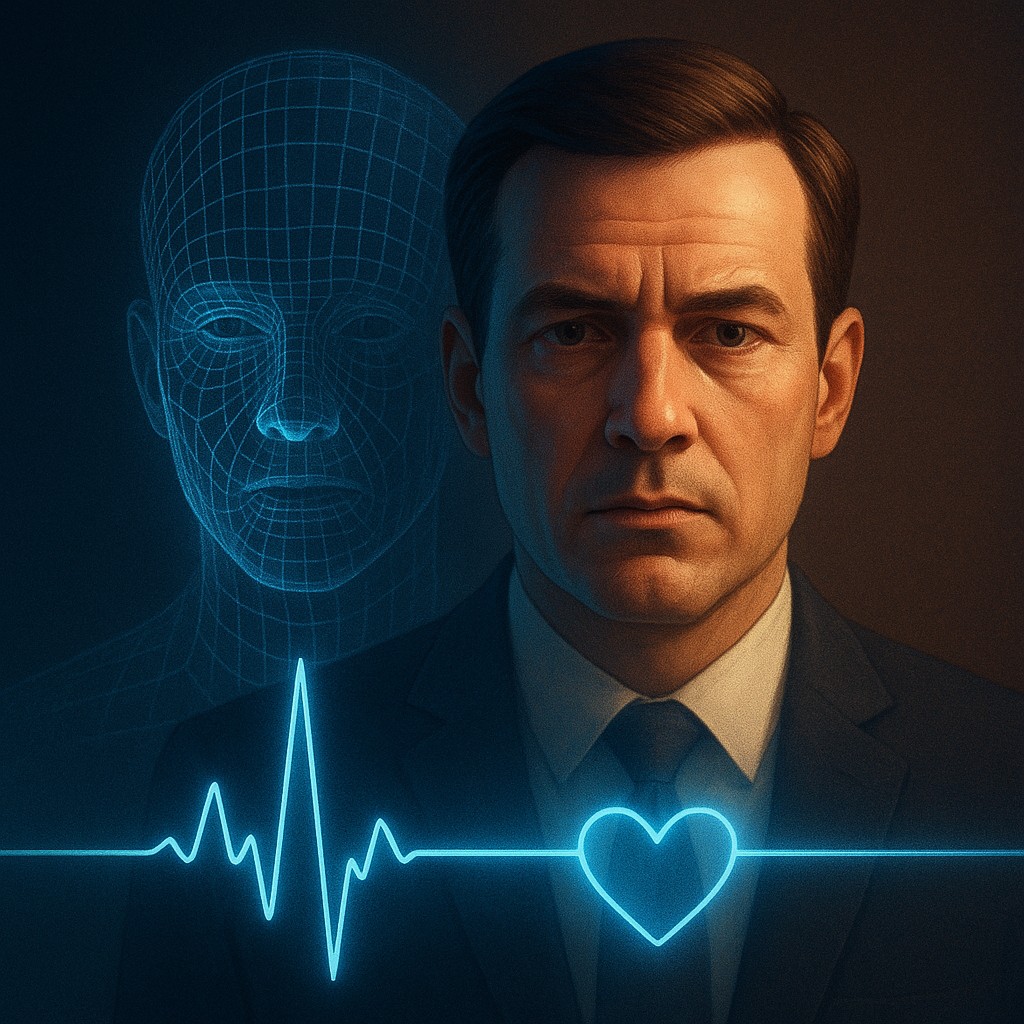
Imagine you are watching a high-stakes video of a world leader making a shocking announcement or a celebrity endorsing a sketchy investment scheme. The lighting is perfect, the voice sounds exactly right, and their mouth moves in perfect sync with the audio. In the era of generative AI, your eyes are no longer the reliable witnesses they once were. We have entered the age of the deepfake, where pixels are manipulated so precisely that the "uncanny valley"-that strange sense of unease we feel when a digital person looks almost, but not quite, human-has been mostly filled in. For digital forensics experts, the challenge is no longer about spotting a stray pixel or a weird shadow; it is about finding the "soul in the machine," or more specifically, the pulse in the person.
While AI is incredibly good at mimicking how we look, it is currently quite bad at mimicking our biological functions. Every time your heart beats, it sends a wave of blood through your body. This blood flow causes microscopic changes in the color and transparency of your skin. These changes are so subtle that the human eye cannot see them, but a sensitive camera sensor can. This is the new frontier of digital truth, a field where forensic science meets human physiology. By looking past the surface of the "person" on screen to find the rhythmic signature of a cardiovascular system, researchers are developing tools that can separate a living person from a computer-generated one with startling accuracy.
The Invisible Rhythm of Photoplethysmography
To understand how we catch a deepfake using biology, we first have to understand a concept called photoplethysmography, or PPG for short. It sounds like a mouthful, but you have likely used this technology if you have ever worn a fitness tracker or used a pulse oximeter (the clip-on device for your finger) at a doctor’s office. Standard PPG works by shining a light onto the skin and measuring how much of that light is absorbed or reflected back. Because blood absorbs light differently than skin tissue, each heartbeat creates a measurable dip in the reflected light. When we apply this to video, we call it remote photoplethysmography (rPPG), because we are measuring it from a distance without touching the subject.
When a coach or news anchor speaks to a camera, their face is essentially a canvas of their internal biology. As the heart pumps, the tiny blood vessels (capillaries) in the cheeks, forehead, and chin fill and empty in a rhythmic cycle. An rPPG algorithm monitors these specific regions of the face, frame by frame, and calculates the tiny shifts in color. If the video shows a real human, these fluctuations will form a steady, repeating wave that matches a human heart rate. In a deepfake, these signals are usually missing, completely chaotic, or do not match up across different parts of the face.
The beauty of rPPG is that it relies on a "hard" biological benchmark. A generative adversarial network (GAN), which is the engine behind many deepfakes, is designed to make an image look right to another AI. It focuses on textures, edges, and expressions. However, most deepfake models do not "know" about blood flow. They generate pixels to match a visual pattern, not a biological process. Even if an AI were programmed to simulate a pulse, it would have to perfectly replicate the way blood moves differently through various facial tissues - a level of complexity that is currently out of reach for real-time video generation.
Mapping the Face for Forensic Integrity
Digital forensic tools like Intel’s "FakeCatcher" take the rPPG concept and turn it into a spatial map. Instead of just looking for a single pulse, the software divides the face into dozens of small regions. In a healthy, living human, the pulse signal should be consistent across these areas. While the timing might vary slightly between the forehead and the jaw, the overall rhythm should be mathematically synchronized. This multi-point check is crucial because it prevents a simple video overlay from tricking the system.
When an investigator runs a suspicious video through a biological signal detector, they are looking for "spatiotemporal consistency." This means that the biological signal must make sense in both space (across the face) and time (throughout the clip). A fake video might show a pulse-like flicker in one area, but it will likely fail to show the same rhythm on the nose or cheeks at the same time. By comparing these multiple points, the software can generate a "probability of authenticity" score.
| Detection Feature |
Real Human Video |
Deepfake/Synthetic Media |
| Blood Flow (rPPG) |
Periodic and rhythmic |
Generally absent or noisy |
| Spatial Consistency |
Signal matches across face regions |
Disjointed or localized signals |
| Spectral Power |
Clear peak at heart rate frequency |
Flattened or erratic spectrum |
| Lighting Sensitivity |
Natural interaction with skin |
Often produces digital artifacts |
| Signal Source |
Internal cardiovascular system |
Mathematical pixel generation |
This table illustrates the fundamental gap between a biological being and a mathematical approximation. For a forensic investigator, the absence of a signal is just as informative as its presence. If a video claims to be a live broadcast of someone under intense stress, yet their facial "pulse" remains perfectly flat or undetectable, red flags start flying. The technology essentially allows us to "listen" to the heart of the person on screen, even if we cannot hear it with our ears.
Technical Barriers and Environmental Hurdles
While biological detection is a powerful tool, it is not a magic fix for every scenario. To detect a pulse through a camera lens, the software needs high-quality data. This usually means high-resolution video with a steady frame rate. If a video is heavily compressed - which often happens when it is shared repeatedly on social media or messaging apps - the subtle color changes required for rPPG are often lost. Compression algorithms tend to smooth out "noise," and unfortunately, the tiny fluctuations of our blood flow can look like noise to a computer trying to save file space.
Lighting also plays a massive role in whether these forensic tests succeed. If a person is filmed in low light or under flickering fluorescent bulbs, the external "noise" from the environment can overwhelm the internal biological signal. A deepfake creator could theoretically hide their tracks by intentionally releasing a low-quality, dimly lit video, claiming it was recorded on a cheap smartphone. In these cases, the biological detector might return an "inconclusive" result, forcing investigators to rely on older methods like checking file data (metadata) or looking at how well the lips sync with the words.
Furthermore, there is the issue of "presentation attacks." This is when someone tries to fool the sensor not with a digital deepfake, but with a physical mask or a high-resolution screen held up to a camera. Advanced rPPG systems fight this by looking for the specific way light interacts with human skin compared to plastic or glass. Human skin has "subsurface scattering," meaning light enters the skin, bounces around, and comes back out. Sensors are being trained to recognize this specific optical signature, adding another layer of defense against those trying to bypass biological verification.
The Evolutionary Arms Race of Truth
The history of security is an arms race. For every new lock, someone invents a new pick. In the world of synthetic media, we are seeing this play out in real time. As forensic experts champion rPPG as the ultimate deepfake killer, AI researchers are already looking into "biologically aware" models. There are already experimental papers discussing how to build heart rate signals into the training data for deepfakes. The goal of these advanced fakes would be to generate pixels that pulsate at 72 beats per minute just to satisfy a detection algorithm.
However, replicating biology accurately is much harder than it sounds. It isn't just about a steady pulse; it's about how that pulse changes when a person laughs, gets angry, or takes a deep breath. Human physiology is incredibly reactive. If a deepfake shows someone shouting in anger but their blood flow pattern remains calm and steady, that "biological mismatch" becomes the new smoking gun. This forces the AI to not just simulate a face, but to simulate an entire nervous system and its cardiovascular responses.
This shift in focus from "how it looks" to "how it functions" represents a major philosophical change in digital forensics. We are no longer just looking for mistakes in the pixels; we are looking for the presence of life. As long as deepfakes are generated by software that lacks a physical body, there will always be a gap between the copy and the reality. The task of the forensic scientist is to stand in that gap with a metaphorical stethoscope, checking to see if the digital image has a heart.
Empowering the Digital Citizen
As these technologies move out of the lab, they will likely be built into our web browsers and social media platforms. Imagine a future where a small icon appears next to a video, showing that its biological signals have been verified. This would provide a layer of "digital trust" that we currently lack. However, the most important tool remains our own critical thinking. Technology can provide the data, but humans must provide the context. We must learn to ask not just "Does this look real?" but "Does this behave like a human?"
The ongoing work to detect deepfakes using biological signals offers a fascinating glimpse into the future of security. It reminds us that for all our digital sophistication, our humanity is still anchored in our biology. In a world of infinite copies and synthetic replicas, the rhythmic beat of a heart remains one of the few things that is truly difficult to fake. By understanding these systems, we become more than just passive consumers of media; we become informed observers capable of navigating a world where the line between the real and the generated is constantly shifting.
As you move forward in this digital landscape, remember that the "tell" for a lie is often hidden in the things we take for granted. The next time you see a video that seems too good (or too bad) to be true, think about the blood pumping beneath the skin of the person on screen. Truth in the 21st century is no longer just about what we can see, but about the invisible rhythms that define us as living beings. Stay curious, stay skeptical, and always look for the pulse.