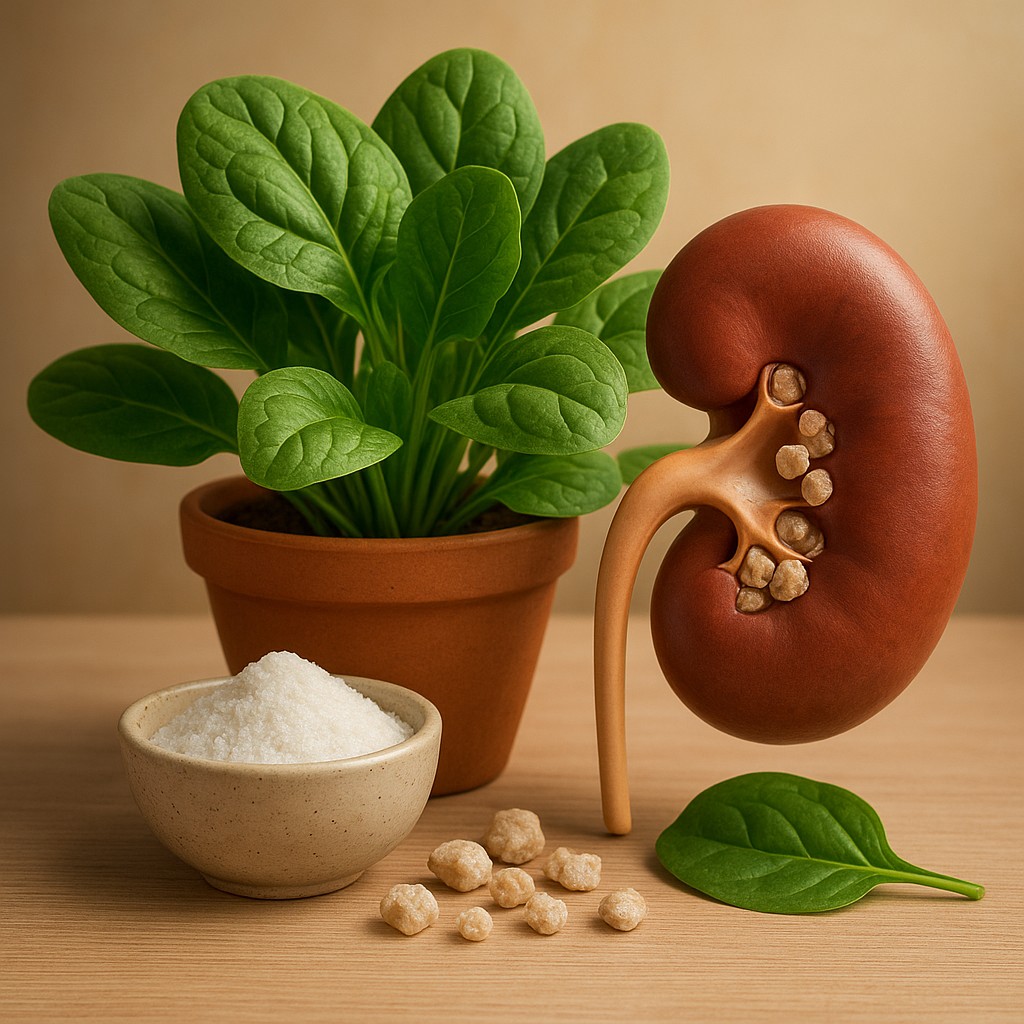
Spinach has a bit of an image problem. One day it is a leafy green superhero, full of vitamins and quietly making your future self proud. The next day someone online calls it a kidney stone in plant form, and suddenly your salad feels like a risky choice.
Most of that worry comes down to one word: oxalates. The story goes: oxalates are "anti-nutrients," they "steal minerals," and they "cause kidney stones," so you should avoid spinach, almonds, beets, and half the produce aisle if you care about your health. It is a tidy, scary story. It also skips some important context.
Let us fix that. Oxalates are real and they do have real effects. For a small group of people they can be a real problem. But for most people, the "never eat spinach" conclusion is an overreaction. Think of oxalates less like a poison and more like a spice - dose, timing, and the person eating them all matter.
Oxalates, explained without turning this into a chemistry lecture
Oxalate (or oxalic acid, when we talk about it in foods) is a natural compound found in many plants. Plants make it for practical reasons, like storing minerals and deterring animals from eating them. You can think of oxalates as tiny molecular "Velcro" that likes to grab certain minerals, especially calcium.
In your body, oxalate comes from two places. Some oxalate comes directly from food. Some is made inside you when your body breaks down things like vitamin C and certain amino acids. That means even a perfect "oxalate-free" diet would not remove oxalate from your life, because your metabolism keeps making some.
Most oxalate leaves the body in stool and urine. Trouble starts when a lot of oxalate ends up in urine and meets calcium there. Calcium plus oxalate can form calcium oxalate crystals, the most common ingredient in kidney stones. That is the core reason oxalates get blamed, and it is not completely wrong. It is just not the whole story.
Why oxalates got a bad reputation (and what the science actually says)
Oxalates are criticized for two main reasons: "anti-nutrient" effects and kidney stone risk. Both have a grain of truth, but both get blown out of proportion online.
The “anti-nutrient” label: yes, but let us be specific
Oxalates can bind to minerals like calcium (and, to a lesser extent, magnesium and iron) in the gut. When oxalate binds calcium in your intestines, that calcium may not be absorbed. That is why some people call spinach a "bad" source of calcium, even though it contains calcium on paper.
Here is the nuance: this does not mean spinach removes calcium from your bones. It means the calcium in spinach is not absorbed as well as calcium from lower-oxalate foods like dairy, fortified plant milks, or kale. If your overall diet has enough calcium, this is usually not a problem. The human body does a pretty good job of balancing nutrients over time when your overall pattern is solid.
Kidney stones: the risk is real, but it is not universal
Kidney stones are common, painful, and memorable in the worst way, so anything tied to them draws strong reactions. Calcium oxalate stones are the most common type. For people who already form stones, high oxalate intake can be a meaningful factor.
But most people who eat spinach do not get kidney stones. Stone risk depends on a web of factors: hydration, urine volume, sodium intake, calcium intake, genetics, gut bacteria, certain medical conditions, and more. Oxalates matter most when several of those factors line up in an unhelpful way, like a group project where everyone actually shows up.
Spinach on trial: should you stop eating it?
If spinach were only "high in oxalates," it would be easy to demonize. But spinach is also rich in folate, vitamin K, carotenoids like lutein and zeaxanthin, and plenty of fiber and other plant compounds. It is a nutritional multitool.
The truth is spinach can be both:
- A very healthy food for many people
- A high-oxalate food that some people should manage carefully
The key question is not "Is spinach bad?" but "Is spinach a problem for you, given how you eat it and your health?"
If you have never had a kidney stone and you eat a varied diet, spinach is unlikely to be an issue. If you have a history of calcium oxalate stones, or you have certain gut conditions that increase oxalate absorption, then spinach might need some strategy, not necessarily a permanent ban.
The big misconception: “Oxalate foods cause kidney stones” (full stop)
This myth survives because it feels simple: oxalate is in the stone, therefore oxalate foods cause the stone. But kidney stone formation is more like making rock candy than swallowing rocks. Crystals form when urine is concentrated and certain compounds are high compared with the substances that normally stop crystals from forming.
Here are a few underappreciated truths:
Hydration often matters more than oxalate. Low urine volume is a huge driver of stone risk. If you are dehydrated, your urine becomes concentrated and crystals get a better chance to form. Many stone-prevention plans start with "drink enough fluids to produce plenty of urine," because it works.
Calcium is not the enemy in calcium oxalate stones. This one is counterintuitive. Getting enough dietary calcium can reduce oxalate absorption because calcium binds oxalate in the gut and sends it out in stool instead of into urine. Many people with stones mistakenly cut calcium and actually increase their risk.
Sodium and high-dose supplements can push things the wrong way. High sodium intake increases calcium excretion in urine for many people, raising stone risk. High-dose vitamin C supplements can increase oxalate production in the body, which is why megadoses are sometimes discouraged for stone formers.
So if someone says, "Never eat spinach," they are skipping the part where kidney stones are usually about the whole system, not one food.
A practical oxalate map: high, moderate, and low (and why it is not just spinach)
Oxalates appear in a wide range of plant foods, but amounts vary a lot. Spinach is indeed near the top. So are a few other foods that surprise people, especially when you eat them in large, concentrated forms (hello, smoothie life).
Below is a useful, simplified guide. Exact oxalate values vary by variety, growing conditions, and preparation, so treat this as a compass, not a courtroom verdict.
| Oxalate level (general) |
Foods commonly in this range |
Practical take |
| Higher oxalate |
Spinach, beet greens, Swiss chard, rhubarb, almonds, sesame, cocoa, wheat bran |
If you form calcium oxalate stones, manage portions and frequency, and pair with calcium. |
| Moderate oxalate |
Beets, sweet potatoes, peanuts, soy foods, black tea, berries |
Usually fine in normal servings, but watch stacking several in one day if you are stone-prone. |
| Lower oxalate |
Kale, bok choy, cabbage, broccoli, cauliflower, peas, cucumbers, most melons |
Good choices for frequent use, especially for people limiting oxalate. |
One sneaky pattern: "health foods" can become high-oxalate traps when you concentrate them. A handful of spinach is different from a daily 10-ounce spinach smoothie. A sprinkle of cocoa is different from a daily cocoa-based protein dessert. Dose matters.
How your gut decides whether oxalates become a problem
Oxalate is not automatically absorbed. A lot depends on what is happening in your digestive tract.
Calcium in the same meal can lower oxalate absorption
When calcium is present in your gut, it binds oxalate there. That reduces how much oxalate gets absorbed into the bloodstream and later shows up in urine. This is why pairing high-oxalate foods with calcium-containing foods can be a smart move, especially for stone formers.
Examples of calcium pairings:
- Spinach eaten with cheese or yogurt (yes, your salad can be both tasty and functional)
- Spinach cooked into a dish with calcium-set tofu
- A meal that includes a calcium-fortified plant milk
Fat malabsorption can raise oxalate absorption
Certain gut conditions can increase oxalate absorption. When fat is not absorbed well, it can bind calcium in the gut, leaving less calcium to bind oxalate. More free oxalate may then get absorbed. This can happen in some people with inflammatory bowel disease, after certain bariatric surgeries, chronic pancreatitis, or other malabsorption states.
That is why oxalate advice should be personalized. For some people it is background noise. For others it is a real dial to adjust.
Gut bacteria may play a role, but it is not a magic fix
Some gut microbes can break down oxalate. You might hear about a bacterium called Oxalobacter formigenes. It is interesting, but we do not yet have a reliable, mainstream probiotic that consistently reduces stone risk by "eating" oxalate. It is a promising area, not a proven trick.
If you are worried about kidney stones: the smarter playbook (not the panic button)
If you have a history of kidney stones, or you want to prevent a recurrence, you can be strategic without making vegetables the enemy. Many clinicians focus on a few high-impact habits:
High-leverage habits that often help
- Drink enough fluids to keep urine diluted. Many plans aim for steady urine output across the day, not a big water chug at night.
- Get adequate dietary calcium, usually from food. Counterintuitive, but often protective for calcium oxalate stones.
- Moderate sodium. High salt intake can increase urinary calcium.
- Be careful with high-dose vitamin C supplements, especially if you are stone-prone.
- Avoid stacking multiple high-oxalate foods daily if you are sensitive. A spinach smoothie plus almonds plus dark chocolate dessert is tasty, but it is a lot of oxalate at once.
Cooking and preparation: can you reduce oxalates?
Boiling leafy greens can lower soluble oxalates because some leach into the water. Steaming reduces less than boiling. If you boil spinach and discard the cooking water, you can lower oxalate content somewhat. This does not mean you must boil all joy out of your food, but it is one tool.
Blending does not remove oxalates. It just makes them easier to eat in larger amounts. The blender is not evil, but it is very good at helping you finish three salads worth of spinach in 90 seconds.
So, should you avoid spinach?
For most people: no. Spinach is a nutrient-dense food that can fit into a healthy diet. If you enjoy it, it does more good than harm in typical portions, especially as part of a varied diet with enough calcium and fluids.
For people with specific risk factors: maybe manage it. If you have had calcium oxalate kidney stones, especially repeated ones, it is reasonable to limit high-oxalate foods like spinach, not necessarily to cut them out completely, and to use pairing strategies. If you have a medical condition that increases oxalate absorption, talk with a clinician or dietitian who can tailor advice, sometimes using urine testing to see what is actually happening in your body.
The most balanced conclusion is this: spinach is not "bad." It is a food with a known compound that matters for certain people in certain contexts. The internet loves universal villains. Human biology prefers individualized answers.
A memorable way to think about oxalates (so you can stop doom-scrolling)
Try this mental image: oxalates are like glitter.
A little glitter in a craft project is fine, even festive. Dump a whole jar on the carpet and you will find sparkles in strange places for months. Most bodies handle normal oxalate intake just fine. Problems tend to show up when intake is consistently high, hydration is low, calcium is low, or someone has a physiology that absorbs more oxalate than average.
If you want to keep spinach without the drama, keep it varied and sensible. Rotate greens - kale, bok choy, arugula, romaine - watch the "daily spinach smoothie" habit if you are concerned, and remember that food decisions are best made with context, not fear.
You do not need to eat like a monk to be healthy. You need a pattern that fits your body and your life, and enough curiosity to question simple stories. In nutrition, that curiosity often makes the difference between anxiety and confidence, and spinach deserves at least that much respect.