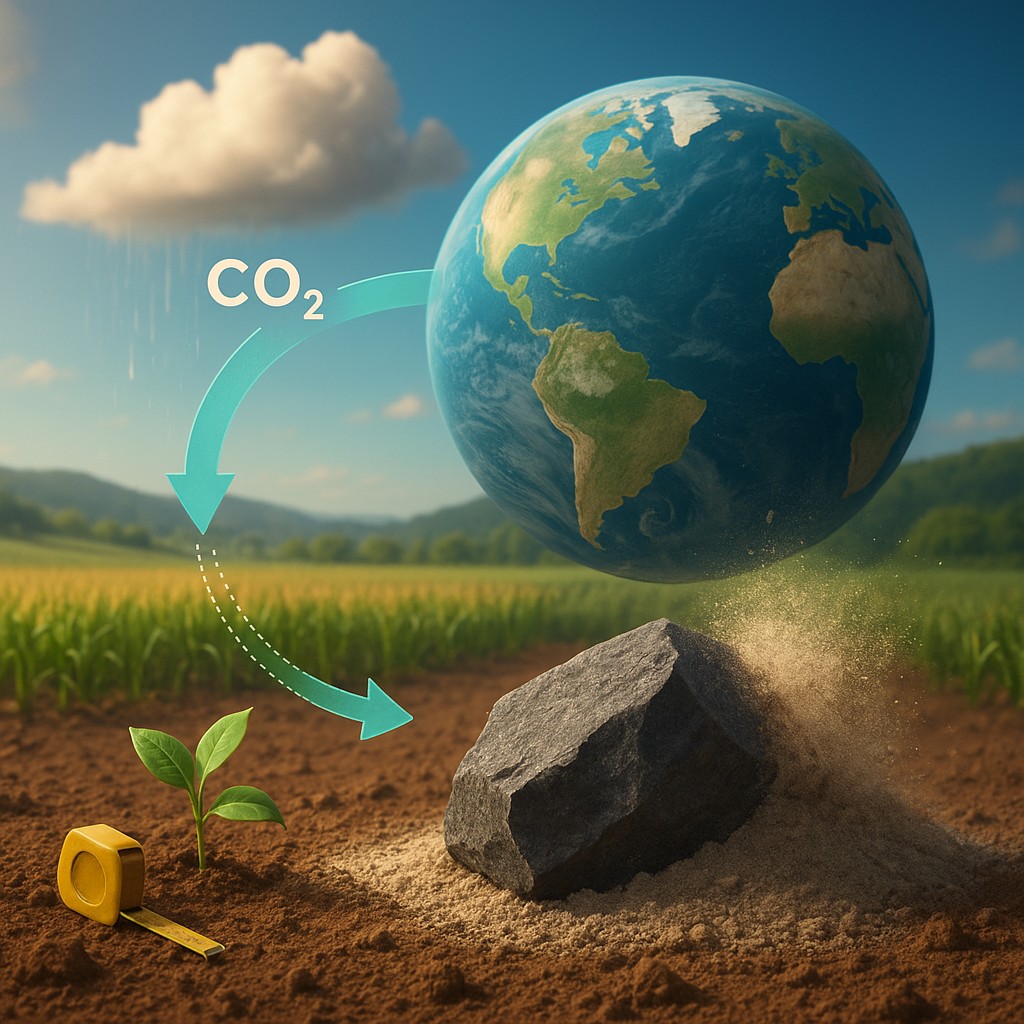
Think of the Earth as having a slow-motion digestive system. For billions of years, our planet has been "eating" carbon dioxide from the air through a process so gradual it is almost impossible to notice. When rain falls, it absorbs CO2 and becomes a very weak acid. This rain lands on rocks, reacts with them, and turns the gas into a liquid mineral that eventually flows into the sea. This natural cycle acts as the world's thermostat, keeping things from getting too hot or too cold over vast stretches of time. The problem, of course, is that humans have turned up the carbon furnace so high that the Earth’s natural "digestion" cannot possibly keep up.
What if we could give the planet’s metabolism a jump-start? Instead of waiting for mountains to crumble over millions of years, what if we brought the mountains to the fields? This is the core goal of a fast-growing field of climate science called Enhanced Rock Weathering (ERW). By grinding up specific types of volcanic rock and spreading it across millions of acres of farmland, scientists and farmers are working together to speed up a process that usually takes eons, finishing it in just a few years. It is a rare "triple-win" that promises to clean the air, heal the soil, and protect the oceans, all while using the farming tools we already have.
The Chemistry of a Crumbling Mountain
To understand why basalt dust is suddenly the most interesting thing in a farmer’s shed, we have to look at the chemistry of a single raindrop. As water falls through the sky, it picks up carbon dioxide to form a mild carbonic acid. When this slightly acidic rain hits a rock rich in calcium or magnesium - such as basalt - a chemical reaction occurs. The rock dissolves, and the carbon dioxide turns into bicarbonate ions. This isn't just a fancy term for the ingredients in baking soda; it is a stable, dissolved form of carbon that no longer acts as a greenhouse gas.
This process is essentially nature’s way of "locking" the sky into the ground. Once that carbon becomes bicarbonate, it is incredibly stable. It doesn’t just sit in the dirt waiting to evaporate; it moves through the groundwater into rivers and eventually settles in the ocean. Once there, it can stay put for over 100,000 years. By crushing the rock into a fine powder, we increase its surface area millions of times over. A handful of basalt dust has vastly more "reaction sites" than a solid boulder, allowing the chemistry that normally takes a millennium to happen in a single growing season.
Turning Farmland into a Natural Air Filter
The beauty of this method is its scale. We don’t need to build massive, power-hungry fans or complex underground storage tanks to capture carbon. Instead, we can use the 12 billion acres of agricultural land that already exist. Farmers are already used to spreading "lime" (crushed limestone) on their fields to balance soil acidity. Swapping or adding silicate rocks like basalt fits perfectly into current farming routines. Most farmers would not even need new machinery; they would simply be changing the recipe of what they spread on their crops.
Large-scale trials are proving that this is more than just a lab fantasy. In the U.S. Corn Belt and across the United Kingdom, researchers are watching how basalt interacts with different soils and climates. They have found that the rock does more than just soak up carbon; it actively helps the farm. Because basalt is volcanic, it is packed with nutrients like silica, magnesium, and iron. As the rock breaks down and captures carbon, it slowly releases these minerals. This acts as a natural fertilizer that leads to healthier, tougher crops with stronger stalks and better resistance to pests.
Broad Benefits of Mineral Weathering
While the main goal of these trials is to clean the atmosphere, the side effects are surprisingly positive. In many parts of the world, intensive farming has stripped the soil of its natural minerals and left it too acidic. Basalt is naturally alkaline, so as it reacts with the rain, it raises the pH of the soil. This creates a better home for the "good" bacteria and fungi that plants need to grow. This means farmers may actually need less chemical fertilizer over time, which reduces the amount of nitrates leaking into our waterways.
The benefits even reach the oceans where the bicarbonate eventually ends up. As we know, the oceans are currently suffering from acidification because they are absorbing too much CO2 directly from the air. However, the bicarbonate produced by rock weathering is alkaline. When this "rock juice" reaches the sea, it helps balance the water, acting like an antacid for the ocean. It provides the raw materials that coral reefs and shellfish like oysters and clams need to build their shells, turning a climate change waste product into a building block for sea life.
| Feature |
Natural Rock Weathering |
Enhanced Rock Weathering (ERW) |
| Timeframe |
Thousands to millions of years |
Months to decades |
| Material Form |
Large boulders and mountain faces |
Fine dust with high surface area |
| Primary Location |
Mountains and riverbeds |
Managed farms and forests |
| Carbon Storage |
Deep ocean as bicarbonate |
Deep ocean as bicarbonate |
| Impact on Farming |
Minor on a human timescale |
Improves soil pH and mineral levels |
| Human Effort |
None |
Mining, grinding, and spreading |
Balancing Energy Use and Mining
If this sounds like a "magic bullet," it is important to look at the energy costs. Crushing rock into fine powder takes a huge amount of power. If we use coal-fired power plants to run the grinders, we might release more carbon into the air than the rock dust could ever catch. Furthermore, mining basalt is an industrial process. Moving millions of tons of heavy rock from a quarry to a farm requires trucks, trains, and ships, all of which have their own carbon footprints. The math must add up: the "net" carbon capture must be much higher than the carbon produced by the process itself.
Fortunately, the numbers are looking good. Current studies suggest that for every four tons of CO2 the rock absorbs, about one ton is emitted during mining and transport, leaving us with a clear win. To improve this even more, many trials are focused on using "waste" products. The mining industry already produces mountains of "fines" - tiny rock fragments that are currently considered useless. By taking basalt from these existing piles, we can skip the initial mining costs and turn a waste stream into a climate solution, cleaning up two industries at once.
Proving the Results
The hardest part of turning a farm into a carbon sink isn't the chemistry; it is the bookkeeping. In a lab, you can measure exactly how much bicarbonate is in a glass. In a 500-acre field with changing rain, temperatures, and underground water flow, it is much harder to prove exactly how many tons of CO2 have been "deleted." This is vital because if businesses are going to fund these projects by buying carbon credits, they need solid proof that the carbon is gone for good.
Scientists are now developing "fingerprinting" techniques to solve this. By looking at specific chemical traces in the soil water, they can tell the difference between carbon that was already there and carbon captured by the basalt. High-tech sensors and satellite images are being combined with soil samples to create "digital twins" of farms. This helps predict and verify carbon removal with better accuracy. While these systems are still new, the data from ongoing trials is building the confidence needed to grow this from a few research plots into a global movement.
Facts and Myths
When people hear about "spreading dust on fields," they often have two worries: Is it safe to breathe, and will it ruin the food? Regarding safety, the basalt used here is not the same as the silica dust that causes lung issues in mining. The particle size is carefully controlled, and the rock is often applied while damp or plowed into the soil to keep it from blowing away. As for the food, basalt is a natural volcanic rock that has been part of the Earth's crust for billions of years. It does not contain the heavy metals found in some industrial waste, making it a "clean" additive that is safe for crops and consumers.
Another common myth is that this is a "set it and forget it" excuse to stop cutting emissions. Some critics argue that focusing on "geoengineering" tricks like rock weathering gives us a reason to keep burning fossil fuels. However, scientists agree that simply stopping emissions is no longer enough. We now need "negative emissions" - ways to actually take back what we have already released. Enhanced rock weathering is not a "get out of jail free" card; it is more like a vacuum cleaner for a room that is already full of smoke.
A Vision for the Future
As we look toward the middle of the century, the image of a farm may change. We will see fields not just as places to grow food, but as active tools to cool the planet. A farmer in the future might be paid as much for the carbon their land "inhales" as for the wheat they harvest. This connects the financial health of rural communities with the health of the global climate, providing a new way for farmers to make a living while protecting the environment.
The journey from a volcanic eruption to a farm field to the bottom of the ocean is a long one, but it shows the kind of big-picture thinking we need. By copying and speeding up the Earth’s own ancient cycles, we can find a path to a stable climate using the very rocks beneath our feet. It is a humbling reminder that the solutions to our modern problems are often hidden in the oldest processes of our planet, waiting for us to notice them and give them a push in the right direction.