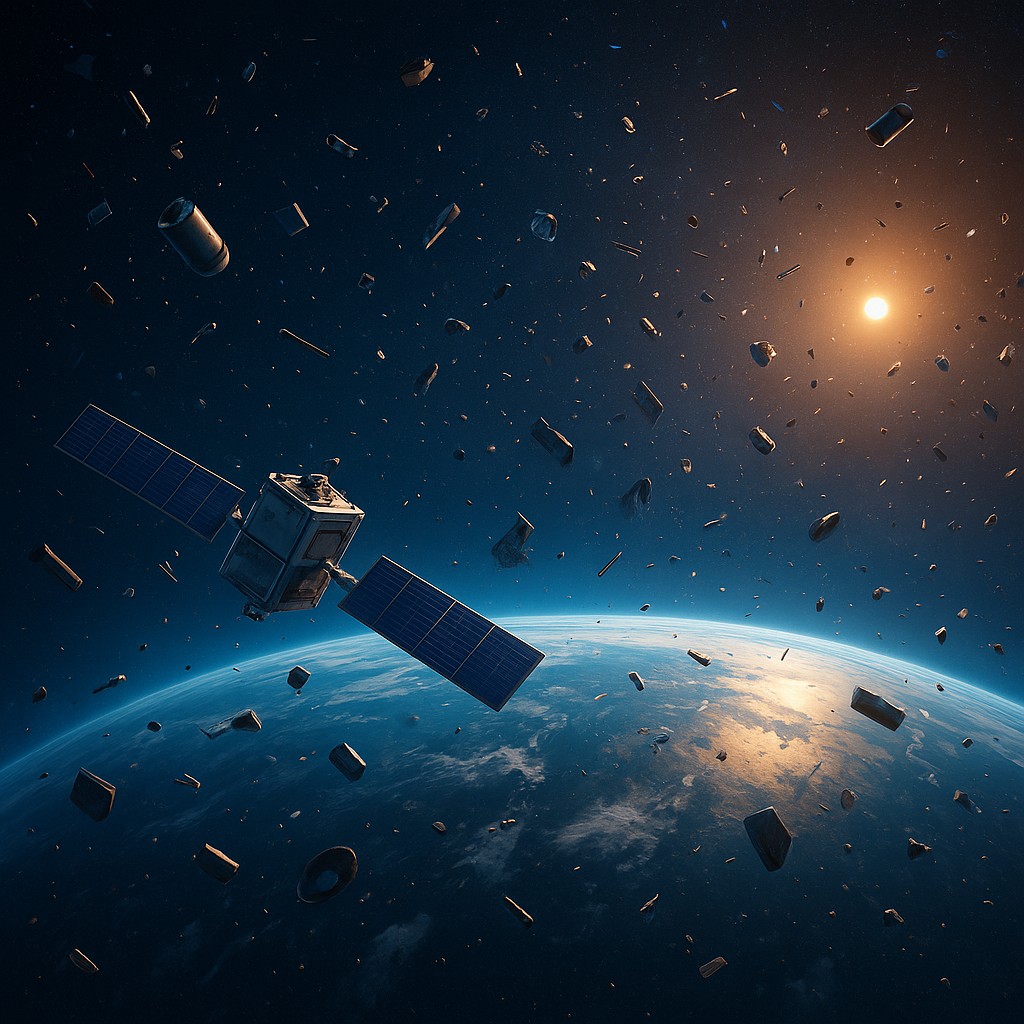
Imagine standing on the deck of a ship in the middle of the Atlantic, looking out at the horizon. It feels infinite, doesn't it? For decades, we viewed the space around our planet through that same lens. We saw it as a vast, empty void where we could toss up satellites, rocket boosters, and scientific probes without a second thought. After all, space is enormous, and a rogue nut or bolt floating around up there is essentially a grain of sand in the Sahara. But we have reached a point where the "Big Sky" theory, the idea that space is so large it can absorb any amount of junk, is starting to crack under the weight of thousands of tons of metal.
The problem isn't just that we are putting more objects into orbit, but that these objects do not stay where they belong. When a satellite reaches the end of its life, it doesn't just disappear. It stays there, circling the Earth at speeds that would make a bullet look like it was standing still. At these velocities, even a tiny fleck of paint can hit with the force of a bowling ball. We are now facing a scenario where one bad day in orbit could trigger a chain reaction that locks us out of the heavens for centuries, a phenomenon known as the Kessler Syndrome.
The High-Speed Physics of Orbital Pinball
To understand why a few pieces of junk are so dangerous, we have to talk about kinetic energy. In our daily lives on Earth, if you drop a teaspoon on your toe, it might hurt, but it won't require a surgical team. If 그 same teaspoon is orbiting at 17,500 miles per hour, it carries enough energy to blow a hole through a reinforced titanium hull. Because everything in Low Earth Orbit (LEO) is moving at these extreme speeds, collisions are not just "bumps," they are energetic events that resemble small explosions. When two large objects, like a defunct Soviet-era satellite and a dead communication probe, smash into each other, they don't just stop.
Instead, they shatter. A single collision can produce tens of thousands of fragments larger than a marble and millions of pieces smaller than a grain of salt. Each one of those new fragments then becomes a high-speed projectile, orbiting the Earth on its own path. This is the "domino effect" that Donald Kessler warned us about back in 1978. He theorized that once the density of objects in a particular orbit reaches a certain point, a single crash creates a cloud of debris that inevitably strikes other objects. This creates more debris, which strikes more satellites, until the entire orbital path is filled with a lethal swarm of shrapnel.
The Growing Graveyard Above Our Heads
When we look at the night sky, we see a peaceful expanse of stars, but the reality is much more cluttered. There are currently thousands of active satellites providing us with GPS, internet, weather data, and national security surveillance. Tucked between them are tens of thousands of tracked pieces of "space junk," including discarded rocket stages, frozen patches of coolant, and even tools dropped by astronauts. Below that size, experts estimate there are over a million fragments smaller than a centimeter. These are completely untrackable but still capable of causing "lethal non-trackable" damage.
The density of this debris is highest in Low Earth Orbit, the region between 100 and 1,200 miles above the surface. This is the prime real estate of the space age because it is the easiest and cheapest area to reach. However, because it is so popular, it is also the most vulnerable to the Kessler Syndrome. If a cascade begins here, it would do more than just destroy a few expensive machines. It would create a permanent, high-energy barrier that makes it impossible for us to launch through that layer to reach the Moon, Mars, or anywhere else. We would effectively be trapped under a shell of our own making.
Comparing the Scales of the Orbital Environment
To visualize the sheer scope of the challenge, it helps to look at the different categories of objects we are currently trying to manage. The volume of material is staggering when you consider that we only started launching things in 1957.
| Object Category |
Approximate Count |
Risk Level |
Mitigation Strategy |
| Active Satellites |
9,000+ |
Low (Maneuverable) |
Collision Avoidance Maneuvers |
| Tracked Debris (>10cm) |
35,000+ |
High (Predictable) |
Constant Monitoring & Shielding |
| Small Debris (1cm to 10cm) |
1,000,000+ |
Severe (Untrackable) |
Heavy Whipple Shielding |
| Microscopic Dust (<1mm) |
100 Million+ |
Low to Medium |
Surface Erosion Protection |
As the table shows, the "danger zone" is that middle tier of small debris. We can see the big objects and move out of their way, but the millions of tiny shards are invisible until they have already punctured a million-dollar sensor. This is why "space traffic management" is becoming the most important job you have never heard of. If we do not treat the orbital environment as a finite resource, like a national park or a clean river, we will inevitably pollute it beyond the point of no return.
Why Space Can No Longer Be a Free-For-All
In the early days of the Space Race, there were no rules. If you had a rocket, you could go wherever you wanted and leave behind whatever you liked. Today, that lack of oversight is catching up with us. We often hear that space is "filling up," but that is a bit of a misnomer. Space is not full of physical objects in the same way a closet is full of clothes. Instead, it is becoming full of "risk." Every new satellite constellation, like the massive "mega-constellations" intended for global internet, adds thousands of new targets for debris to hit.
This has shifted the conversation from exploration to sustainability. Modern satellite operators are now required to prove they have a "de-orbit plan." This usually involves saving enough fuel to push the satellite back into the Earth's atmosphere so it burns up safely at the end of its life. But what happens if a satellite breaks down before it can move? And what about the thousands of objects already up there that have no engines? We are now seeing the birth of the "space janitor" industry, where companies are designing robotic harpoons, nets, and magnetic arms to physically grab old debris and pull it down.
Correcting the Myths of the Cosmic Barrier
One of the biggest misconceptions about the Kessler Syndrome is that it would happen all at once, like an explosion in a Hollywood movie. In reality, it is a slow-motion disaster. It might take decades for the chain reaction to fully play out. A collision today makes a collision five years from now slightly more likely, which makes a collision ten years from now even more probable. If we do not intervene, we might wake up in fifty years and realize that we can no longer send humans into orbit safely. By then, it will be too late to clean it up.
Another myth is that the debris will eventually just fall back to Earth. While the Earth's atmosphere does extend slightly into space and creates "drag" that pulls objects down, this process is incredibly slow at higher altitudes. A piece of junk at 300 miles might fall in a few years, but something at 600 miles could stay up there for centuries. We cannot rely on nature to do the housekeeping for us. We have to manage the kinetic energy we have introduced into the environment, treating every bolt and screw as a potential threat to our technological civilization.
Preserving the Gateway to the Stars
The Kessler Syndrome represents a unique challenge for humanity because it is a problem of our own success. We have become so good at reaching space that we are now crowding ourselves out of it. However, identifying the problem is the first step toward solving it. By developing better tracking systems, international laws for traffic management, and innovative ways to remove existing junk, we can ensure that the "final frontier" remains open for the generations that follow us.
Imagine a future where space is treated with the same reverence as our most pristine oceans or ancient forests. It is a place of infinite potential, a laboratory for new technologies, and a launchpad for the human spirit. By respecting the delicate balance of orbital physics and taking responsibility for the traces we leave behind, we do more than just protect our satellites. We protect our ability to dream, to explore, and to one day step beyond the cradle of Earth into the wider cosmos. The sky is not the limit; it is a garden that we must tend with care.