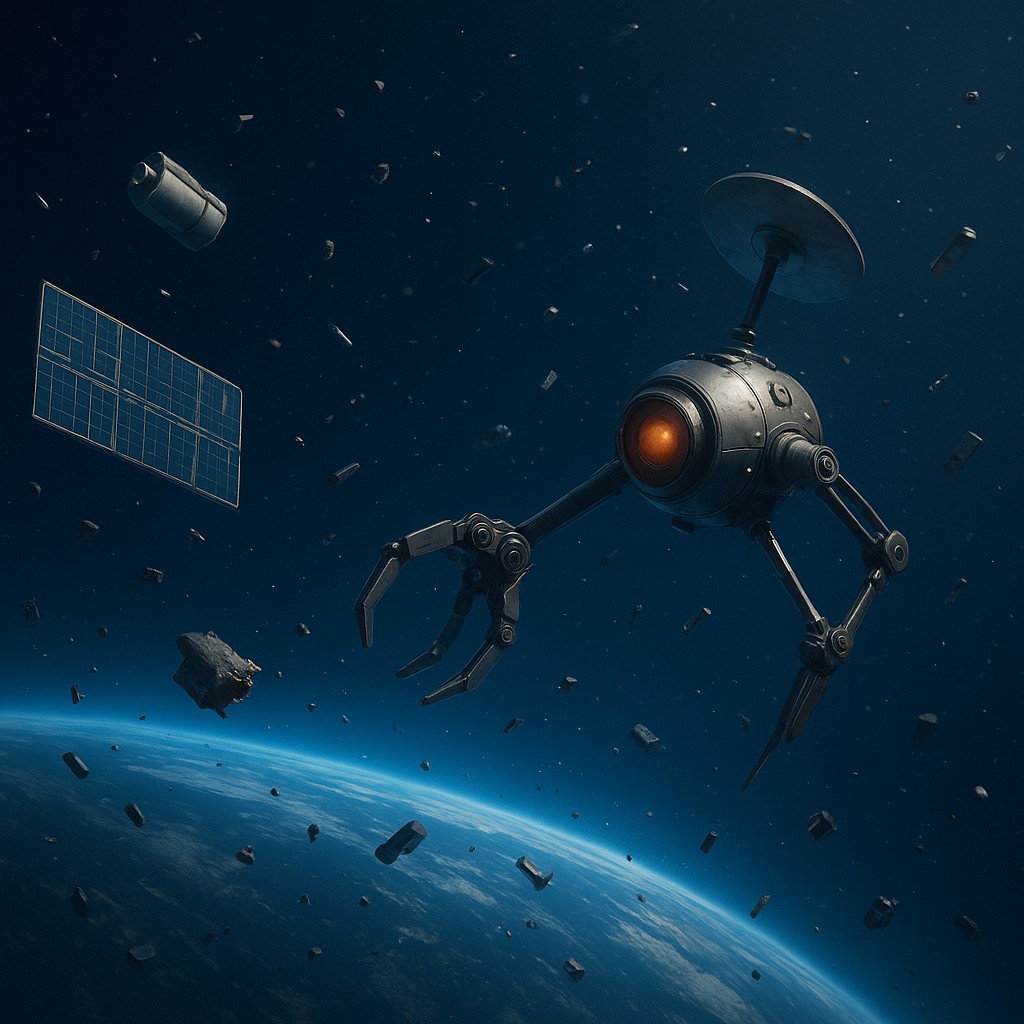
Imagine standing in a pitch-black room miles wide, where thousands of invisible bowling balls are flying around at 17,500 miles per hour. This sounds like a scene from a stressful sci-fi movie, but it is a real-world description of Low Earth Orbit (LEO) today. For decades, we treated space as a bottomless trash can. We launched satellites and simply abandoned them when their batteries died or their computers crashed. This "out of sight, out of mind" attitude has turned our orbital highways into a crowded mess where a single stray bolt can strike with the force of a hand grenade.
The situation has reached a breaking point known as the Kessler Syndrome. This is a scenario where there are so many objects in orbit that every collision creates a new cloud of debris, which then triggers even more crashes. This chain reaction could eventually make certain orbits completely unusable, trapping humanity on Earth behind a cage of our own trash. To prevent this orbital disaster, the global community is moving from avoiding the mess to cleaning it up. We are no longer just dodging junk; we are building robotic garbage trucks equipped with magnets, harpoons, and nets to hunt down debris and drag it back to burn up in Earth's atmosphere.
The High-Speed Cost of Space Litter
To understand why we must go out and physically grab old satellites, we first have to respect the sheer violence of physics in orbit. In the vacuum of space, there is no air to slow things down. When a satellite "dies," it does not just stop; it stays in motion, acting like a projectile moving ten times faster than a bullet. If two large objects - like an old Soviet rocket body and a retired weather satellite - hit each other at these speeds, they do not just get dented. They undergo "catastrophic fragmentation," shattering into thousands of jagged pieces that each become a new, unguided missile.
While we are excellent at tracking large objects like satellites the size of a school bus, we are surprisingly bad at tracking small debris. Radar currently monitors about 34,000 objects larger than ten centimeters, but experts estimate there are over 128 million fragments smaller than one centimeter. These tiny "paint chips" or metal shards move so fast they can punch through the hull of a space station or wreck a billion-dollar telescope. Since we cannot easily clear away millions of tiny flecks, our best strategy is to remove the "parent" objects before they break apart. This logic drives the new push for Active Debris Removal (ADR).
Magnets and Harpoons in the Final Frontier
On Earth, catching a moving car is straightforward for a tow truck. In space, catching a "tumbling" satellite that has no power and no pilot is an engineering nightmare. Several companies and space agencies are testing different "capture tools" to solve this. One promising method uses powerful magnetic docking systems. Since many satellites contain magnetic metals and steel, a chase craft can approach the target and use a high-tech magnetic plate to "stick" to the junk. This method is elegant because the debris does not need a special docking port; it just needs to be metallic.
However, not all junk is magnetic, and some objects spin so wildly that touching them with a magnet would be like trying to grab a spinning saw blade. For these chaotic targets, engineers are looking at more aggressive mechanical tools. This includes firing titanium harpoons to spear the target or throwing massive, high-strength nets that wrap around the debris like a spider web. Once the "prey" is caught, the "hunter" satellite uses its engines to pull the junk toward Earth. As they hit the upper layers of the atmosphere, the friction of the air creates intense heat, vaporizing both the trash and the collector in a final, intentional blaze of glory.
Navigating the Legal Maze of Space Salvage
Technology is only half the battle. Space is a legal "wild west" governed by treaties written during the Cold War. Under the Outer Space Treaty of 1967, every object launched into space remains the property and responsibility of the nation that launched it forever. This means if a private company from Switzerland wants to remove a piece of old American or Russian junk, they technically need permission from that country first. Grabbing someone else’s satellite without a permit is more than a breach of manners; it could be seen as an act of war or a test of a space weapon.
New international agreements are being drafted to create "Good Samaritan" laws for orbit. These rules aim to make it easier to identify high-risk debris and grant permission for third-party cleanup services to do their work. We are seeing a shift in how we define space junk, moving from "abandoned property" to an "environmental hazard." This legal change is vital because it creates a commercial market for cleaning up. If a company can get paid a "bounty" to remove a dangerous rocket, the private sector will likely innovate much faster than government agencies alone.
| Capture Method |
Primary Tool |
Best Used For |
Risk Level |
| Magnetic Capture |
Magnetic Docking Plate |
Heavy steel objects that aren't spinning |
Low (no physical impact) |
| Net Capture |
Expanding Mesh Net |
Small to medium tumbling fragments |
Medium (debris might tear net) |
| Harpoon Capture |
Titanium Barbed Spear |
Large rocket bodies with thick walls |
High (can create more debris) |
| Robotic Arm |
Multi-jointed Grapple |
Cooperative or stable satellites |
Low (highly precise) |
From an Infinite Void to a Managed Resource
The most significant change brought by these missions is not the hardware, but our change in perspective. For the first fifty years of the space age, humanity viewed the vacuum above us as an infinite void. We treated it the same way we treated the oceans in the 1800s, assuming the environment was so big that our mistakes would just wash away. We now know that space is a limited resource. There are only so many "lanes" in orbit where satellites can safely work, and we are running out of room.
By treating space like valuable real estate that needs maintenance, we are finally growing up as a spacefaring species. We are beginning to use "circular economy" thinking, where satellites are designed to be repaired, refueled, and safely removed when they fail. Some modern satellites are even being built with "tow hooks" or magnetic docks to make it easier for future janitors to pick them up. This proactive design ensures the next generation of explorers will not have to clean up the mess of the previous one.
Cleaning up our orbit is perhaps the greatest engineering challenge of this century. It requires us to be both incredibly precise and remarkably humble. We are learning that our reach into the stars depends on how well we keep our own backyard clean. As harpoons fly and magnets click into place miles above our heads, we are doing more than moving metal; we are keeping the window to the universe open. There is a quiet beauty in the idea that the same ingenuity that got us into the stars is now being used to protect the path that leads there.