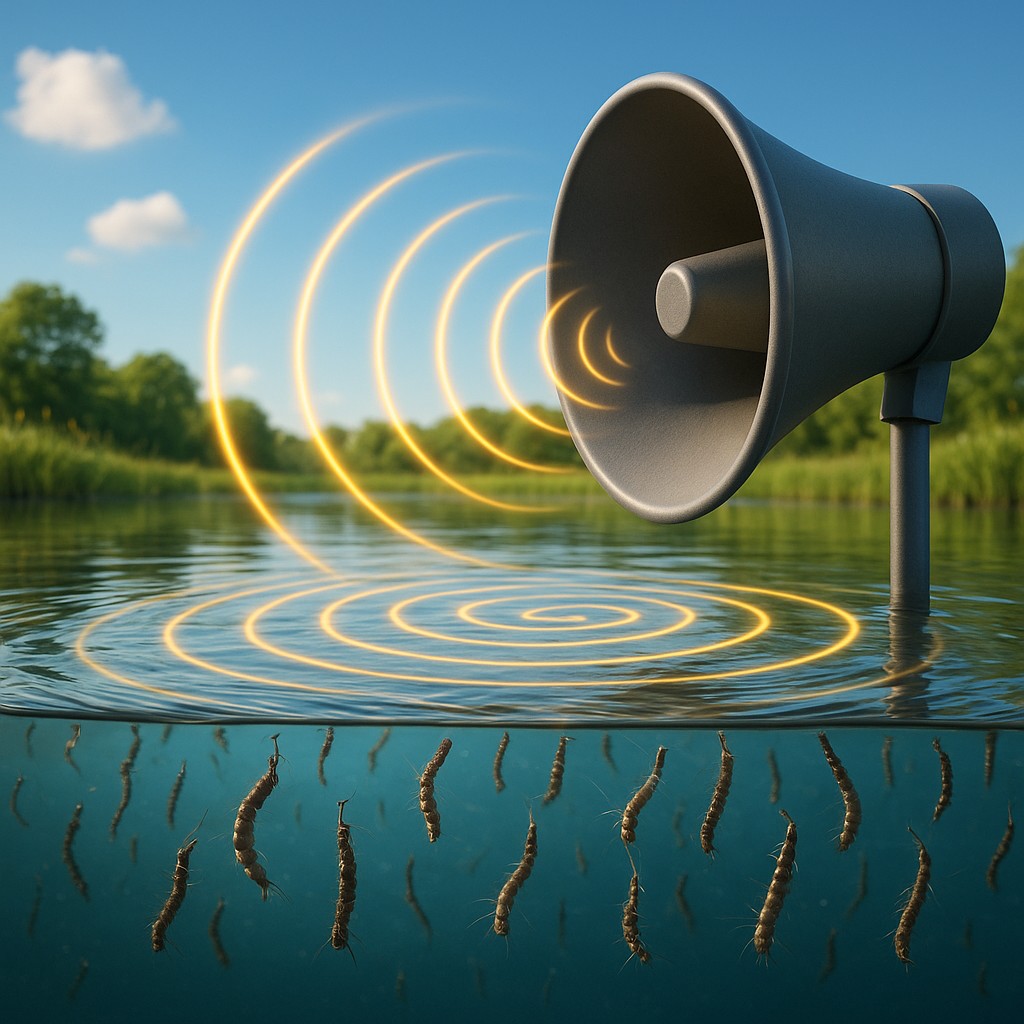
Imagine standing beside a quiet, forgotten pond behind a suburban park. The surface looks like a perfect mirror reflecting the sky, but just beneath that glassy boundary, a biological war is breaking out. Thousands of mosquito larvae hang upside down, their bodies twitching in a frantic dance to stay afloat while they breathe through tiny snorkels. For decades, our main weapon against these pests has been chemistry, a constant barrage of oils, bacterial toxins, and nerve agents designed to poison the water. But evolution is a patient strategist. Mosquitoes are rapidly building resistance to our best laboratory mixtures, leaving public health officials searching for a more reliable way to clear the water.
In a fascinating shift, engineers have decided to stop fighting with poisons and start fighting with physics. Instead of trying to disrupt a mosquito’s complex biology, they are targeting its physical structure using nothing but sound. Public health agencies are now deploying "acoustic larvicides," devices that send specific sound frequencies through standing water to turn a larva's own body against it. It is a clean, surgical, and surprisingly violent solution to a global health problem, relying on the laws of vibration rather than the uncertainty of poison. By seeing how these sound waves hit biological structures, we can understand a new frontier in pest control that feels more like science fiction than traditional sanitation.
The Physical Weakness of a Tiny Scuba Diver
To understand why sound can be a lethal weapon, we first have to look at how a mosquito larva is built. Unlike fish, which use gills to pull oxygen from the water, most mosquito species are "obligate air-breathers." They have specialized tubes called siphons at their tails that they poke through the water's surface. To stay upright and active while they feed on algae and bacteria, they use internal gas-filled pipes called dorsal tracheal trunks. These act as both a breathing system and a life jacket, keeping the larva at the right depth without it having to swim constantly.
These air pockets are the larva's greatest asset and its fatal flaw. Because air can be squeezed much more easily than water, it reacts differently to pressure changes. If you submerge a balloon in a pool and squeeze the water, the water doesn’t change size much, but the balloon shrinks instantly. In the microscopic world of a stagnant pond, these breathing tubes are like those tiny balloons. They are pockets of air surrounded by soft, wet tissue. This setup is perfect for a phenomenon called resonance, where a structure vibrates more and more violently when hit by a specific frequency.
In the case of acoustic larvicides, the goal isn't just to annoy the larvae; it is to cause a complete mechanical breakdown. When the sound waves hit the larvae, the air inside their tubes begins to shake. If the frequency is tuned correctly, these vibrations become so intense that the air pockets expand and contract with enough force to tear the surrounding organs apart. It is the biological version of a singer hitting a high note that shatters a wine glass, except here, the "glass" is the breathing system of a future disease-carrier.
Riding the Waves of Instant Destruction
The magic of this technology lies in how sound moves through liquid. When a sound-producing device (a transducer) is placed in water, it sends out pressure waves, which are essentially cycles of high and low pressure. In the "high" phase, water molecules are pushed together; in the "low" phase, they are pulled apart. For a human swimming in the water, these pressure changes are too small to notice. However, for a microscopic creature with a gas-filled cavity, these changes feel like a series of rapid-fire hammer blows.
Once the sound reaches the larva, the gas in the breathing tubes experiences "acoustic cavitation," or extreme vibration. This causes the internal gas to be forced out or the tube walls to collapse entirely. The result is an immediate loss of buoyancy and the total destruction of the tissue used for breathing. The larva doesn't just "die" in the way it would from being poisoned; it is physically dismantled from the inside out. Within seconds of hitting the right frequency, the larvae lose their ability to stay at the surface, sink to the bottom, and die almost instantly.
| Feature |
Chemical Larvicides |
Acoustic Larvicides |
| Method |
Biochemical disruption (poison) |
Physical resonance (rupture) |
| Speed |
Hours to days |
Seconds to minutes |
| Resistance |
High risk (mosquitoes evolve) |
Low risk (physics is constant) |
| Eco-Impact |
Risk of runoff and residue |
No residue, localized sound |
| Selectivity |
Varies by chemical type |
Tuned to specific sizes |
| Target Stage |
Feeding larvae |
All gas-holding aquatic stages |
Avoiding Collateral Damage in the Water
A common concern with any new weapon is whether we are accidentally hurting other creatures. If we are blasting sound waves into a pond, what happens to the frogs, dragonflies, and fish? This is where the precision of physics helps. The effectiveness of an acoustic larvicide depends entirely on the "resonant frequency" of the target. This frequency is set by the size and shape of the gas-filled tube. Because mosquito larvae fall into a very specific size range, they react to frequencies that larger or smaller animals simply ignore.
Fish, for example, have swim bladders that are much larger and thicker than a mosquito's breathing tube. The frequency needed to burst a mosquito larva is far too high to cause problems for the much larger lungs or bladders of vertebrates. It is like trying to knock over a skyscraper by shaking it at the same speed you would ring a hand-bell; the energy just doesn't transfer. Furthermore, many aquatic plants are made of tough fibers or water-filled cells that don’t vibrate easily, making them "invisible" to the acoustic attack.
However, the technology isn't completely without risk. There are other small water insects, such as midges, that use tiny air bubbles to breathe. If these insects are the same size as mosquito larvae, they could be caught in the crossfire. This is why calibration is the most important part of the job. By fine-tuning the frequency and the length of the sound bursts, engineers can protect other species while maximizing the kill rate for the mosquitoes.
Ending the Arms Race Against Pesticides
One of the most exhausting parts of public health is the "evolutionary arms race." When we spray a chemical, 99 percent of the mosquitoes might die, but the remaining 1 percent has a lucky genetic mutation that helps them survive. Those survivors breed, and soon, we have a population that can eat our pesticides like vitamins. This forces scientists to constantly invent newer, more toxic chemicals, leading to a cycle of tougher and tougher bugs.
Acoustic larviciding offers a way out. It is much harder for a creature to "evolve" a way around the basic laws of physics. To become immune to sound-induced rupture, a mosquito larva would have to fundamentally change its body, perhaps by getting rid of its air tubes or growing a shell so thick it couldn't move. Neither of these is a likely path for an insect that needs to float and grow quickly. By switching from a chemical attack to a physical one, we use a weapon that doesn't lose its edge over time.
Additionally, this method helps protect water quality. In many parts of the world, mosquito breeding grounds are also the main sources of drinking water or the water used for farming. Dousing these areas in chemicals is often a desperate choice between two evils. Acoustic devices, which can be mounted on drones, helicopters, or handheld poles, leave behind nothing but silence. Once the device is turned off, the water is exactly as it was before, minus the several thousand insects that would have spread malaria, Zika, or West Nile virus.
Practical Steps in the Field
When public health agencies use this technology, they don't just drop a speaker in a swamp and press "play." It requires a deep understanding of the environment and the specific species they are targeting. The process usually involves several key steps:
- Scouting and Mapping: Finding "hot spots" where lots of larvae live. This is vital because sound waves weaken as they travel through water, so the closer the device is to the larvae, the better it works.
- Frequency Calibration: Testing local larvae to see exactly how old they are. Younger, smaller larvae might need a different frequency than older, larger ones, as their air tubes change size as they grow.
- Controlled Pulsing: Instead of a steady hum, the devices often use "pulsed" sound waves. This creates high-intensity pressure shocks that are better at breaking the larvae's structures than a steady vibration.
- Monitoring and Checking: Using simple water tests to confirm that the larvae have sunk to the bottom and died, ensuring the area is clear before moving the equipment to the next spot.
This shift toward physics-based control is part of a bigger trend in modern ecology. We are learning that we don't always need to out-poison nature; sometimes, we just need to understand its physical limits. By finding the literal "vibrational weak point" of one of humanity's oldest enemies, we are building tools that are safer for us, deadlier for them, and far better for the planet.
As we look toward a future where cities and wetlands are managed with more precision, it is inspiring to see that the solutions to our hardest biological problems might be found in the simplest rules of motion and pressure. The next time you walk past a still pond and don't hear the whine of a mosquito swarm, remember that there might be a silent symphony of physics playing just beneath the surface, keeping the world a little safer through the power of sound.