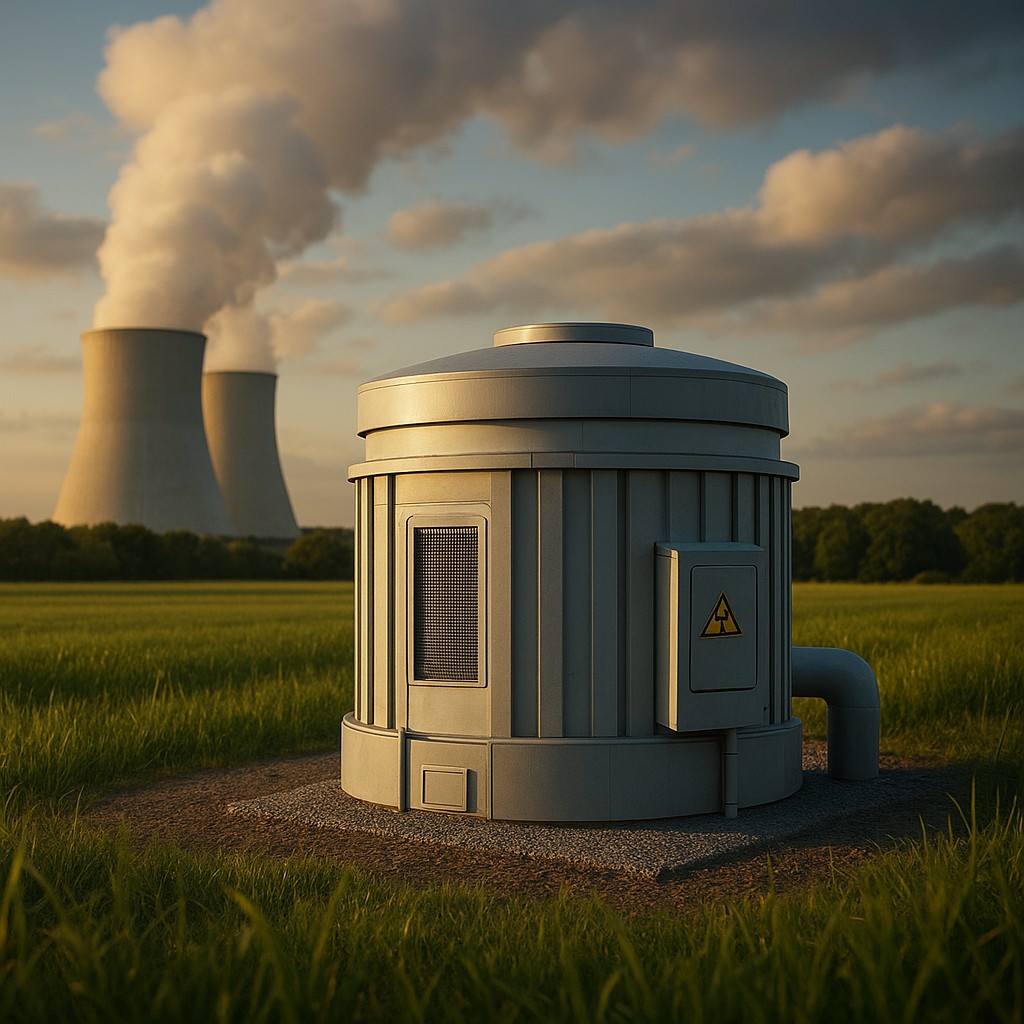
For decades, our image of nuclear power has been defined by the massive concrete structures of the mid-twentieth century. We think of sprawling complexes and towering cooling vents releasing plumes of white steam into the sky. These industrial giants were built with a "bigger is better" mindset, designed to supply electricity to entire cities from a single, central hub. While they are effective, their massive scale requires billions of dollars in upfront costs and decades of planning. They also rely on a complex web of active safety systems that need constant electricity and human oversight to keep things running smoothly.
A quiet revolution, however, is shrinking this technology down to a human scale. Imagine a nuclear reactor so compact it could be built in a factory, shipped on a flatbed truck, and installed in a fraction of the time it takes to build a traditional plant. These are Small Modular Reactors (SMRs), and they represent a fundamental shift in how we use atomic energy. By rethinking the physics of cooling and containment, engineers have created a system that offers more than just power; it provides a self-sustaining level of safety that works even if the lights go out and the operators go home.
The Strength of Thinking Small
The "M" in SMR stands for modular, which is the biggest change from traditional nuclear engineering. In the past, every nuclear plant was a custom construction project built on-site with thousands of workers and unique local hurdles. SMRs flip this approach by treating the reactor more like a jet engine or a car. They are designed for assembly lines in controlled factory environments where quality is easier to manage. Once finished, these modules are hauled to their destination and plugged into the power grid like giant, high-tech batteries.
This modular design does more than just lower the cost of clean energy; it offers incredible flexibility. If a remote mining town or a massive data center needs more power, they do not have to build a giant plant that produces more energy than they can use. Instead, they can start with one module and add a second or third as their needs grow. This "LEGO-style" approach makes nuclear power accessible to places the industry used to ignore, from island nations to isolated military bases. It provides a steady baseline of carbon-free electricity that does not depend on the sun shining or the wind blowing.
Natural Physics as a Safety Net
The most clever feature of many SMR designs is "passive safety." In a traditional large reactor, the core generates intense heat that must be constantly moved away by powerful electric pumps. If those pumps fail and the backup generators do not start, the heat builds up, which can lead to a meltdown. SMRs solve this by using the laws of thermodynamics. Because the reactor core is small, it can be submerged in a large pool of water or a special liquid coolant that moves through natural convection.
Natural convection is the same principle that causes hot air to rise in a room. As the water near the reactor core heats up, it becomes lighter and rises to the top, while cooler, heavier water sinks to take its place. This creates a continuous, self-circulating loop. No pumps, no electricity, and no human commands are needed to keep the water moving. Even in a total "station blackout" where the facility loses all outside power, the physical properties of the water itself carry the heat away from the core and release it safely. This design makes the reactor "walk-away safe," providing a level of security that once seemed like science fiction.
Comparing the Giants to the Newcomers
To see how much the industry is changing, it helps to look at the numbers and design philosophies that separate the old guard from the new wave. Traditional plants are triumphs of engineering, but SMRs are triumphs of efficiency.
| Feature |
Traditional Large-Scale Reactors |
Small Modular Reactors (SMRs) |
| Power Output |
1,000 to 1,600 Megawatts |
10 to 300 Megawatts |
| Construction |
Built on-site (Years or Decades) |
Factory-built modules (Months or Years) |
| Cooling System |
Active pumps and external towers |
Passive natural convection |
| Size |
Covers hundreds of acres |
Compact, often fits on a small lot |
| Safety Mechanism |
Complex backup electrical systems |
Inherent physics and built-in containment |
| Ideal Location |
Near large cities and major water sources |
Remote areas, industrial hubs, microgrids |
As shown in the table, this shift is about more than shrinking the hardware; it is about making it smarter. While a large plant might power a million homes, an SMR could power a specific factory or a small city with much less infrastructure. By removing the need for iconic, towering cooling vents, SMRs also have a much smaller visual and environmental footprint. The containment is "functional," meaning the reactor vessel and its surroundings are designed to trap any potential leaks within a small, manageable space, often underground. This adds extra protection against outside threats or accidents.
Redefining the Nuclear Waste Conversation
Despite the promise of SMRs, they are not a magic fix for the long-standing challenges of nuclear energy. The main concern remains the same as it was in the 1970s: radioactive waste. While SMRs are exceptionally safe to operate, they still produce spent fuel that stays hazardous for thousands of years. Some critics even point out that because SMR cores are smaller, they might actually produce more waste for every unit of electricity they generate compared to larger plants.
The industry is now racing to standardize how this waste is handled. In the past, waste management was often an afterthought. With SMRs, the goal is to build waste management into the modular design from the start. Some designs propose using "spent" fuel from older reactors to power the new modular units, essentially recycling hazardous material into more energy. However, international regulators and local governments are still working on a unified plan for how these small batches of waste will be collected, moved, and stored. Moving toward a "local" energy model means we must also find safe, acceptable ways to manage its byproducts on a local scale.
Empowering the Cities of Tomorrow
The true value of the SMR movement is its ability to decentralize energy. For the last century, we have lived in a world of centralized power, where electricity is generated far away and sent across thousands of miles of vulnerable wires. SMRs allow us to imagine a different future. Picture a hospital or a water treatment plant with its own dedicated, carbon-free power source tucked away on the property. Think of remote Arctic communities that currently rely on expensive, polluting diesel fuel flown in by plane, finally having a "plug-and-play" energy source that lasts for years without refueling.
This evolution is about more than just physics; it is about resilience. By shrinking the reactor and automating its safety, we have created a tool that helps us fight climate change while making our energy supply more secure. We are moving from a world that feared the complexity of the atom to one that respects its potential as a reliable, local neighbor. As we perfect the manufacturing process and the rules for waste, the Small Modular Reactor is ready to start a new chapter in history, proving that the biggest revolutions often come in the smallest packages.