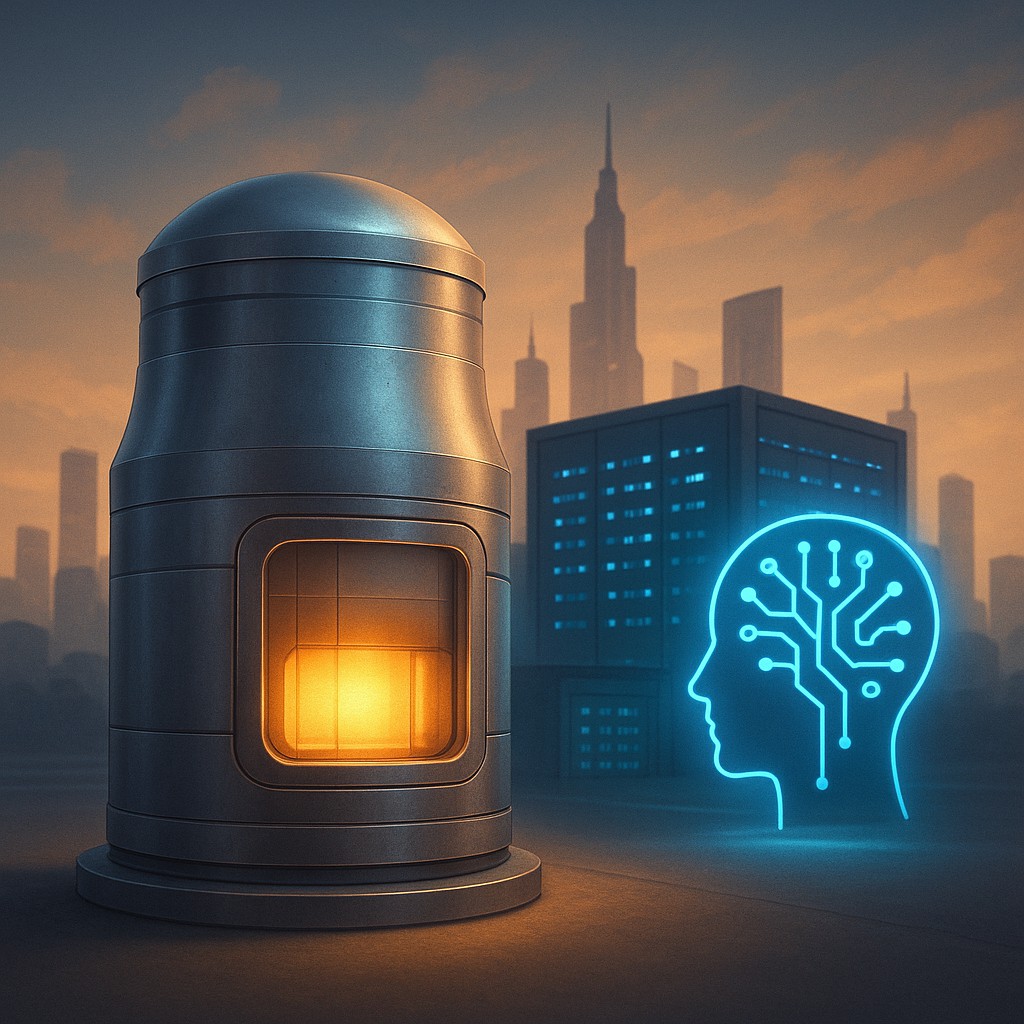
Every time you ask an AI to write a poem about a toaster or summarize a complex legal contract, you trigger a silent, energy-hungry chain reaction. Deep inside a distant data center, thousands of high-performance chips roar to life, gulping down electricity at a rate that would shock a Victorian industrialist. We are currently living through a digital gold rush, but instead of using pickaxes, we are using GPUs. The problem is that our power grid is essentially a network of old, narrow pipes trying to handle a sudden, massive flood. Tech giants are realizing that the lights of progress might flicker out if they cannot find a way to power these "silicon brains" without crashing the neighborhood's air conditioning.
This tension has sparked a surprising comeback for an industry many thought was becoming a relic of the past. Nuclear power is getting a total makeover, trading the image of giant concrete cooling towers for something sleeker, smaller, and more flexible. These are called Small Modular Reactors, or SMRs. They represent a major shift in how we build infrastructure. Instead of building one massive power plant and hoping the wires can carry the electricity where it needs to go, companies want to build the power source right in their own backyard. It is a move toward energy independence that mirrors the way we moved from giant mainframe computers to the smartphones in our pockets.
The Hungry Beast in the Server Room
To understand why we are suddenly talking about nuclear reactors and chatbots in the same breath, we have to look at the sheer scale of AI’s appetite. A standard Google search uses very little power, but a request handled by a large language model requires much more "heavy lifting." Data centers are no longer just warehouses for hard drives; they are becoming massive heat engines. Experts suggest that by the mid-2030s, these facilities could account for nearly 10 percent of all electricity demand in the United States. This surge is happening just as we are trying to shut down old coal plants, creating a "power gap" that wind and solar cannot always fill because the sun doesn't always shine and the wind doesn't always blow.
AI systems require what engineers call "baseload" power. This is the steady, reliable flow of electricity that stays constant 24 hours a day, seven days a week. While batteries are getting better, storing enough solar energy to run a massive data center through a week of cloudy weather is currently an expensive logistical nightmare. This reliability is why nuclear energy looks so good to companies like Google, Microsoft, and Amazon. They aren't just looking for green energy; they want "always on" green energy that doesn't change with the weather report.
By putting a dedicated power source next to a data center, companies can skip the "traffic jams" of the national grid. Our existing power lines are often crowded, and building new high-voltage lines can take decades due to legal and environmental hurdles. If a tech company can build a self-sufficient "energy island," they can grow their AI business as fast as they can plug in new servers, rather than waiting for a utility company to upgrade the local equipment. It is a total break from the old centralized model, turning data centers into their own private power companies.
Shrinking the Giant to Fit the Backyard
The word "nuclear" often brings up images of the massive complexes of the 1970s, which were multibillion-dollar projects built by hand. These traditional plants are so big and complicated that they often take over a decade to build and routinely go way over budget. Small Modular Reactors are the industry's answer to that inefficiency. As the name suggests, they are much smaller, usually producing about a third of the power of a standard reactor. But the real secret is that they are "modular."
In the world of SMRs, reactors aren't built from scratch on-site; they are made in a factory like airplanes or cars. This assembly-line method allows for much better quality control and saves a lot of money over time. Once a unit is finished, it can be shipped by truck or train to its destination and simply "plugged in." This makes it easy to grow. If a data center needs more power, the company doesn't need to design a whole new plant; they just add another module to the site, much like adding LEGO blocks to a tower.
Beyond their size, many SMR designs use advanced cooling methods that make them naturally safer than older models. While traditional reactors rely on complex pump systems to keep the core cool, many SMRs use "passive safety." These designs rely on basic physics, like gravity and natural heat flow, to move coolant around. This means that even if the power goes out and the computers fail, the physics of the reactor itself will keep it from overheating. It is a "fail-safe" design that greatly reduces the risk of the kinds of accidents that have hurt the industry's reputation in the past.
Comparing the Old Guard and the New Wave
When we look at how nuclear technology has evolved, the differences between the giant plants of the past and the modular units of the future are clear. It helps to see them side-by-side to understand why Silicon Valley is betting so much on the newer version.
| Feature |
Traditional Large Reactors |
Small Modular Reactors (SMRs) |
| Power Output |
1,000+ Megawatts |
50 to 300 Megawatts |
| Construction |
Built on-site (Custom/Bespoke) |
Factory-assembled (Modular) |
| Footprint |
Needs massive amounts of land |
Compact; fits on existing industrial sites |
| Safety Systems |
Active (needs pumps and power) |
Passive (uses gravity and natural cooling) |
| Upfront Cost |
Massive (Tens of billions) |
Lower, scalable investment |
| Time to Build |
10 to 15+ years |
Goal of 3 to 5 years (once established) |
This table shows that SMRs aren't just smaller versions of the same thing; they represent a completely different way of doing business. For a tech company, the ability to start small and grow is much better than spending 20 billion dollars on a project that might not be finished until the AI world has moved on. Being modular gives them the speed and flexibility that matches the fast-paced culture of the software world.
Navigating the Regulatory Hurdles
If SMRs are so efficient, safe, and easy to grow, you might wonder why they aren't everywhere yet. The reality is that while the technology is exciting, the legal and social paths are still being cleared. For very good reasons, nuclear energy is one of the most strictly regulated industries on the planet. Every new reactor design must go through years of intense testing by safety boards. Even though SMRs are designed to be safer, they still have to prove they meet the same gold standard for security and reliability as the giants. That process involves mountains of paperwork and millions of dollars in legal fees.
Then there is the question of nuclear waste. Even a small reactor creates used fuel that stays radioactive for thousands of years. While the amount of waste from an SMR is relatively small, deciding where to put it is still a huge political fight. Right now, many countries store waste temporarily at the reactor sites because permanent underground storage is stuck in endless political debate. For a tech company, taking care of nuclear waste is a massive long-term responsibility that requires security and oversight far beyond what a normal data center handles.
Security is another big piece of the puzzle. Because nuclear reactors contain sensitive materials, they need armed guards, constant surveillance, and strict "no-go" zones. Mixing a high-security nuclear site with a high-tech data center is complicated. Companies have to protect their "energy island" from physical threats as well as digital hackers. This extra layer of complexity is the "price of admission" for leaving the public grid, and right now, only the wealthiest companies in the world can afford it.
The Era of the Energy-Independent Tech Giant
The pairing of AI and SMR technology marks a turning point in history. We are moving away from the massive, centralized power models of the 20th century toward a more local, spread-out future. In this new world, companies like Microsoft or Google are no longer just software providers; they are becoming energy producers and infrastructure builders. This allows them to control their own destiny, making sure their AI labs have the fuel they need without competing with local residents for power during a heatwave.
This shift could also help the rest of society. As tech giants pay for the early development and testing of SMR technology, the costs for everyone else will likely drop. Much like how early satellite technology was a luxury for the military but eventually gave us GPS, this AI-driven nuclear comeback could lead to clean reactors that power remote hospitals, turn seawater into drinking water, or provide carbon-free heat for heavy industry. Today’s server rooms are basically acting as labs for tomorrow’s clean energy.
Ultimately, the story of AI and nuclear power is about where our digital dreams meet physical reality. We want a world where AI can help cure diseases and solve climate change, but we have to power those dreams without making the planet's problems worse. By shrinking the reactor and bringing the power directly to the data, we are seeing the birth of a more resilient and sustainable digital age. It is a reminder that even the most advanced software is ultimately tied to the physical reality of atoms and energy.
As we look ahead, imagine a future where the data center down the road isn't a drain on the local power supply, but a silent, clean, and self-contained marvel of engineering. The transition will have its share of bumps, and the debates over waste and safety will continue, but the momentum is real. We are entering an era where our greatest digital achievements are powered by the very building blocks of the universe. This isn't just about keeping servers running; it is about redesigning our civilization to be smarter, stronger, and more capable. The "energy islands" being built today are the first steps toward a brighter, more electrified future for everyone.