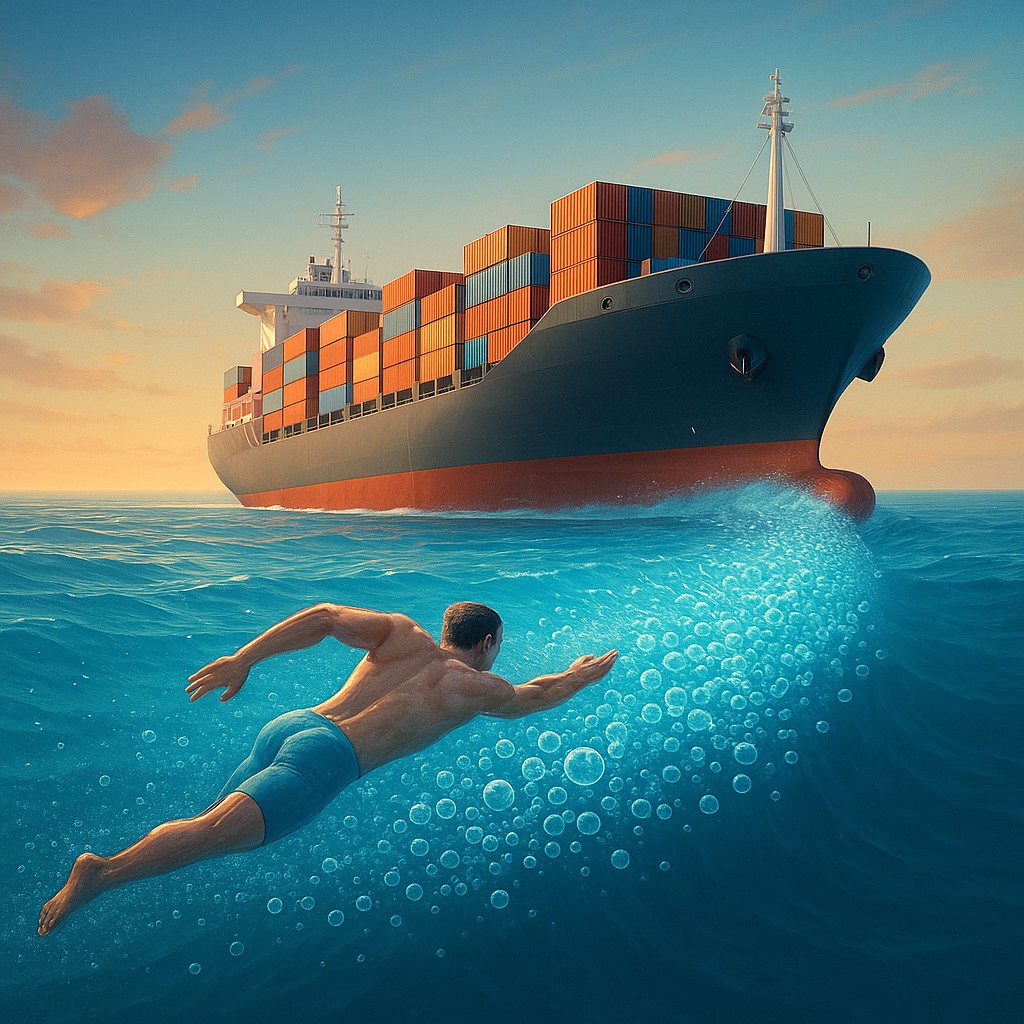
Imagine for a moment that you are trying to sprint through a swimming pool with the water at waist height. Every movement feels like you are pushing against a massive, invisible wall. This happens because water is roughly 800 times denser than air. It also has a property called viscosity, which acts like a microscopic glue between the water molecules and your skin. Now, imagine if someone could suddenly wrap your legs in thin, slippery silk or, better yet, surround you with a cloud of tiny bubbles. Suddenly, that "wall" softens, the water lets go, and you find yourself gliding forward with much less effort.
The global shipping industry faces this exact struggle every day on a giant scale. Massive cargo ships, some longer than the Eiffel Tower is tall, must brute-force their way through thousands of miles of ocean. They burn incredible amounts of fuel just to overcome the friction of the water against their steel hulls. For decades, the only solution was to build bigger engines and burn more oil. However, as international rules get stricter and the environmental cost of shipping becomes impossible to ignore, engineers have turned to a clever solution: they are teaching ships how to "skate" on a carpet of air.
The Problem with Sticky Water
To understand why air lubrication is such a breakthrough, we first have to look at the enemy: skin friction. When a ship moves through the ocean, the layer of water touching the hull moves at the same speed as the ship, while the water just a few inches away stays still. This creates a "boundary layer," a messy zone where water molecules are constantly being pulled and swirled along. This invisible tug-of-war accounts for 60% to 90% of the total resistance a cargo ship faces. It is the main reason why shipping is one of the most energy-heavy industries on Earth, using millions of barrels of fuel every day.
In the past, the only way to fight this was by using special non-stick paints or "antifouling" coatings to keep the hull smooth and free of barnacles. While these help, they do not change the basic physics of water rubbing against steel. This is where air lubrication comes in. By adding air into that boundary layer, we can change how the ship interacts with the sea. Since air is much thinner and less "sticky" than seawater, it acts as a buffer. Instead of the hull rubbing against heavy water, it rubs against a cushion of bubbles, effectively greasing the wheels of global trade.
How a Bubble Carpet Works
This technology is more than just blowing bubbles into the wind. It uses a smart internal system of air compressors and special wing-like distributors on the flat bottom of the ship’s hull. These distributors, often called air release units, pump out a steady, controlled stream of micro-bubbles. These are not the large, messy bubbles you see in a bathtub; they are tiny, uniform circles designed to stay trapped under the hull for as long as possible. The goal is to create a "bubble carpet" that covers most of the ship's bottom.
As the ship moves forward, the natural flow of water sweeps these bubbles toward the back, keeping them pinned against the hull by the heavy pressure of the ocean. This creates a thin layer of "low-density fluid" between the steel and the sea. Because this layer is much thinner than pure seawater, the engine does not have to work nearly as hard to keep up the same speed. It is important to note that this does not replace the engine or the propeller. The ship still needs traditional power to move, but air lubrication makes that movement much more efficient, similar to how a car gets better gas mileage on a smooth road than in thick mud.
Comparing Standard Hulls to Air-Lubricated Systems
When we look at the data, the impact of this "bubbly" technology is clear. While it costs a lot upfront to install the compressors and pipes, the long-term energy savings are changing how ships are designed and upgraded.
| Feature |
Standard Steel Hull |
Air-Lubricated Hull |
| Main Resistance |
High friction from water density |
Lower friction due to air buffer |
| Engine Load |
Full power needed for cruising |
5% to 15% less power needed |
| Maintenance |
Frequent cleaning to remove growth |
Bubbles can help keep the hull clean |
| Fuel Efficiency |
Baseline performance |
Lower fuel use, even after powering compressors |
| Environment |
Higher CO2 and sulfur emissions |
Fewer emissions per ton of cargo |
While the benefits are clear, the system does need its own energy to run. It takes power to run the compressors that push air down into the high-pressure environment under the ship. However, the "energy profit" is huge. If it takes 2% of the ship’s energy to make the bubbles, but the bubbles save 10% of the total fuel, that 8% net gain is a massive win. A single large vessel can burn hundreds of thousands of dollars in fuel on a single trip across the Pacific.
Engineering the Perfect Micro-Bubble
The success of an air lubrication system (ALS) depends on the size and spread of the bubbles. If the bubbles are too large, they clump together and float away quickly, escaping from under the hull. Engineers use computer models to see exactly how water flows around different hull shapes to make sure the bubbles stay "stuck" to the bottom. Ideally, the bubbles should form a stable, even sheet. This is why the technology works best on large, flat-bottomed ships like tankers, grain carriers, and giant cruise ships.
There is also a great secondary benefit: noise reduction. The shipping industry has long been criticized for underwater noise, which can confuse whales and dolphins. The layer of air bubbles acts as a muffler, soaking up some of the mechanical noise from the ship's engines and the vibration of the hull. By making the ship "slippery" in the water, we accidentally make it "quieter" for the animals in the deep. It is a rare "win-win" where a business upgrade also helps the environment.
To Be Clear: The Ship Isn't "Floating"
A common mistake people make is thinking the ship "floats" on air like a hovercraft. That isn't the case. A hovercraft uses high-pressure air to lift its entire weight out of the water, which takes a massive amount of energy. That would not work for a ship carrying 20,000 heavy steel containers. An air-lubricated ship is still a "displacement" vessel, meaning it sits deep in the water and relies on buoyancy to stay afloat. The air bubbles are just a thin interface, a secret lubricant that reduces the ocean's grip without changing how the ship floats.
Another myth is that this technology is meant to replace green fuels like hydrogen. In reality, air lubrication works with any fuel. Whether a ship burns old-fashioned heavy oil, natural gas, or new green methanol, it will still benefit from less drag. By focusing on the efficiency of the hull, the industry is building a foundation for a cleaner future regardless of what is in the fuel tank. It is much easier to switch to expensive green fuels if you have already figured out how to use 15% less of them through smart engineering.
The Future of the Fleet
Looking ahead, air lubrication is no longer an experiment; it is becoming a standard feature for the next generation of ships. International rules, such as the Carbon Intensity Indicator (CII), are putting pressure on ship owners to lower their carbon footprint right now. While replacing 50,000 ships with electric or hydrogen power will take decades, adding air lubrication systems to existing ships can happen much faster. It represents a shift from simply "finding a better fuel" to "building a better machine."
The beauty of air lubrication is its simplicity. It takes a basic natural element, air, and uses it to solve a problem that has bothered sailors since the first wooden boat hit the waves. By understanding the invisible forces of friction, we can move the world's goods with a much lighter touch. The next time you see a giant cargo ship, do not think of it as a heavy iron beast. Imagine it instead as an elegant giant gliding on a microscopic cloud.