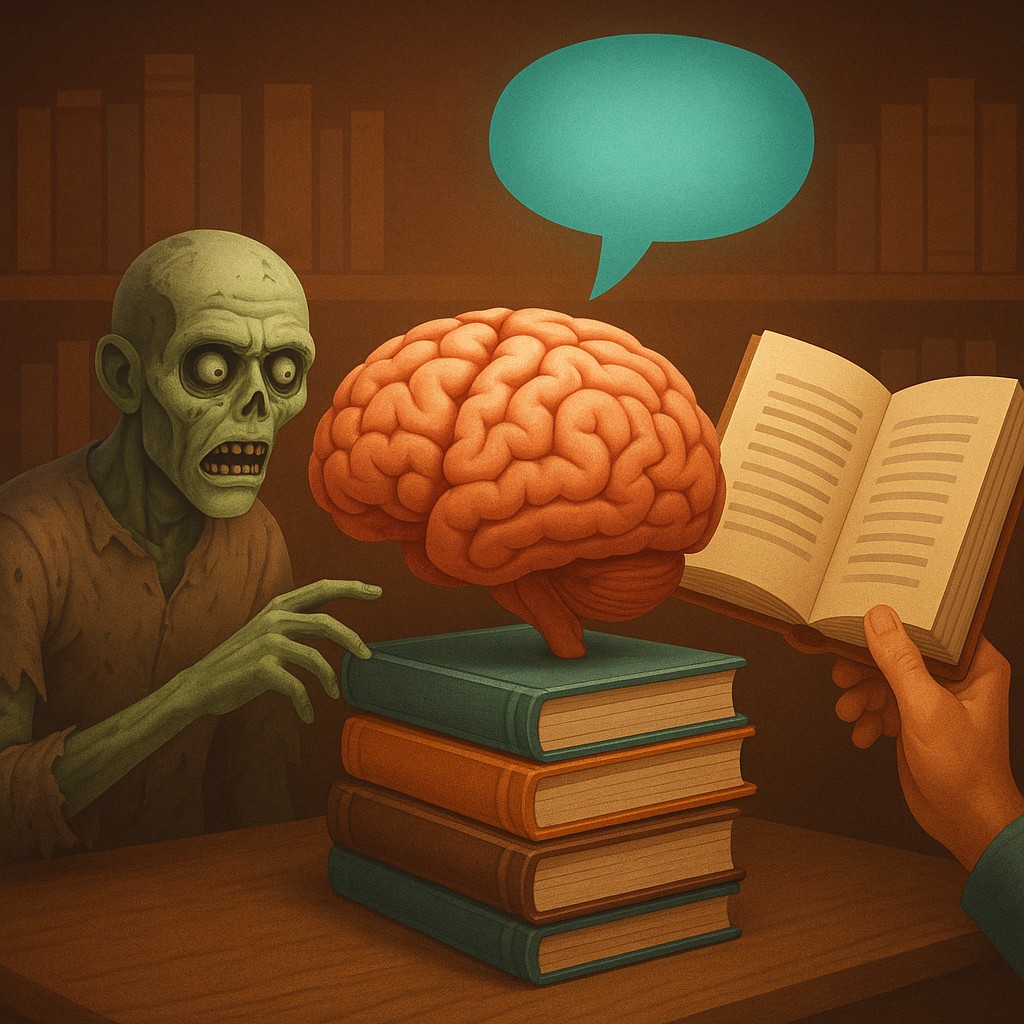
Imagine for a moment that your brain is a meticulously organized library. Every time you learn something new, you don't just toss a book onto a random shelf. Instead, you try to slot it into an existing category, connecting it to things you already believe to be true. The problem is that sometimes the shelves themselves are built on shaky ground. We all carry around "folk theories" about how the world works, like the idea that heavier objects fall faster than light ones or that blood inside our bodies is blue until it touches oxygen. When a teacher tells you the truth, your brain doesn't necessarily delete the old, wrong idea. Instead, it often tries to "smush" the new fact on top of the old myth, creating a confusing, fragmented mess that falls apart the moment you leave the classroom.
Traditional education often operates on the "blank slate" theory, assuming that students arrive with empty minds ready to be filled with pure, unadulterated facts. However, cognitive scientists have discovered that the human mind is rarely blank. It is crowded with "zombie facts," bits of intuitive but incorrect logic that are incredibly resistant to change. If a lesson simply presents the correct information without acknowledging the lie your brain is already telling you, the two ideas engage in a silent tug of war. Usually, the old intuition wins because it feels more natural. This is why we need a more aggressive, honest form of teaching known as refutation texts. These are documents that look the lie in the eye, call it out by name, and then systematically dismantle it to make room for the truth.
The Architecture of Cognitive Conflict
To understand why refutation texts work so well, we have to look at the inner workings of the human mind. Most of our learning is "additive," meaning we just add new layers of detail to things we already understand. But when we encounter something that contradicts our worldview, we require a "conceptual change." This isn't just a software update; it is a hardware replacement. A refutation text helps this happen by following a specific three-step process. First, it explicitly states the misconception. It might start by saying, "Many people believe that seasons change because the Earth gets closer to the sun in the summer." By doing this, the text pulls up the "wrong" folder in your brain, bringing the error into your conscious awareness.
Once the misconception is active, the text introduces a "refutation cue," which is a direct signal that the previous statement is incorrect. This is the moment of cognitive conflict. Your brain suddenly realizes that two pieces of information are fighting for the same space. Research suggests that this conflict creates a state of "positive frustration" or curiosity. The brain hates when things do not match, so it becomes desperate for a resolution. This is where the third step comes in: the scientific explanation. The text explains that seasons are actually caused by the Earth's axial tilt, or the specific angle at which the planet leans. Because the brain is already primed and looking for an answer to the conflict, it absorbs the correct explanation much more deeply than if the fact had been presented on its own.
This process transforms the student from a passive listener into an active investigator. Rather than just memorizing a sentence about axial tilt, the student is forced to compare their old theory with the new evidence. This "comparing and contrasting" is the secret to long-term memory. When you have to argue against your old self, the memory of the correct information becomes anchored to the memory of the mistake. This creates a dual-layered memory that is much harder to forget because you don't just know the answer; you know why the "easy" answer is a trap.
Why Intuition is the Enemy of Accuracy
We like to think of our intuition as a superpower, a gut feeling that guides us through life. In social situations, intuition is great. In physics and biology, intuition is often a disaster. Our brains evolved to survive on the open plains, not to calculate the vacuum of space or the microscopic behavior of cells. Consequently, we develop "naive theories" that feel right but are objectively wrong. For example, in mathematics, many students struggle with fractions because their intuition tells them that "bigger numbers mean bigger values." When they see 1/8 and 1/2, their gut screams that 1/8 must be larger because 8 is larger than 2.
A standard textbook might just say, "1/2 is greater than 1/8," and provide a diagram. A refutation text, however, would tackle the "whole number bias" head-on. It would state, "You might think that 1/8 is larger than 1/2 because 8 is a bigger number than 2. However, this is incorrect. In fractions, the bottom number tells you how many pieces the whole is divided into. If you divide a pizza into 8 slices, each slice is much smaller than if you divided it into only 2." By specifically addressing the "big number" logic, the text prevents the student from making the same mistake the next time they see a fraction. It builds a mental guardrail around the common pitfall.
The effectiveness of this method has been proven across dozens of subjects. In a recent review of educational studies, researchers found that refutation texts consistently beat traditional "informational texts" in helping students overcome deep-seated myths. This is particularly true in "hard" sciences where the truth goes against our natural instincts. Without the refutation, the student might pass the test by reciting the facts, but three months later, they will go back to their original, incorrect intuition. The refutation text aims for a permanent shift in how the mind works, not just a temporary data entry.
The Three Pillars of a Refutation Text
Not all debunking is created equal. To truly change a mind, a refutation text must be structured carefully to avoid the "backfire effect," where people dig their heels in and believe the lie even harder. The success of a refutation text relies on several key components that guide the reader from confusion to clarity. It’s not about being rude or telling the reader they are "wrong" in a mean way; it is about acknowledging that these myths are natural and common. This lowers the reader's defenses and makes them more open to new evidence.
| Feature |
Description |
Why It Works |
| Explicit Mention |
The text identifies the specific myth or common error. |
It brings the unconscious bias into the light so it can be examined. |
| Refutation Cue |
A clear statement like "This is a common misunderstanding" or "Actually..." |
It creates the necessary mental tension to trigger a search for truth. |
| Plausible Alternative |
A detailed, logical explanation of how things really work. |
It fills the "knowledge gap" left behind when the myth is removed. |
| Self-Correction Hint |
Tips on how to spot the error in the future. |
It trains the reader to watch their own thinking and avoid similar traps. |
By using this structure, teachers can ensure they aren't just shouting facts into the void. They are starting a conversation with the student's existing beliefs. This is especially useful in the age of the internet, where misinformation spreads like wildfire. If students aren't taught how to identify and dismantle their own misconceptions, they are far more likely to fall for "fake news" that appeals to their gut feelings. Learning how to be wrong is perhaps the most important skill a modern student can possess.
Navigating the Emotional Side of Learning
One of the most fascinating aspects of refutation texts is the emotional journey they take the reader on. Learning is not a purely cold, logical process; it is deeply emotional. When a text tells you that something you believed is wrong, you might feel a brief flash of confusion, embarrassment, or even irritation. Cognitive scientists who study "knowledge-based emotions" have found that these brief moments of discomfort are actually the engines of deep learning. Confusion is the brain's way of saying, "Wait, the world doesn't work the way I thought it did. I need to pay more attention."
Refutation texts lean into this confusion. Instead of smoothing over the difficulties, they highlight them. This creates a more active reading experience. When you read a standard textbook, it is easy to "zone out" because the writing is often flat and predictable. But a refutation text feels like a mystery or a debate. It sets up an idea, knocks it down, and then reveals the hidden truth. This story-like flow keeps the reader engaged and makes the eventual "aha!" moment much more satisfying. You aren't just learning a fact; you are winning a battle against your own ignorance.
Furthermore, this method builds "metacognition," which is just a fancy way of saying "thinking about your own thinking." When students are repeatedly exposed to refutation texts, they start to realize that their first instinct is often a rough draft rather than the final truth. They become more comfortable with the idea of being wrong, which is the hallmark of a scientific mind. They start to ask themselves, "What am I assuming right now that might be a misconception?" This healthy skepticism is a protective layer that helps them judge new information throughout their lives, long after they have forgotten the specific details of Earth's tilt or how to divide fractions.
Building a More Resilient Memory
The ultimate goal of any educational tool is to create memories that stick. The problem with standard "encoding," or the process of putting info into the brain, is that it is often "shallow." You might remember a word or a definition, but you don't understand the underlying system. Refutation texts encourage "deep encoding" because they force the brain to link the new information to an existing concept, even if that link is a contradiction. In the world of memory, a "no" is often more memorable than a "yes." When you are told, "No, it's not the sun's distance," the brain builds a strong connection between "seasons" and "not distance," which then points directly to "tilt."
This "error-based learning" is incredibly tough. Imagine you are learning to drive and you keep hitting the curb when you turn. If an instructor just tells you to "turn wider," you might remember it for a few minutes. But if they say, "You think you should turn when the front of the car hits the line, but that's what's making you hit the curb; you actually need to wait until your shoulder passes the line," you have a much clearer mental map. You know exactly what the error looks like and exactly how to fix it. Refutation texts do the same for the "driving" of our minds. They point to the curb we keep hitting and explain why our logic is flawed.
In summary, the use of refutation texts represents a shift from "telling" to "teaching." It recognizes that the human mind is a complex web of existing beliefs, and that the only way to weave in new, accurate information is to carefully unknot the old, tangled threads. By making the error part of the lesson, we stop treating students as empty containers and start treating them as active thinkers. This approach doesn't just produce better test scores; it produces more curious, critical, and humble human beings who aren't afraid to let go of a comfortable lie in favor of a complex truth.
Go forth and look for the "zombies" in your own garden of knowledge. The next time you find yourself absolutely certain of an intuitive fact, take a moment to ask if there is a refutation waiting to be discovered. Real intelligence isn't about knowing everything; it is about having the courage to dismantle your own misconceptions one by one until only the evidence remains. Embrace the conflict, lean into the confusion, and remember that every time you realize you were wrong, your brain is actually getting a massive upgrade. Your library is being rebuilt on a foundation of reality, and that is the most exciting journey any learner can take.