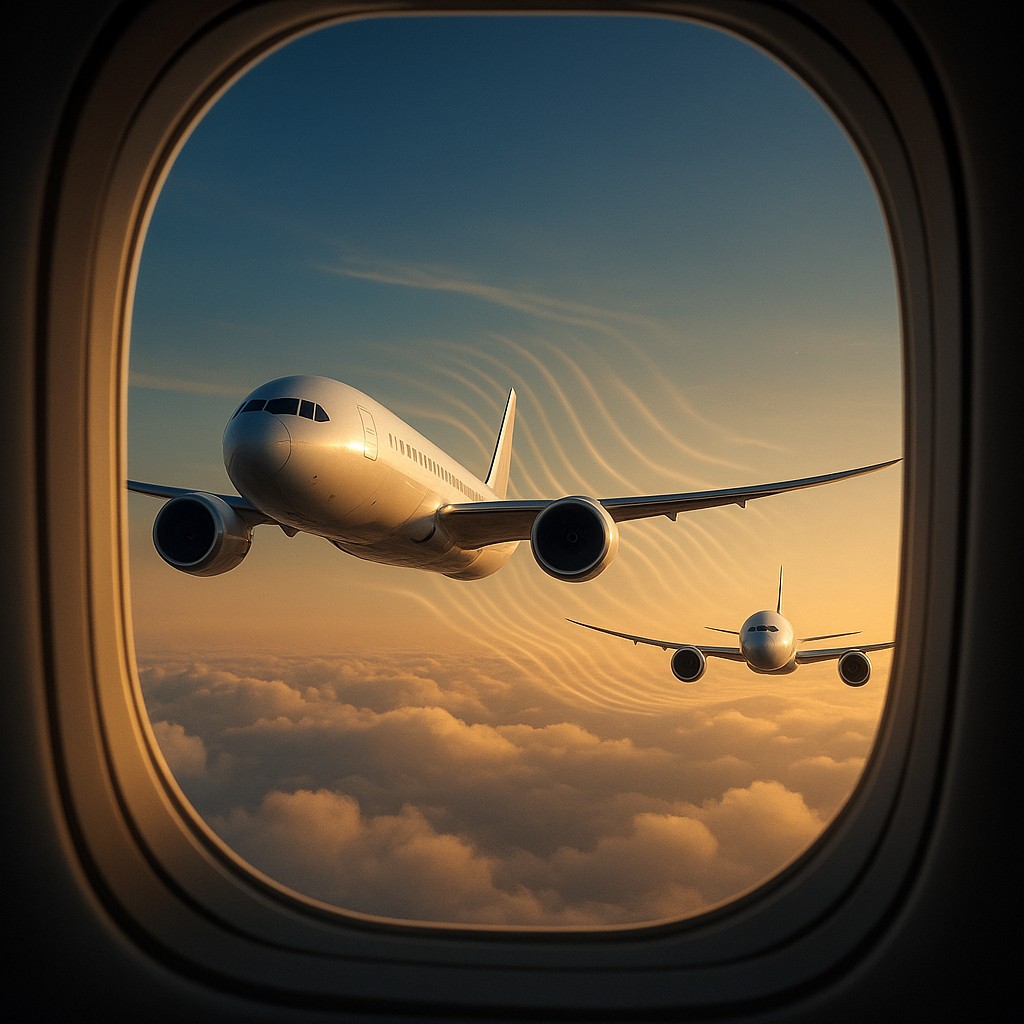
Imagine looking out of a small oval window at 35,000 feet and seeing another massive commercial jet just a few miles away, its wingtip seemingly tracing the same path as your own. While this might look like a scene from an action movie or a military drill, it is actually the future of sustainable travel. For decades, the aviation industry has searched for a "holy grail" of efficiency, trying to squeeze every drop of energy out of expensive jet fuel. As it turns out, the answer was not hidden in a new chemical formula or a radical engine design. It was in the sky itself, following a blueprint written by migratory birds millions of years ago.
The concept is simple and surprisingly elegant. When a bird, or a Boeing 787, moves through the air, it creates invisible ripples in its wake. Most of this disturbed air is a nuisance, but on the outer edges of the wings, there is a golden opportunity in the form of rising air. By positioning a second aircraft precisely within this upward flow, airlines can let the trailing plane "surf" on the energy already spent by the leader. This is not just a theoretical experiment; it is a growing field of aerospace engineering that uses satellite navigation and automated controls to make the skies greener without changing how we build planes.
The Secret Mechanics of the Invisible Wave
To understand why flying in formation works, we have to look at the invisible structure of the air around a wing. As an aircraft moves forward, the high-pressure air beneath the wing naturally seeks out the lower-pressure air above it. Since it cannot pass through the solid wing, it curls around the wingtips. This creates two powerful, spinning spirals known as wingtip vortices. Within these spirals, air moves in two directions: it is pushed down directly behind the center of the plane, called downwash, and pulled up on the outer edges, called upwash.
For the lead aircraft, these spirals are essentially "lost" energy. However, for a trailing aircraft, that upwash is a free gift. If the second plane can place its wing inside that upward-moving air, it gets a natural boost of lift. Because the air is already lifting the plane, the engines do not have to work as hard to stay at the right altitude and speed. It is exactly like a cyclist tucking in behind a teammate to avoid wind resistance, but in three dimensions and at 600 miles per hour. The "sweet spot" is remarkably small, often requiring the follower to stay within a specific patch of air only a few meters wide, but the payoff is worth it.
Lessons from Nature and the V-Formation
Nature has been running these flight trials for ages. If you have ever watched a flock of geese migrating for the winter, you have seen the "V" formation in action. Biologists have used sensors on birds to prove that those at the back of the "V" have much lower heart rates than the leader. They are literally working less because they are using the upwash created by the bird in front of them. When the leader gets tired, they rotate to the back, ensuring the entire group can travel thousands of miles without wearing out.
In aviation, we call this "Wake Energy Retrieval." While birds do this by instinct, humans have struggled to copy it because of the size and speed of modern jets. A goose weighs a few pounds; a fully loaded Airbus A350 weighs hundreds of tons. The turbulence created by such a massive machine is violent and messy. If a trailing plane slips even slightly out of the upwash and into the "downwash" zone, it will be sucked downward. This forces the engines to roar to life, burning more fuel than if the plane were flying alone. This "penalty zone" is why formation flight remained a dream for decades; we simply did not have the technology to stay in the "surf zone" safely.
Precision Navigation: The Tech Behind the Surf
The reason we are talking about this now, rather than fifty years ago, is the arrival of ultra-precise positioning technology. In the past, pilots relied on radar and visual sightings, which were not accurate enough to maintain a tight formation across the Atlantic Ocean. Today, we have "ADS-B" (a system that broadcasts a plane's position) and satellite links that allow planes to talk to one another in real time. The lead plane broadcasts its exact location and speed, and the trailing plane’s computer adjusts its path with tiny, perfect movements to stay locked into the upwash.
This automation is the secret to modern formation trials. It is not the pilot’s hands on the controls doing the fine-tuning; it is an algorithm making hundreds of tiny adjustments every second. This ensures the plane stays in the most efficient part of the wake while keeping a safe, staggered distance. To the passengers inside, the flight feels completely normal. There is no extra shaking or tilting, just a quiet, steady cruise. The table below compares a standard solo flight to this new collaborative approach.
| Feature |
Standard Solo Flight |
Formation "Surfing" Flight |
| Lift Source |
Created entirely by the plane's engines |
Helped by the lead plane's upward wake |
| Fuel Efficiency |
Standard baseline (100% use) |
5% to 10% reduction for the follower |
| Pilot Workload |
Normal navigation tasks |
High reliance on automated steering |
| Environment |
Standard CO2 and vapor trails |
Lower emissions and fewer vapor trails |
| Safety Margin |
Maintained by large distances |
Maintained by data links and automation |
Challenges of High-Altitude Cooperation
If the benefits are so clear, why aren't all planes flying in clusters like a swarm of high-tech bees? The primary hurdle is not physics, but logistics. Current air traffic control rules are designed to keep planes as far apart as possible. Bringing two massive jets within a few miles of each other requires rewriting the rulebook. Controllers need to be trained to handle "formations" as a single unit rather than separate planes, and international borders create a maze of different laws that all have to agree on these new safety standards.
There is also the "scheduling problem." For this to work, two planes need to be going to the same place at roughly the same time. While busy routes like London to New York provide plenty of chances, smaller routes might not. Airlines would need to coordinate their departures with the precision of train schedules. Furthermore, there is a question of fairness: the lead plane does not save any fuel, while the follower saves a lot. Commercial agreements would be needed so airlines can trade positions or share the savings, ensuring no one is stuck as the "lead bird" forever without being paid back.
A Greener Future Without New Engines
One of the most exciting things about formation flight is that it works with the planes we already have. Most environmental fixes for aviation involve expensive, high-risk gambles, such as hydrogen engines or heavy batteries that cannot yet handle long trips. In contrast, formation flight is a software and procedural upgrade. This means we could see a 5% to 10% reduction in total emissions relatively quickly, compared to the decades it takes to design a brand-new aircraft.
Beyond fuel savings, there is evidence that flying in formation can reduce contrails, the white streaks in the sky that trap heat. By interacting with the lead plane's wake, the trailing plane can change how ice crystals form in its own exhaust. This means formation flight could offer a double win: less carbon dioxide from the engines and a smaller heat-trapping footprint from the clouds they leave behind. It’s a rare example where a more complex way of flying actually results in a cleaner outcome for the world.
As we look toward the future, it is humbling to realize our most advanced machines are becoming more efficient by mimicking nature. The sky is not just an empty space to push through, but a dynamic environment full of hidden energy. By embracing the physics of the wingtip vortex, we are entering an era where flight is defined not just by speed, but by how well we can dance together in the air. The next time you see a V-formation of birds high above, remember that you might soon be following their lead on your next trip across the ocean, surfing the invisible waves of the sky.