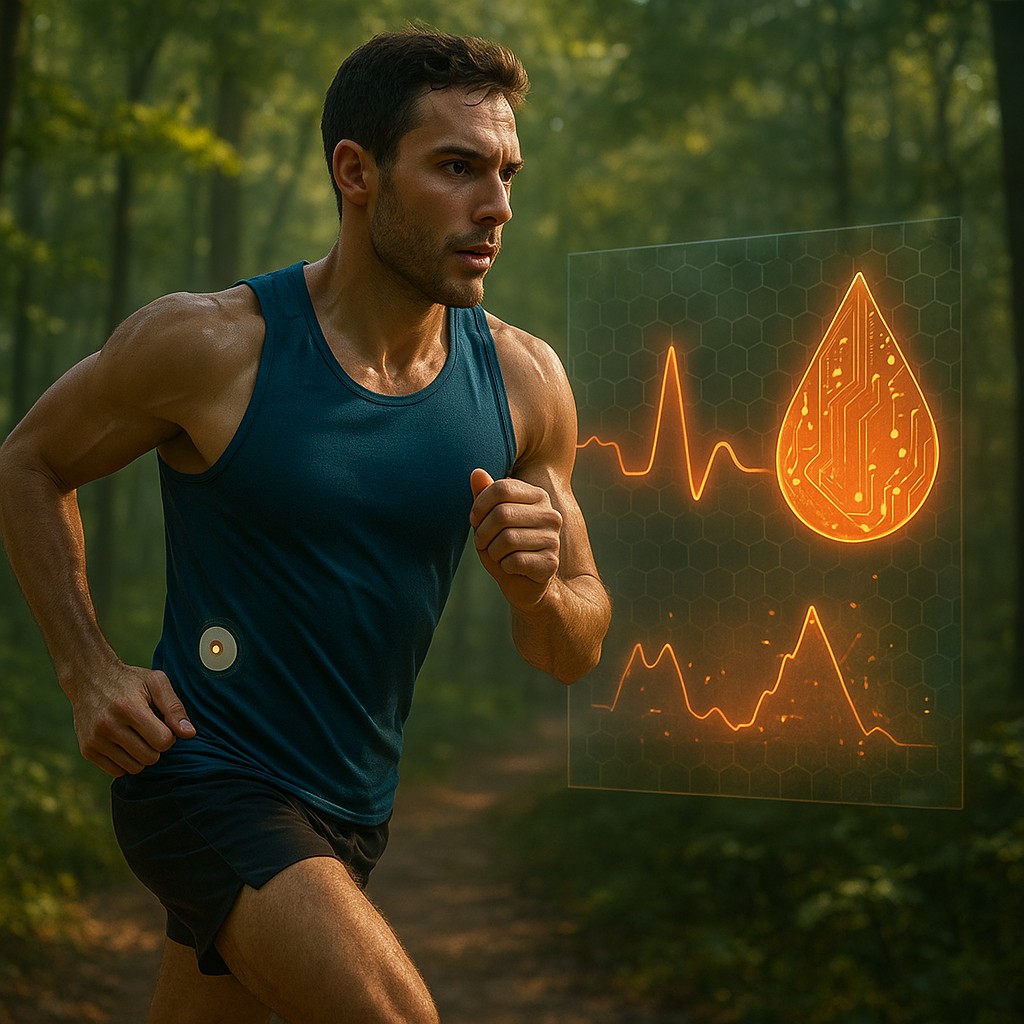
Imagine you are in the middle of a final sprint. Your lungs are burning, your legs feel like lead, and a small voice in your head is begging you to slow down. At this exact moment, your body is fighting an invisible chemical battle to turn glucose into energy. Until now, understanding exactly what was happening under your skin required stopping, pricking your finger, and placing a drop of blood into a portable analyzer. It is an effective method for a lab, but let’s face it, nobody wants to play nurse in the middle of a forest trail run or halfway up a mountain bike climb.
The good news is that science is about to make this hassle a thing of the past, thanks to a breakthrough straight out of a sci-fi movie: the wearable lactate sensor. These smart patches, currently undergoing rigorous clinical testing, promise to read your physiological secrets through a single drop of sweat. By turning your perspiration into a digital dashboard, these devices offer a brand-new window into your metabolism. They allow you to know exactly when you are pushing past your limits without having to shed a single drop of blood.
Muscle Chemistry and the Truth About Lactate
To understand why everyone is so excited about a sweat sensor, we first need to clear lactate’s reputation. For decades, "lactic acid" was wrongly blamed for the muscle soreness you feel the day after a jog. In reality, lactate is an unsung hero. It is a backup fuel that your body produces when oxygen runs low. When you run at a gentle pace, your muscles use oxygen to burn sugars and fats very efficiently. But as soon as the intensity spikes, the system can no longer supply enough oxygen. This is when "anaerobic" mode kicks in, producing lactate to keep the engine running.
The problem isn't the lactate itself, but its "traveling companions," such as hydrogen ions. These make the muscle environment more acidic, causing that familiar burning sensation. Measuring lactate levels is like looking at a car's tachometer: it tells you if the engine is running smoothly or if it is overheating in the red zone. By tracking this molecule, athletes can identify their anaerobic threshold, that critical point where fatigue starts to build up faster than the body can clear it.
This threshold is the "Holy Grail" of sports training. If you know exactly where it is, you can train just below it to build endurance, or just above it to boost explosive power. Without a sensor, people often rely on heart rate, but heart rate is fickle. One too many coffees, a bad night’s sleep, or stress at work can make your heart race even if your muscles aren't working any harder. Lactate, however, never lies, because it is a direct byproduct of muscle metabolism.
A Miniature Biology Lab on Your Skin
Moving from a finger prick to an adhesive patch is a feat of micro-engineering. These new wearables use "electrochemical sensors." The principle is fascinating: the sensor's surface is coated with a specific enzyme called lactate oxidase. This enzyme reacts chemically when it touches the lactate molecules in your sweat, producing a tiny electric current. The more lactate there is in your sweat, the stronger the current. A built-in microchip picks up this signal, translates it into easy-to-read data, and sends it instantly to your watch or smartphone via Bluetooth.
This is a major achievement because sweat is a complex and "messy" environment for precision electronics. It contains more than just lactate; it’s a mix of salts, proteins, and cellular debris. Engineers had to create selective membranes that act like nightclub bouncers, allowing only lactate molecules through to the active enzyme. Furthermore, these devices must be flexible enough to move with the body. A rigid sensor would peel off at the first sign of sweat or the slightest muscle contraction.
The table below compares traditional testing with this new wearable skin technology:
| Feature |
Blood Test (Gold Standard) |
Sweat Sensor (Wearable) |
| Method |
Invasive (finger or ear prick) |
Non-invasive (adhesive patch) |
| Frequency |
One-time snapshot |
Continuous (real-time) |
| Convenience |
Requires stopping exercise |
Used during peak effort |
| Setup |
Medical gear or complex kit |
Simple sticker on the skin |
| Current Accuracy |
Very high (reference point) |
High, but sensitive to outside factors |
| Cost per test |
High (disposable strips) |
Potentially low over time |
Technical Challenges of Wet Analysis
While the idea sounds simple, making it work in the real world is a puzzle for researchers. The first major hurdle is the "dilution effect." Imagine sweating heavily in pouring rain or a humid gym. The concentration of lactate in your sweat could be thrown off by the total volume of water your pores release or by mixing with the humidity in the air. To fix this, some advanced sensors measure chloride levels or sweat conductivity at the same time. This allows them to adjust the results and provide an accurate reading, whether you are a "human fountain" or a relatively dry runner.
Temperature is another troublemaker. Enzymes are delicate structures that work faster or slower depending on the heat. Hot skin during a heatwave might trick the sensor into thinking lactate levels are higher than they actually are, simply because the chemical reaction speeds up with heat. The latest models include miniature thermometers to calibrate the data in real time. This ability to ignore environmental interference is what separates lab prototypes from the products we will soon see in stores.
Finally, there is the problem of "old sweat." If lactate sits on the sensor, the device will show data that is ten minutes old, which is useless during a sprint. Researchers are developing "microfluidic channels," which are tiny pipes etched into the patch. These channels funnel fresh sweat toward the electrode and flush out the old sweat. This ensures that the numbers on your screen reflect how your muscles feel right now, not the effort you put in during your warm-up.
Optimizing Training and Preventing Injury
The value of this technology goes far beyond just getting a faster time. For a professional cyclist, knowing they are at 3.8 mmol/L of lactate (just below their limit) allows them to stay in a breakaway without "blowing up." But for the average person, it is a powerful health tool. Overtraining is a leading cause of injury for amateur athletes. By seeing lactate levels rise abnormally at the start of a session, a runner could realize their body hasn't recovered from the day before and it's time to take it easy.
Body tracking in real time allows for personalized effort like never before. We are not all built the same: what feels like a recovery jog for one person might be an exhausting workout for another, even if their heart rates are the same. With a lactate sensor, training becomes an exact science. We can imagine apps that literally whisper in your ear: "Speed up by 2%, you’re still in your comfort zone," or "Slow down immediately, you are hitting the fatigue wall."
Beyond sports, the medical potential is promising. Monitoring lactate is vital in hospitals, especially for tracking patients in septic shock or those with heart failure. A wearable, non-invasive sensor could allow doctors to monitor patients at home or in the ER without repeated needle pokes. We are moving from a gadget for elite athletes to a technology that could save lives by detecting metabolic changes before the first visible symptoms even appear.
The Future of the Data-Enhanced Human
The arrival of these sensors marks a major shift in how we relate to our own biology. We are moving from an era where we had to guess based on vague feelings, like fatigue or pain, to an era of molecular precision. It is like switching from a hand-drawn paper map to a high-precision GPS that shows you not only where you are, but the exact condition of the engine and how much fuel is left in the tank.
It is fascinating to think that in the near future, putting on a lactate patch will be as common as lacing up a pair of running shoes. We will learn our limits not by hurting ourselves, but by listening to the chemical signals of our cells. This gives us immense power over our own progress, removing guesswork and allowing us to strive for excellence with new confidence.
Next time you feel that signature burn in your muscles, remember that your molecules are telling a story. Soon, thanks to a drop of sweat and a small high-tech sensor, you will finally be able to translate that secret language. You won’t just be training with your heart and muscles anymore, but with a deep, scientific understanding of what makes you unique. The future of performance isn't just about mental toughness; it's about turning our own biology into a clear, data-driven ally.