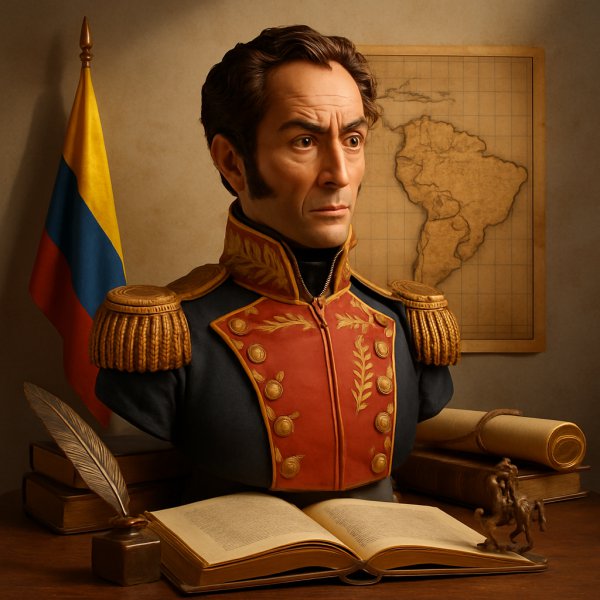
Why Simón Bolívar’s story can grab you right now
Imagine a man who crosses plains, mountains and oceans of ideas to redraw an entire political map. Simón Bolívar is more than a name on statues and banknotes; he is a figure who still shapes national identities in Venezuela, Colombia, Peru, Ecuador and Bolivia. His era, in the early 19th century, plays out like a political adventure movie - battles, conspiracies, long journeys and constitution-writing - but with real consequences that last to this day.
Why should this matter to you personally? Because Bolívar’s story is about leadership under pressure, collective ambition, the gap between ideals and reality, and the limits of political greatness. Learning his story asks universal questions: what is freedom? What institutions defend it? How can a political dream survive regional differences and personal interests?
In the account that follows, I invite you to follow Bolívar from his Creole childhood in Caracas to his exhausted final days in Santa Marta. We will mix facts, anecdotes, ideas and practical lessons. Expect epic battles, inspiring letters, troubling compromises and twists that show history is rarely simple.
First steps: a young Creole with the world to discover
Simón Bolívar was born in 1783 into a well-off Creole family in Caracas, then part of the Viceroyalty of New Granada under Spanish rule. Orphaned young, he received a European-style education that immersed him in Enlightenment ideas - liberty, sovereignty, natural rights - and familiarized him with Old World culture and politics. These influences shaped a curious mind and a sense of personal destiny, two ingredients that pushed Bolívar to believe he could change the course of history.
His travels in Europe, especially time in Madrid and a stop in Paris a few years after the French Revolution, were decisive. He saw the aftermath of revolutions and the limits of monarchical systems, and he watched how Napoleon was redrawing borders. Those experiences convinced him that major political change was possible, but that it required first will, then military and institutional strategy.
It is important to note Bolívar did not grow up as a street-level rebel; he belonged to the colonial elite. That background partly explains his approach: he sought independence from Spain, but he did not initially aim to overturn the basic social order. His path shows how personal origins shape political goals.
From exile to the Letter from Jamaica - when an idea becomes a plan
After a series of setbacks and a period of exile in 1815, Bolívar wrote his famous Letter from Jamaica, a thoughtful letter to a friend that analyzes the causes of the Spanish American independence movement and outlines a vision for the future. In this text he compares the colonies to peoples who must find their way out from under Spanish tutelage, and he anticipates internal conflicts and the need for strong institutions. The Letter from Jamaica is a kind of intellectual manifesto that clarifies his ideas and his sense of what is possible.
This moment marks his transition from an impulsive military leader to a strategist thinking long term about independence. Bolívar balances realism and idealism: he knows the war will be long, and that independence without stability risks tumbling into anarchy. His thinking moves toward the idea of a strong, centralized state capable of protecting civil liberty after victory.
This phase offers a useful life lesson: before acting, it pays to articulate your goal clearly and anticipate the steps. The Letter from Jamaica is an excellent example of strategic writing that turns frustration into a plan.
Decisive military campaigns - a moving map
Bolívar’s military career is a series of spectacular campaigns, often marked by grueling marches and bold maneuvers. There are brilliant victories and bitter defeats, but taken together they produce the independence of vast territories. Here is a concise table to keep the key moments, places and significance in mind.
| Year |
Battle or event |
Location |
Importance |
| 1819 |
Campaign for New Granada - Battle of Boyacá |
Boyacá, Colombia |
Decisive victory that secures the liberation of New Granada, opens the route to Santa Fe (Bogotá) |
| 1821 |
Battle of Carabobo |
Carabobo, Venezuela |
Secures the effective independence of Venezuela with a victory over royalist forces |
| 1822 |
Battle of Pichincha / unification of Ecuador |
Quito region, Ecuador (operations) |
Contributes to Ecuador's independence, often credited to Antonio José de Sucre |
| 1823-1824 |
Campaigns in Peru - Junín and Ayacucho (mainly led by Sucre in 1824) |
Junín, Ayacucho, Peru |
Final defeats of royalist armies in South America, completing independence |
| 1825 |
Founding of Bolivia |
Andean highlands |
Creation of a new independent state named in his honor |
Reading this list may seem linear, but each episode reads like a saga: crossings of the high plain, logistic nightmares, desertions, fragile alliances and decisions made under fire. Bolívar did not win everything alone; he relied on other leaders like Antonio José de Sucre and on local contingents.
An ambitious and controversial political vision
Military victory was only part of Bolívar’s project. His great ambition was to build institutions capable of keeping unity and freedom after the war. In 1819, at Angostura, he delivered a foundational speech and proposed creating Gran Colombia - a state that would bring together the territories that are now Venezuela, Colombia, Ecuador and Panama. The idea was to create a common market and a political force to protect the young republics from European powers and internal division.
However, Bolívar believed institutions needed to be strong, and he leaned toward a powerful executive to prevent fragmentation. He proposed constitutions that granted more authority to the president and included "extraordinary powers" to stabilize the state. This stance drew criticism: some saw it as bordering on authoritarianism, others as a necessary evil to preserve liberty.
The unity project collided with deep realities: geographic differences, regional interests, reluctant local elites and divergent economies. In the end, Gran Colombia dissolved in the early 1830s. That tension between the dream of unity and local realities is one of the central dramas of Bolívar’s political life.
The final years - disappointments, failing health and death
Bolívar’s final years were marked by fatigue, disappointment and illness. Worn down by years of military campaigns and endless political battles, he watched his dream of unity fall apart. Political divisions deepened, state coffers were empty, and opponents - both internal and external - resisted his centralizing measures.
In 1830, sick and disillusioned, Bolívar resigned the presidency and headed into what was likely exile, but he died in Santa Marta early in his retirement. His death, far from triumphant, has a tragic quality: a great founder exhausted by the contradictions of his time, leaving behind fragile institutions and nations searching for identity.
His end reminds us that political greatness does not guarantee inner peace. Bolívar’s story also shows that even heroes can be overwhelmed by systems larger than themselves.
Common myths and nuanced realities
There are several misconceptions about Bolívar that are worth clearing up. The first myth is that he was the sole liberator of the Andean nations. The reality is he played a central role, but he relied on lieutenants, local forces and popular support. Hagiography can hide the cooperation and diversity of actors involved.
Another myth claims he wanted to be king. In truth, Bolívar experimented with strong forms of power, but he never explicitly sought a monarchy for himself. His preference for a strong executive springs more from fears of instability than from a personal desire for a crown. Finally, many think he solved the question of slavery; the truth is more complicated - he enlisted and integrated enslaved people into independence forces and supported some abolition measures, but the eradication of slavery did not happen uniformly or immediately.
Grasping these nuances helps avoid turning history into a simple fable. Bolívar is a complex figure - a strategist, a statesman, a product of his time, and a builder of political empires that were often short-lived.
Why his legacy remains alive and sometimes contested
Today Bolívar is used symbolically by governments, movements and intellectuals across the spectrum. His name inspires the creation of states, currencies, cities and political movements. This shows the power of a historical symbol: it can unite, but it can also be instrumentalized.
His enduring legacy rests on two things. On one hand, his actions changed South America’s political geography. On the other hand, his ideas - Latin American unity, the importance of institutions, moral leadership - continue to feed political debate. Current divisions in the region sometimes produce contradictory interpretations of his image; some view him as a defender of national sovereignty, others as a precursor of authoritarian rule justified by stability.
Acknowledging these uses does not diminish the scale of his achievements. It only shows that historical heroes become mirrors in which each generation reads its own concerns.
Some concrete activities to deepen your knowledge and apply what you learned
If you want to move from reader to engaged explorer, here are simple, useful actions to continue your journey or to apply Bolívar’s lessons to your life.
- Read the Letter from Jamaica and excerpts from the Angostura Address, to hear his political thinking in his own words. These texts reveal his balance of idealism and realism.
- Visit a local museum or a virtual exhibition on Latin American independence. Objects and maps make history tangible.
- Organize a friendly debate or book group around the question: "Is stability worth the loss of some freedoms?" This exercise sharpens civic judgment and puts historical analysis into practice.
- Study the biography of one of Bolívar’s lieutenants, such as Antonio José de Sucre, to see how collective leadership operates in times of crisis.
These steps are modest but powerful: understand deeply, discuss with others, and connect the past to contemporary choices.
Questions to reflect on and locate yourself in relation to the past
- If you had to choose between a very strong government able to stabilize a society in chaos and a fragile but sovereign democracy, which would you choose and why? Think of concrete examples.
- Which aspects of Bolívar’s leadership do you admire most? Which seem problematic? List at least two strengths and two limits.
- How can the memory of a historical figure be transformed by contemporary political uses? Give an example from your own country or elsewhere.
These questions are meant to make you pause and weigh - as Bolívar often did with a map and a pen, you are invited to weigh the consequences of political choices.
How to keep Simón Bolívar alive without turning him into an idol
Bolívar’s story can inspire without sanctifying. Three concrete practices help: read primary documents to hear his voice; read about lesser-known actors to see the full picture; and confront myths with historical evidence. This critical work fosters thoughtful admiration rather than blind reverence.
Applying Bolívar’s lessons today means supporting institutions that protect liberty, while remaining vigilant against authoritarian drift. It means defending collective ambition, but not at the expense of social justice or citizen participation.
With these nuances, Bolívar’s image becomes a tool - a lens for thinking about contemporary challenges - rather than an unchanging model.
A final thought to leave you motivated
Simón Bolívar crossed mountains and oceans of uncertainty to build nations, with both success and contradictions. His story reminds us that great projects require courage, political clarity and a keen sense of compromise. Studying his life gives you a guide for thinking about public challenges: be bold, but care for institutions and listen to diverse voices. Keep your curiosity, a critical eye and the will to act - history is not read only to admire, it is read to learn and to build. If you leave here wanting to read the Letter from Jamaica, explore a historical map or debate a major political dilemma, then Bolívar will have done his work with you.