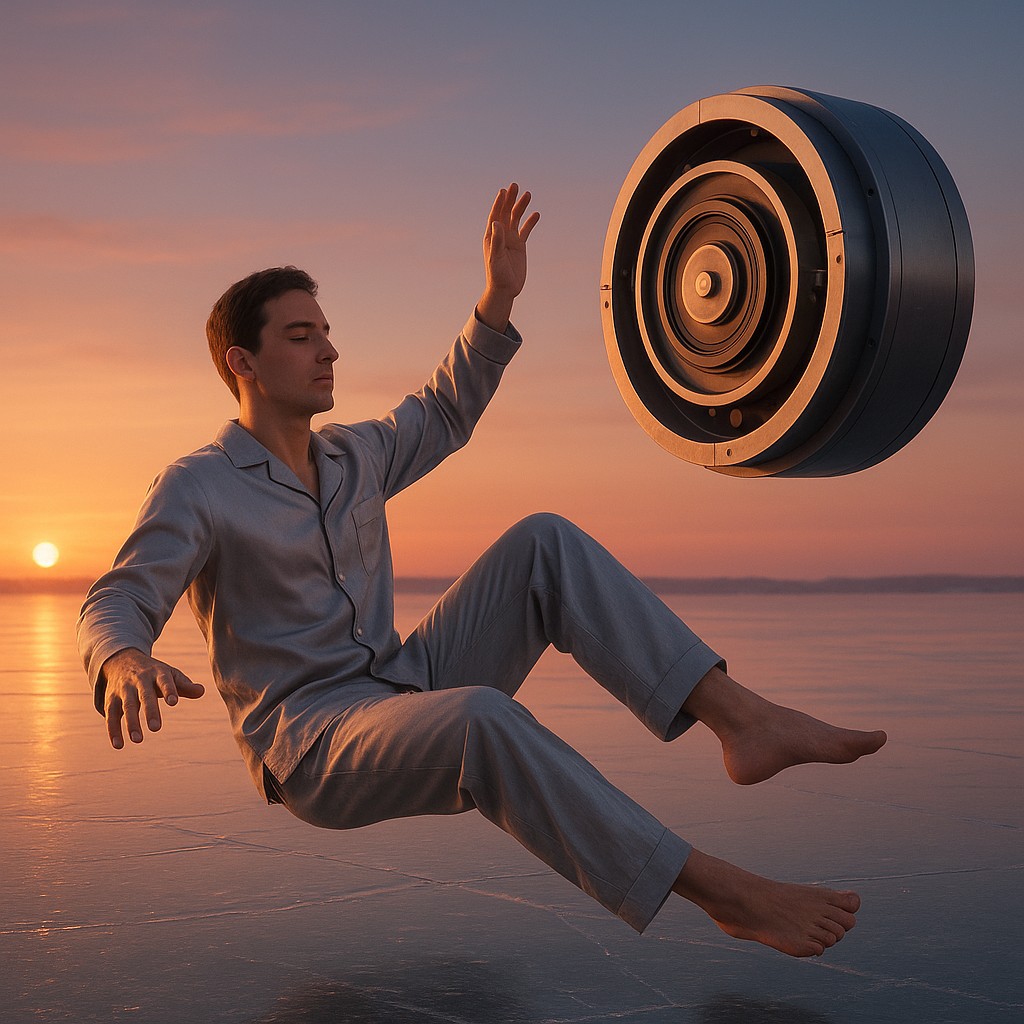
Imagine you are floating in the middle of a perfectly frozen, frictionless lake. You are wearing smooth silk pajamas, and there is absolutely no wind. You want to turn around to see the sunset behind you, but every time you try to shuffle your feet, they just slide uselessly across the ice. You cannot push against the ground, and you cannot push against the air. In this isolated state, you are a closed system governed by the rigid laws of physics. To turn your body to the right, you might try swinging your arms hard to the left. For a brief moment, your torso twists in response, but as soon as your arms stop moving, you jerk back to your original position. This is the fundamental headache of the vacuum: when there is nothing to push against, how do you change which way you are looking?
For a multi-billion dollar piece of equipment like the James Webb Space Telescope, this is more than a physics riddle; it is a critical engineering challenge. Deep in the void of space, there is no pavement, no atmosphere, and no "down." If NASA wants to point a telescope at a tiny, dim galaxy billions of light-years away, they need a level of precision that would make a brain surgeon look shaky. They cannot simply fire giant rocket boosters every time they want to nudge the camera, because fuel is heavy, expensive, and finite. Instead, they exploit a clever rule of Newtonian physics using Reaction Wheels. These internal spinning disks allow a spacecraft to perform a graceful ballet in total silence, turning the ship using nothing but electricity and the conservation of angular momentum.
The Secret Law of Spinning Objects
To understand how a spacecraft turns without a propellant, we have to look at one of the most stubborn rules of the universe: the Conservation of Angular Momentum. In simple terms, this rule states that if an object is spinning, it wants to keep spinning in the same way unless an outside force interferes. More importantly, if you have a self-contained system that isn't spinning at all, and you suddenly make one part of it spin clockwise, another part of that system must spin counter-clockwise to keep the total "spin" at zero. It is the cosmic version of a see-saw. If you push one side down, the other side must go up to keep the universe’s books balanced.
In a satellite, engineers put this into practice by mounting a heavy metal disk, essentially a high-tech flywheel, to an electric motor. When scientists on Earth decide the satellite needs to rotate five degrees to the left, they send a command to start spinning that internal wheel to the right. As the motor speeds up the wheel, the body of the spacecraft reacts by rotating in the opposite direction. The beauty of this system is that it requires no exhaust. No chemicals are spat out into the void, and there are no puffs of gas to cloud a sensitive camera lens. As long as the satellite has solar panels to keep the batteries charged, those motors can spin the wheels back and forth forever.
This concept is often demonstrated using a swivel chair and a bicycle wheel. If you sit on a chair that rotates freely and hold a spinning bike wheel, tilting the wheel will cause you and the chair to spin around. The reaction wheel inside a spacecraft works on the same principle, just with much more expensive bearings and a lot more math. By placing at least three of these wheels at right angles to one another, along the X, Y, and Z axes, engineers can rotate the craft in any direction in three-dimensional space with incredible precision.
Precision Aiming and the Art of Staying Still
The real magic of reaction wheels is not just that they allow for movement, but that they provide a steady hand. Consider the Hubble or James Webb telescopes. These machines look at objects so far away and so faint that even a vibration the size of a human hair would ruin the exposure. If they used traditional thrusters, which rely on small puffs of gas, the movement would be "choppy." Thrusters are essentially tiny explosions, and explosions are rarely subtle. Reaction wheels, however, provide a smooth, continuous force that can be adjusted in microscopic increments.
Sophisticated flight software monitors the telescope's orientation thousands of times per second to control the speed of these wheels. If the telescope begins to drift even a fraction of a degree due to the faint pressure of sunlight hitting the sunshield, the reaction wheels subtly change their speed to counteract that drift. This creates a state of "dynamic stability." The spacecraft isn't just sitting there; it is actively working to remain perfectly still relative to a distant star. It is a constant, invisible struggle between the forces of the universe trying to push the telescope around and the internal wheels pushing back with equal determination.
Because these wheels are the primary way a telescope aims, they are built to be incredibly durable. They are often suspended in magnetic bearings to eliminate the friction that would eventually wear down traditional ball bearings. In the harsh environment of space, where you cannot send a mechanic for a tune-up, these wheels are designed to spin for decades. When you see a stunning high-resolution image of a nebula, you are looking at the result of these metal disks spinning at thousands of revolutions per minute, holding a multi-ton structure as steady as a mountain.
When the Wheels Hit the Speed Limit
While reaction wheels seem like a "cheat code" for physics, they have a major limitation known as saturation. To understand saturation, imagine you are trying to stay balanced on a tightrope while a gentle wind keeps pushing you to the left. To stay upright, you keep swinging your right arm faster and faster to counteract the wind. Eventually, your arm is swinging as fast as humanly possible. You cannot swing it any faster to provide more balance. In orbital mechanics, the "wind" is often solar radiation pressure: the faint but constant stream of light particles from the sun hitting the spacecraft.
Over days or weeks, the reaction wheels might have to spin faster and faster to keep the spacecraft pointed in the right direction against this constant environmental pressure. Eventually, the wheel reaches its maximum safe operating speed. It is "saturated." At this point, the wheel is useless for further control because it has no more room to accelerate. If engineers keep pushing it, the wheel might fly apart or damage its housing. To fix this, the spacecraft must go through a process called "momentum unloading" or "desaturating the wheels."
To desaturate, the spacecraft must slow the wheels down. However, slowing the wheels would cause the entire spacecraft to spin wildly in the opposite direction. To prevent this, the craft uses a secondary system to hold itself steady while the wheels brake. This is usually done with small thrusters or "magnetic torquers." Magnetic torquers are essentially large electromagnets that push against the Earth's magnetic field. By pushing against the planet's magnetism, the satellite can stay still while the internal reaction wheels slow to a stop, effectively resetting the system for the next round of observations.
A Comparison of Spacecraft Maneuvering Systems
To see where reaction wheels fit in the larger toolkit of space exploration, it helps to compare them to other ways we move things in the void. Each system has a specific role, and most modern satellites carry a combination of these to ensure they never get stuck looking the wrong way.
| Feature |
Reaction Wheels |
Chemical Thrusters |
Magnetic Torquers |
| Primary Power |
Electricity (Solar) |
Chemical Fuel (Propellant) |
Electricity + Earth's Magnetism |
| Precision |
Extremely High |
Low to Medium |
Low |
| Fuel Usage |
None |
Consumable (Limited) |
None |
| Best Used For |
Precise pointing and small turns |
Large maneuvers and raising orbits |
Unloading momentum (near planets) |
| Longevity |
Very High (Years/Decades) |
Limited by fuel tank size |
Very High |
| Vibration |
Minimal |
Significant |
None |
As the table shows, reaction wheels are the marathon runners of the group. They aren't great for sprinting or jumping, but they can keep going for years without needing a refill. Chemical thrusters are the heavy lifters, used for getting into orbit or making drastic course corrections, but they are expensive to use because every drop of fuel spent is gone forever. Magnetic torquers are the anchors, but they only work if you are close enough to a planet like Earth to feel its magnetic field. If you are out by Mars or in deep space, those torquers won't find much to push against, leaving the wheels and thrusters to do the work.
The Shift in How We Understand Force
The existence of reaction wheels challenges our Earth-based intuition about movement. On Earth, if you want to move, you must interact with something outside of yourself. You push against the ground to walk, you push against the water to swim, and your car tires push against the asphalt to drive. We are conditioned to believe that movement requires an external partner. Reaction wheels prove that when it comes to rotation, you carry the power to change within yourself. By simply rearranging how energy and momentum are distributed inside your own frame, you can change your perspective on the entire universe.
This concept has implications beyond just satellites. It is a reminder of the elegance of closed systems. It shows that even in the most isolated, lonely environments imaginable, the laws of conservation provide a way to navigate. We often think of space as a place of emptiness, but the success of the reaction wheel shows that space is governed by a very strict set of rules. If you move one thing, the universe insists that something else moves in response. It is a perfectly balanced equation that engineers have learned to play like a musical instrument.
As we look forward to the next generation of space exploration, from missions to the icy moons of Jupiter to giant telescopes searching for life on distant planets, the humble reaction wheel will remain at the heart of the journey. It is a testament to human ingenuity that we can use a spinning piece of metal to peek into the beginning of time. It teaches us that while the vacuum of space may offer nothing to push against, we can always find leverage by looking inward and mastering the laws that keep the stars in their place. This invisible dance of momentum is what allows us to keep our eyes on the prize, turning slowly and silently in the dark.