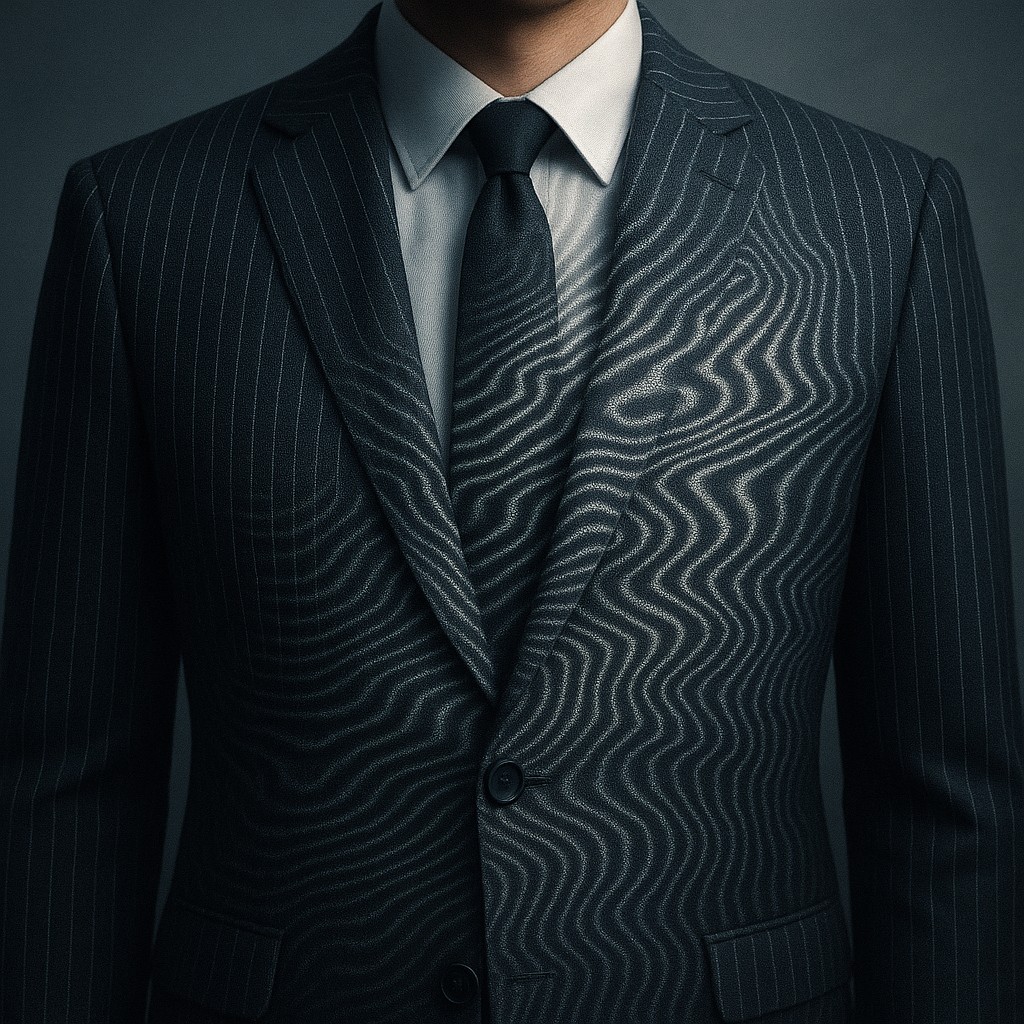
Imagine you are looking at a high-definition photo of someone in a pinstriped suit on a TV screen. As the person moves, a strange, shimmering ripple seems to crawl across the jacket like a ghostly map. This visual glitch, called a moiré pattern, is a classic example of what happens when two different grids - the stripes on the suit and the pixels on your screen - clash. It is more than just an annoying flicker; it is a fundamental warning about how we process information. When we try to pack too much complexity into a space too small to hold it, our brains and our screens work together to create "ghost" stories, inventing patterns that aren't actually there.
In the world of big data, this phenomenon is much more dangerous than a shimmering suit. When a data scientist tries to squeeze a million data points into a chart only 1,000 pixels wide, they hit a mathematical wall. If they simply grab every thousandth point and throw the rest away, they might accidentally create a chart showing a massive spike or a rhythmic pulse that never existed in the original data. This is a visual "halftime show" of misinformation. To prevent this, professionals use a process called iterative down-sampling. By learning how to thin out the data without losing the heart of the message, we can ensure that what looks like a trend is a true fact, not just a byproduct of a crowded screen.
The Mathematical Mirage of the Crowded Screen
At the heart of every misleading chart is a concept called aliasing. This happens when the frequency of your data is higher than the "sampling rate" (the frequency of snapshots) of your display. Think of a spinning bicycle wheel. If you take a photo of it every time it completes 90 percent of a rotation, the wheel will look like it is spinning backward in your video. This is a lie told by the camera. In data visualization, if a heart rate monitor pulses faster than a chart can draw, you end up with a slow "ghost" wave. It looks like a significant event, but it is actually just a mathematical error.
Moiré patterns are the visual version of this struggle. They happen because the human eye is desperate to find order in chaos. When data points are shoved together without a plan, they overlap and interfere with one another. This creates dark clusters and light gaps that suggest a rhythm. A scientist looking at a high-frequency brain scan might see a rhythmic "alpha wave" and start a new treatment plan, only to realize later that the wave was just an accident caused by the computer skipping data points. We are essentially "seeing" the gaps between the pixels rather than the data itself.
To fight this, we have to move away from the idea that "more data is always better." On a small screen, more data often just means more noise. The goal of a professional is not to show every single point, but to show the statistical reality of those points. This requires a shift in perspective. Instead of seeing a chart as a collection of dots, we must see it as a summary. When done correctly, this process removes distracting interference while keeping the critical spikes and dips that actually matter.
The Art of Thinning Data and Statistical Weight
When we talk about "decimating" data, it sounds like we are destroying it. In the world of data science, however, decimation is a careful, strategic reduction. It is the difference between a sculptor blindly hacking at marble and one carefully removing chips to reveal a statue. The simplest way to thin data is "naive sampling," where you just take every 10th or 100th point. As we have seen, this is the main cause of moiré patterns. To fix this, we use smarter methods like "Every-Nth with Averaging" or the "Largest Triangle Three Buckets" (LTTB) algorithm.
LTTB is a clever tool used for data that changes over time. It divides the data into buckets and, for each bucket, selects the point that best preserves the visual "shape" of the data compared to the buckets before and after it. This ensures that if there is a sudden, massive spike, it doesn't get skipped just because it didn't land on an even-numbered spot. It prioritizes the outliers - the unusual points - that define the trend. By using these methods, we create a simplified version of the data that "feels" like the original to the human eye, even if 90 percent of the original points are gone.
Another approach is using "moving averages" or filters before shrinking the data. This acts like a "blur." By smoothing out the tiny, jittery jumps before we shrink the dataset, we get rid of the sharp edges that cause moiré patterns. It is like sanding a piece of wood before painting it. This prevents aliasing because the data no longer has details that are too fine for the screen to handle. The resulting chart looks cleaner because the statistical noise has been filtered out, leaving only the meaningful trends.
Balancing Detail and Reality in Industry
The stakes for these techniques depend on what you are looking at. In some fields, a moiré pattern is a minor annoyance; in others, it is a disaster. A marketing professional looking at website clicks might not care about a slight shimmer in a graph. But for a structural engineer checking the vibrations of a suspension bridge, or a doctor looking at a heart monitor, the difference between a smooth, filtered line and a jagged, poorly sampled line can be a matter of life and death.
| Method |
How it Works |
Pros |
Cons |
| Naive Sampling |
Pick every Nth data point (e.g., every 10th). |
Extremely fast and easy to code. |
High risk of false patterns and "lost" spikes. |
| Simple Averaging |
Take the average of every group of points. |
Smooths out noise and prevents interference. |
Can hide important extremes and peaks. |
| LTTB Algorithm |
Uses geometry to keep the most "visible" points. |
Keeps the visual shape and important outliers. |
Takes more computing power than averaging. |
| Gaussian Filtering |
Applies a weighted "blur" to the data. |
Excellent at removing false patterns. |
Can make data look "too smooth," hiding reality. |
In finance, high-frequency trading creates millions of data points every second. No screen can show them all. Analysts rely on "OHLC" charts (Open, High, Low, Close), which are a form of categorized thinning. If they used naive sampling, they might miss the lowest point of a stock market crash, which would be a nightmare for managing risk. By using specific rules, they ensure the high and low points of the day are always visible, no matter how much they zoom out. This allows the human brain to see a summary that is still "honest" about the extremes.
The Psychological Trap of the Smooth Narrative
There is a hidden danger in being too good at cleaning up data. When we use advanced filters to remove noise and false patterns, we create a "smooth" chart. To the human brain, smoothness suggests stability and safety. When we see a clean, flowing line, we are less likely to question how messy the data actually is. This is "Aesthetic Bias." We tend to trust information more when it looks beautiful, even if that beauty was manufactured by an algorithm.
As someone who looks at data, you must remember that a smooth chart is often the result of deliberate filtering, not necessarily a smooth reality. The truth might be a chaotic, jagged mess. The designer has chosen to show you the "vibe" of the data rather than the raw details. This is necessary for understanding, but it is also a form of editing. If the filtering is too aggressive, it can strip away the "texture" of the data, making a risky investment look stable or a sick patient look healthy.
We must learn to look at charts with "algorithmic awareness." When you see a high-density trend, ask yourself how the data was thinned. Was it averaged? Was it reduced? Is the smoothness a reflection of the real world, or just a very good filter? Understanding the "noise" of a summary makes us better at spotting when a pattern is a real signal and when it is just a ghost in the machine. This skepticism makes us smarter at interpreting the world.
Building a Better Lens for Big Data
To use these concepts in your own work, start by looking for "visual noise." If a chart looks like it is vibrating or has weird dark blobs in crowded areas, you are likely looking at un-filtered data. The solution is rarely to "add more pixels." Instead, use smarter logic to thin the data. If you use programming tools like Python or R, libraries like Plotly or Bokeh often have built-in "downsample" settings that keep your charts from becoming a shimmering mess.
Think of data thinning as a translator. Raw data speaks a language of infinite detail that our eyes cannot understand. The algorithm translates that complexity into a dialect of "trends" and "shapes" that our brains are built to process. Like any translation, some nuance is lost, but the goal is to keep the meaning intact. When we master this, we stop being overwhelmed by data and start being informed by it. We stop seeing the "shimmer" of the suit and start seeing the person wearing it.
The next time you see a clean line graph representing millions of points, appreciate the invisible work happening behind the scenes. Value the filters that removed ghostly patterns and the algorithms that kept the spikes from being lost. But also, stay curious about the messy complexity that was smoothed away for your convenience. In the gap between raw data and a simplified chart lies the art and science of communication. By balancing the two, you ensure your stories are not just beautiful, but deeply, statistically true.