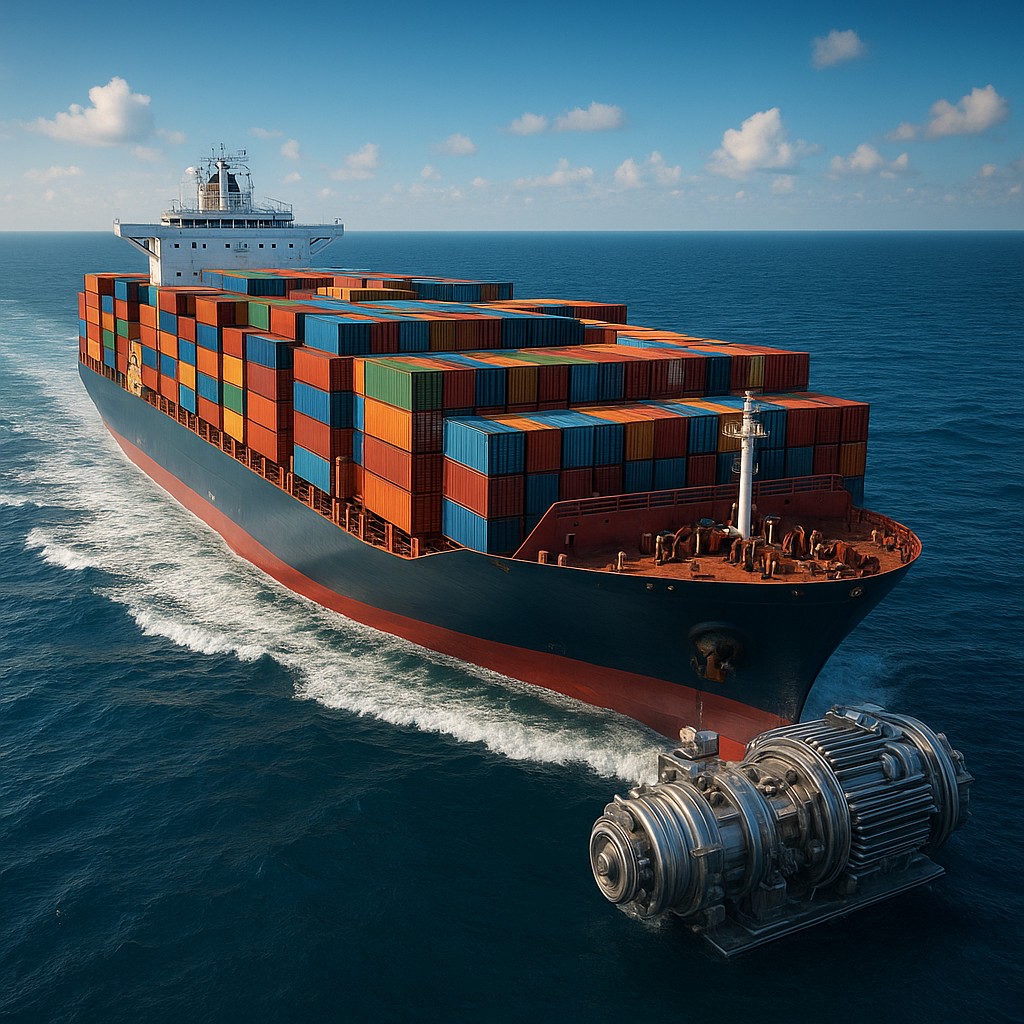
Imagine you are standing on the deck of a massive container ship. This vessel is longer than three football fields and stacked high with thousands of colorful metal boxes, carrying everything from iPhones to avocados. Beneath your feet, a giant engine, perhaps several stories tall, is thrumming away. You might assume the captain’s goal is to reach the port as fast as possible, racing across the waves to satisfy a world that wants its packages delivered yesterday. However, if you look at the wake trailing behind the ship, you will notice something strange. The ship is barely jogging. It is moving at a pace a weekend sailor would consider leisurely, traveling at only half or two-thirds of its top speed.
This isn't due to a mechanical failure or a lack of hurry. It is a calculated, high-stakes move based on physics known as "slow steaming." Across the world's oceans, the giants of maritime trade have collectively decided to hit the brakes. By intentionally slowing down, shipping companies are navigating a tricky path between fluid dynamics (how liquids move), environmental duty, and cold, hard economics. What looks like lost productivity is actually a clever use of a physical law that governs how objects move through water. To understand why the global supply chain has slowed to a crawl, we have to look at the invisible resistance every ship must fight to move a single inch.
The Brutal Math of Moving Through Water
To understand why a ship owner would choose to arrive late, you first have to understand the "cubic law" of fluid resistance. In a vacuum, pushing something twice as fast might take twice the effort, but water is a stubborn barrier. It is roughly 800 times denser than air and incredibly difficult to push out of the way. When a ship doubles its speed, the drag or "pull" it feels doesn't just double, it quadruples. But the real problem is the power needed to beat that drag. Because power is a combination of force and speed, the energy required to move a ship increases with the cube of the speed.
If you want to move your ship twice as fast, you don't just need twice the fuel, you need eight times the fuel. On the flip side, if you slow down just a little bit, your fuel savings are huge. This isn't a steady trade-off where you get a predictable return; it is a steep, punishing curve that rewards the slow and penalizes the fast. For a shipping line spending hundreds of millions of dollars on "bunker fuel" (heavy ship oil) every year, the cubic law is the most important math on their balance sheet. A ship that slows down from 24 knots to 18 knots might cut its fuel costs by 50 percent, a deal that makes "fast shipping" look like an expensive luxury the industry can no longer afford.
Why Speed Is a Climate Villain
The environmental impact of the shipping industry is often hidden because it happens far out at sea, but it is massive. Shipping is responsible for nearly 3 percent of global greenhouse gas emissions. If the world’s cargo fleet were a country, it would be the sixth-largest polluter in the world, ranking somewhere between Japan and Germany. Because most cargo ships burn heavy fuel oil, a thick, sludge-like leftover from oil refining, every drop saved is a win for the atmosphere. Slow steaming has become the most effective "low-tech" way to clean up the industry without waiting for future technologies like hydrogen or nuclear power to be ready.
When a ship slows down, the engine runs in a more efficient "sweet spot." Modern ship engines are engineering wonders, but they work best when they aren't pushed to their limits. By running at lower speeds, these engines produce less carbon dioxide and fewer harmful chemicals like nitrogen and sulfur oxides. It is a rare "win-win" in the business world where the green choice is also the one that saves the most money. However, this shift isn't just about the engine; it’s about how the world views the ocean as a delivery network. We are moving away from an "express delivery" model toward a "floating warehouse" model, where the journey itself is a way to manage inventory.
Comparing Speed, Power, and Efficiency
| Speed (Knots) |
Power Required (Approximate) |
Fuel Consumption |
Impact on Schedule |
| 24 (Full Speed) |
100% |
Extremely High |
Fastest Delivery |
| 21 (Slow Steaming) |
67% |
~30% Reduction |
Moderate Delay |
| 18 (Extra Slow) |
42% |
~50% Reduction |
Significant Delay |
| 15 (Super Slow) |
24% |
~70% Reduction |
Very Long Transit |
The Logistics of the Floating Warehouse
If every ship on the ocean slows down, you might wonder how things still arrive on time. The answer is a strategy called "string thickening." To keep up a weekly service between, for example, Shanghai and Los Angeles, a shipping company can’t just let its five ships take longer to finish the trip. If it did, there would be weeks when no ship arrived at all. To solve this, companies add more ships to the "string" or route. If a round trip takes 35 days instead of 28, the company might put six ships on that route instead of five. Goods still arrive at the port every Monday, but each individual box has spent more time at sea.
This change has turned global shipping lanes into a massive, slow-moving conveyor belt. For many manufacturers, this is actually a benefit. While goods are on the ship, the manufacturer doesn't have to pay for storage space on land. The ship itself becomes the warehouse. This "just-in-case" strategy provides a safety net against supply chain shocks, even if it requires buying more ships. The cost of building and maintaining an extra ship is often much lower than the cost of the extra fuel burned by making the original fleet go faster.
Overcoming the Mechanical Hurdles of Slowness
You might think that slowing a ship down is as easy as letting off the gas, but ship engineering is rarely that simple. Most large cargo ships were built when fuel was cheap and speed was the top priority. Their engines and parts were tuned for high-speed travel. When you run a massive diesel engine at 20 percent power for weeks at a time, it can cause problems like "cold corrosion" or soot buildup because the engine doesn't get hot enough to burn off waste. It is like a marathon runner trying to maintain a slow walk; the muscles and breathing just aren't meant for it.
To adapt, engineers have had to perform "slow steaming retrofits." This involves changing the fuel systems and installing new, more efficient turbochargers that can handle lower airflow. In some cases, ships even have their "nose" or bulbous bow reshaped. A bulbous bow is the rounded part at the front of a ship designed to cancel out waves, but it only works perfectly at a specific speed. If the ship now moves slower, the old shape actually creates more drag. Companies are now putting ships in dry-dock to weld on new, slimmer noses optimized for these slower speeds.
The Human Factor and the Future of the Seas
This shift toward slow steaming also changes the lives of the crews on these vessels. Modern sailors now spend more time at sea on every trip. While satellite internet keeps them more connected than in the past, companies must manage the mental strain of these longer voyages. Furthermore, slow steaming requires a different kind of captain. It is no longer about "making time" at any cost; it is about precise energy management. Captains now use smart software to find the exact path where currents and wind can help them maintain their slow, efficient crawl without wasting a single drop of fuel.
As we look ahead, slow steaming is likely here to stay, even if we develop new fuels. Whether a ship is powered by green ammonia or giant kites, the physics of the cubic law will not change. Water will always be dense, and pushing through it will always take a lot of energy. By embracing the "slow" in shipping, the world is learning a valuable lesson about the limits of growth and the power of working with physics rather than against it. We are discovering that in a world obsessed with speed, there is a deep, planet-saving wisdom in taking the long way around.
The next time you track a package and see it sitting in the middle of the ocean for a few extra days, don't think of it as a delay. Think of it as a quiet victory for the environment. Every knot given up is proof that we can adapt our technology to the realities of our world. Slowing down isn't a step backward; it is a sign of maturity, a realization that we can reach our goals more sustainably by respecting the laws of nature. In the race to protect our planet, sometimes the best way to win is to be the last one to cross the finish line.