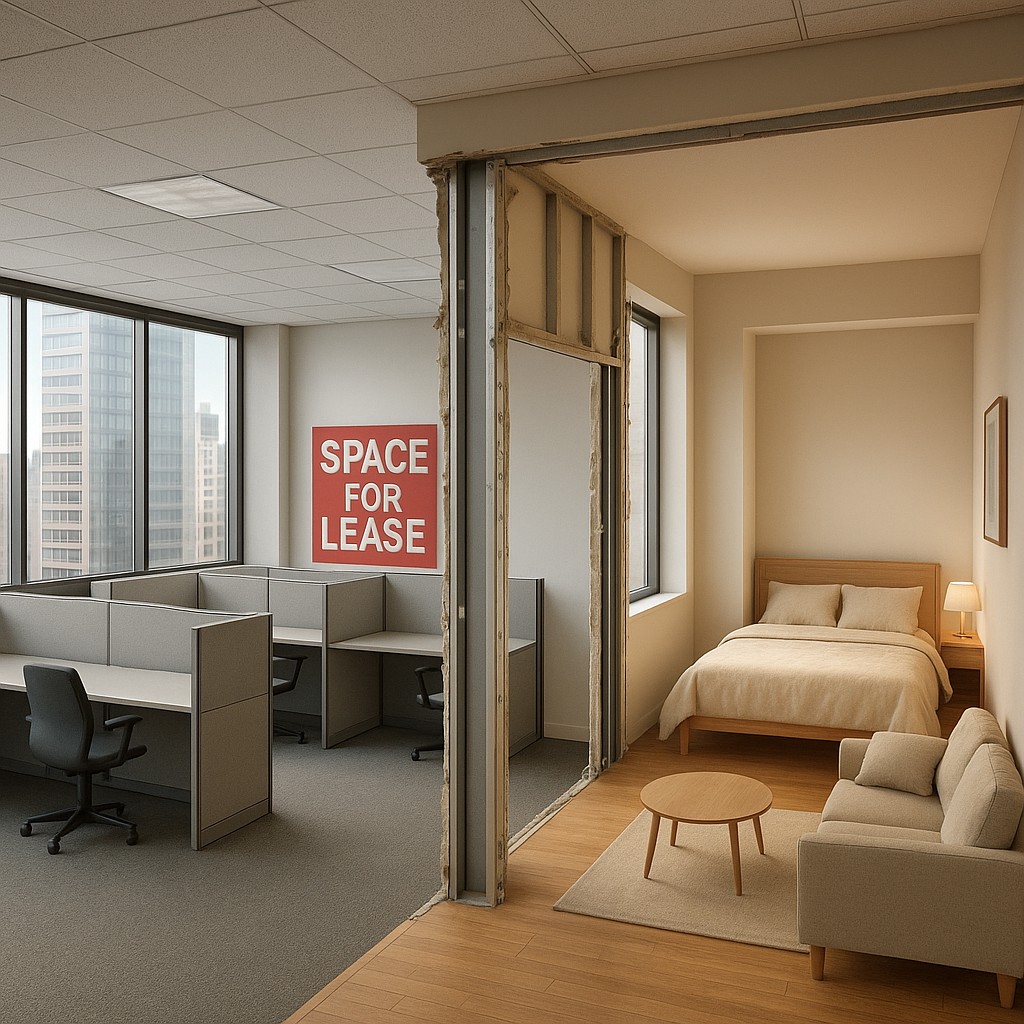
Walk through any major downtown district today, and you will likely notice a strange paradox in the modern economy. Towering glass skyscrapers, once the buzzing hives of corporate life, sit eerily quiet with "Space for Lease" signs plastered across their lobbies. Meanwhile, just a few blocks away, apartment hunting has become a cutthroat sport, with dozens of hopeful tenants competing for a single tiny studio. On the surface, the solution seems so obvious it feels like a trick of logic: why not just take those empty cubicles and turn them into bedrooms? If the building is already there, surely all it needs is a few partition walls and a fresh coat of paint to solve the housing crisis.
Unfortunately, the reason those towers remain empty reveals a fascinating clash between architectural intent and the cold, hard laws of physics. Bringing a classic 1980s office building into the residential market is not just a matter of changing the paperwork or moving some furniture. It is a grueling battle against gravity, light, and the way we have spent the last sixty years engineering the "perfect" workspace. When we build for work, we optimize for efficiency and central control; when we build for living, we prioritize independence and comfort. Bridging that gap is often so expensive and technically complex that it is cheaper to tear a forty-story building down to its foundations and start over.
The Tyranny of the Central Core
To understand why your dream loft in a former accounting firm is so difficult to build, we have to look at the "chassis" of the modern skyscraper. Commercial office buildings are designed around a concept called the central core. This is a massive, vertical concrete spine that runs straight through the middle of the building. Inside this core, architects bundle everything that makes the building function: elevator banks, emergency stairwells, electrical closets, and, most importantly, the plumbing. In an office environment, this design is brilliant because it maximizes the open, "premium" floor space near the windows while tucking the noisy, windowless necessities into the dark center.
In a typical office layout, you might have two large restrooms located right next to the elevators. If you are an employee, you get up from your desk, walk fifty feet to the center of the building, and use the shared facilities. This means the building only needs a few massive pipes running vertically through that central spine. However, if you turn that same floor into fifteen separate apartments, every single unit suddenly needs its own bathroom and its own kitchen. You go from having two concentrated clusters of plumbing to needing thirty or forty separate points for water and waste scattered across the entire floor. This creates a geometric nightmare that the building’s original structure was never designed to handle.
The Gravity Problem and Concrete Constraints
When you brush your teeth or flush a toilet in a residential building, you are participating in a carefully choreographed dance with gravity. Waste pipes must maintain a very specific slope, usually about two percent, to ensure that liquids and solids move smoothly without clogging. In a purpose-built apartment building, the floors are designed with plenty of "sandwich space" to hide these sloping pipes. However, office buildings are often built with thick, post-tensioned concrete slabs that are packed with high-strength steel cables under immense tension. You cannot simply drill hundreds of new holes through these slabs to run pipes for forty new kitchens, because hitting one of those cables could compromise the structural integrity of the entire tower.
Because you cannot easily go through the floor, you have to go above it or below it. To get the necessary slope for a kitchen sink located fifty feet away from the central core, you might have to raise the floor of the apartment by several inches or drop the ceiling of the unit below. Suddenly, you are losing precious vertical space. If you try to run all these new lines to the original central core, the horizontal distance becomes so great that the ceiling becomes too low to be legally livable. The alternative is to drill new vertical "risers" or pipe shafts throughout the building, but this is an engineering feat of such precision and cost that it often breaks the project's budget before the first wall is even put up.
A Comparison of Design DNA
The differences between these two building types are not just skin deep; they are baked into the very dimensions of the structure. The following table highlights the fundamental "genetic" mismatch that makes conversion such a daunting task.
| Feature |
Typical Modern Office |
Typical Residential Building |
| Floor Depth |
Deep (100-150 feet from core to window) |
Shallow (30-40 feet from core to window) |
| Plumbing Layout |
Centralized in one or two massive stacks |
Decentralized with many small stacks |
| Window Access |
Fixed glass, cannot be opened |
Can be opened for fresh air and emergency exits |
| HVAC System |
Giant shared units for the whole floor |
Independent climate control per unit |
| Ceiling Height |
High (to hide massive air ducts) |
Moderate (scaled for a home feel) |
| Legal Status |
Commercial or Light Industrial zoning |
Residential zoning with strict light and air laws |
Dark Centers and the Problem of Deep Buildings
Beyond the plumbing crisis, there is the issue of "deep floor plates." Since the arrival of air conditioning and high-intensity fluorescent lighting, office buildings have become increasingly "fat." Developers realized they could make more money by building massive, square floors that are often 120 feet wide or more. In an office, this is fine because you can fill the center of the room with cubicles, file rooms, or conference centers where people don't mind sitting under artificial lights for a few hours.
Residential law, however, is much stricter. In most cities, every "habitable room" (meaning bedrooms and living rooms) must have access to a window for natural light and ventilation. If you take a massive 20,000-square-foot office floor and try to cut it into apartments, you quickly realize that while the units along the windows are lovely, you are left with a giant, dark, useless "dead zone" in the middle of the building. You cannot legally put bedrooms there. Some developers try to fill this space with oversized walk-in closets or home theaters, but you eventually reach a point where you are paying for thousands of square feet of internal space that nobody wants to live in, which ruins the project's finances.
Private Air and the Ventilation Gap
The way we breathe in an office is fundamentally different from the way we breathe at home. Most modern skyscrapers are sealed glass boxes. The windows do not open, partly for safety and partly to ensure the massive HVAC (heating, ventilation, and air conditioning) systems can maintain a perfectly controlled environment. These systems usually involve giant fans on the roof or on mechanical floors that push a massive volume of air across entire floors at once. It is a communal breathing experience. If your coworker three rows down is microwaving fish, the whole floor knows it.
Residential living requires atmospheric independence. If you are frying onions in Apartment 4B, you don't want that smell drifting into Apartment 4C. This requires an entirely different ventilation strategy, with separate exhaust ducts for every individual kitchen and bathroom. In a conversion, you have to find a way to vent thirty kitchens per floor to the outside world. Since you typically cannot just poke thirty holes in a protected glass facade, you have to find "internal" paths for these vents. This eats into your floor space even further, turning what was once a wide-open floor into a Swiss cheese of ductwork and vertical shafts.
Turning the Structural Tide
The challenge of converting offices to homes is a reminder that our built environment is not just a collection of empty boxes, but a series of highly specialized machines. A 1970s skyscraper was a machine designed to move people into a central hub, keep them at a constant 72 degrees, and provide just enough utility to perform eight hours of white-collar labor. Repurposing that machine for the intimacy and complexity of 24/7 domestic life is perhaps the greatest architectural puzzle of the 21st century.
While the physical reality of pipe sizes and concrete slabs presents a massive barrier, it also invites a new era of engineering creativity. We are seeing designers experiment with "carving out" the centers of deep buildings to create courtyards, or using modular bathroom pods that minimize the need for massive floor surgery. Understanding these technical hurdles doesn't mean conversion is impossible, but it does mean we must respect the physical constraints of the world we’ve built. By looking past the glass and steel and focusing on the hidden veins of plumbing and air, we can better appreciate the complex, invisible systems that make a city truly livable.