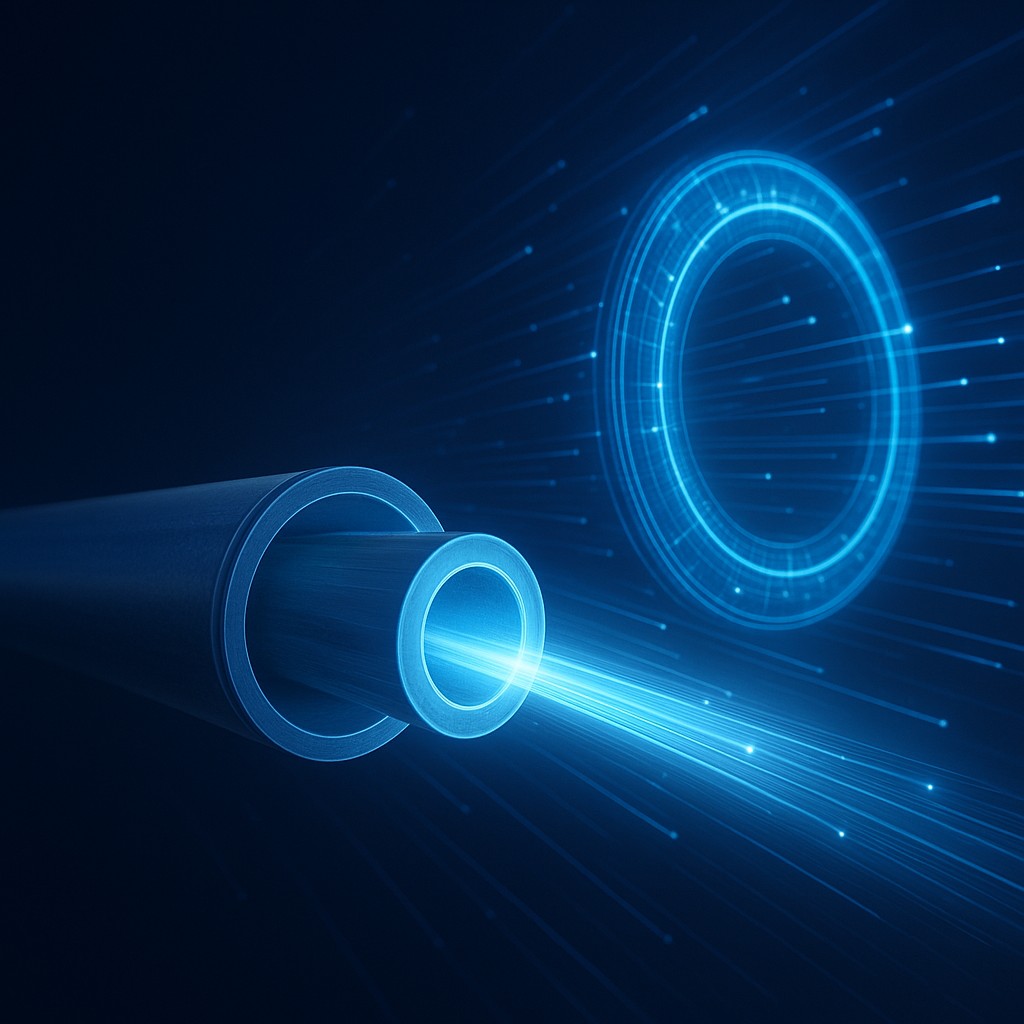
When you look at the stars on a clear night, you are witnessing the universe's ultimate speed limit in action. Light travels through the vacuum of space at a blistering 299,792 kilometers per second. This constant is the backbone of physics - the cosmic yardstick used to measure everything else. However, the moment that same light hits a "thick" substance, like a pool of water or a pane of glass, it hits a wall of invisible friction. In the solid glass core of a modern fiber optic cable, light slows down by roughly 30 percent. While that might not seem like a disaster when you are just scrolling through social media, it acts as a massive "latency tax" on the global economy. In this world, milliseconds are the difference between a successful robotic surgery and a medical emergency.
For decades, we accepted this slowdown as an unchangeable law of engineering. We built our entire digital world on solid silica glass fibers, assuming that the physical properties of glass were a hurdle we simply had to live with. But a quiet revolution is taking place beneath our feet and under our oceans. Engineers have figured out how to stop sending light through the glass itself and instead send it through the air. By creating "hollow-core" fibers, they are essentially building a vacuum-sealed highway for data, allowing information to move at nearly the true speed of light. This shift is more than just a minor update; it is a fundamental redesign of how the internet breathes.
The Glass Ceiling of Traditional Connectivity
To understand why hollow-core fiber is such a breakthrough, we first have to look at the limits of the old way. Standard fiber optic cables work through a process called total internal reflection. Imagine a long glass straw wrapped in a slightly different type of glass. When you shine a laser down that straw, the light bounces off the walls and stays trapped inside the core. This has worked brilliantly for forty years, but glass is a physical medium. It is dense and packed with atoms that act like a crowd of people in a narrow hallway. As light particles, or photons, try to squeeze through, they bump into these atoms, scattering and losing energy. This is why we need large, expensive amplifiers every few dozen miles to boost the signal.
More importantly, these glass atoms act like a speed brake. The refractive index (a measure of how much a material slows down light) of glass is about 1.46, meaning light travels at only about 200,000 kilometers per second inside it. In the world of high-frequency trading, where computer programs compete to buy stocks in the blink of an eye, a delay of even a few microseconds is an eternity. If a competitor uses a signal that travels 30 percent faster than yours, they have already won the trade before your data has even left the building. This "glass ceiling" has become the ultimate bottleneck for next-generation industries, from cloud computing to self-driving vehicle networks.
Designing a Cage for Light
If light travels faster in air, why didn't we use air-filled tubes from the start? The problem is that light is notoriously difficult to keep in a straight line without a solid guide. In a vacuum or open air, light naturally spreads out and fades away. If you simply pumped air into a standard glass tube, the light would soak right into the walls and disappear within centimeters. To solve this, scientists had to get creative with geometry, moving away from simple solid cores toward something that looks more like a high-tech beehive.
Hollow-core fibers use what is known as a photonic bandgap - an anti-reflective structure. If you were to slice the cable and look at it under a microscope, you wouldn't see a solid circle. Instead, you would see a complex, delicate web of tiny glass tubes arranged in a honeycomb or "nested" pattern around a central hole. This geometry creates a mathematical "no-go zone" for light. When the laser hits these specific geometric patterns, the light waves are reflected back into the central air-filled void with incredible efficiency. It is essentially a cage made of geometry rather than matter. Because the light stays in the air and barely touches the surrounding glass, it travels at 99.7 percent of the speed of light.
Shaving Microseconds to Save Lives
The most immediate use for this technology is in high-stakes finance, where "latency," or data delay, is a dirty word. In New York or London, firms pay millions of dollars to shave a single millisecond off their connection to the stock exchange. But the impact goes far beyond the market. Think about the future of remote surgery, where a specialist in Berlin might operate on a patient in Cape Town using a robotic arm. In that scenario, any lag between the doctor's hand movement and the robot's action could be fatal. By switching to hollow-core fiber, the feedback loop becomes almost instantaneous, making remote procedures as responsive as if the doctor were in the room.
We also see huge benefits for high-performance computing and Artificial Intelligence. Modern AI models are trained across thousands of interconnected chips that must talk to each other constantly. If the data transfer between these chips is slow, the entire process grinds to a halt. Hollow-core fiber allows these massive data centers to act as one giant, unified brain. Because the signal doesn't distort as much when it isn't fighting through solid glass, we can also send "cleaner" data over longer distances without needing to stop and fix the signal, which saves enormous amounts of electricity.
| Feature |
Standard Fiber Optic |
Hollow-Core Fiber |
| Core Material |
Solid Silica Glass |
Air or Vacuum |
| Signal Speed |
~200,000 km/s |
~299,000 km/s |
| Latency |
High (30% slower than light) |
Low (Near-vacuum speed) |
| Heat Sensitivity |
Higher (Glass expands/contracts) |
Lower (Light stays in air) |
| Primary Use Case |
Home internet, general telecom |
FinTech, AI, Remote Surgery |
| Signal Distortion |
Atomic interference from glass |
Minimal (Little interaction with matter) |
Overcoming the Manufacturing Nightmare
If hollow-core fiber is so much better, why isn't it already in your house? The answer lies in how difficult it is to make. Drawing a standard glass fiber is like pulling taffy; it is a relatively simple industrial process. Creating hollow-core fiber, however, is like trying to pull a thousand-mile-long piece of glass lace without any of the tiny holes collapsing or stretching out of shape. The honeycomb structure inside must be perfect down to the nanometer. If even one of those tiny air pockets is slightly lopsided, the light will leak out and the cable becomes useless.
Splicing these cables together is also a mechanical challenge. When you connect two standard fibers, you simply melt the ends together. If you try to melt hollow-core fiber without specialized equipment, the delicate internal structures collapse like a failed soufflé. Engineers have had to develop entirely new types of connectors and laser-welded joints to link these cables in the field. This makes the initial rollout much more expensive than traditional infrastructure. Consequently, we are seeing it deployed first in "premium" sectors like data center links and special financial routes before it eventually reaches the general public.
The End of Signal Interference
Beyond speed, there is another hidden benefit to keeping light out of glass: it eliminates "nonlinear effects." When you cram a high-powered laser into a tiny solid glass core, the glass itself starts to act strangely. The intense light actually changes the properties of the glass as it passes through. This leads to "crosstalk," where different channels of data start to bleed into each other. This is a major headache for internet providers because it limits how much data they can squeeze into a single strand of fiber.
In a hollow-core cable, the light travels through air, which is about a thousand times less dense than glass. Air doesn't react to the light in the same way. This means you can turn up the power of the lasers and pack significantly more data into the fiber without the signal turning into a garbled mess. It is like moving from a crowded, echoing hallway where everyone is shouting to a wide-open field where everyone can speak clearly and still be heard. This clarity allows for simpler hardware at both ends of the cable, potentially reducing the overall energy footprint of our global network.
A Future Without Lag
As we move toward a world of augmented reality, autonomous drone fleets, and global AI, our tolerance for delay is vanishing. We are moving out of the "bandwidth era," where we just wanted more data, and into the "latency era," where we need that data to be instant. Hollow-core fiber is the physical foundation for this shift. It represents one of those rare moments in engineering where we stop trying to move faster through an obstacle and instead find a way to remove the obstacle entirely.
The transition to hollow-core fiber reminds us that even the most established technologies are ripe for reinvention. For decades, we thought the "speed of the internet" was limited by our computers, but it turns out it was limited by the very glass we used to carry it. As these air-filled cables begin to span the globe, they will bring us closer to a "real-time" planet, where distance truly stops being a barrier to human connection. The next time you click a link and the page appears instantly, remember that somewhere deep underground, a pulse of light might be flying through a microscopic honeycomb at the true speed of light.