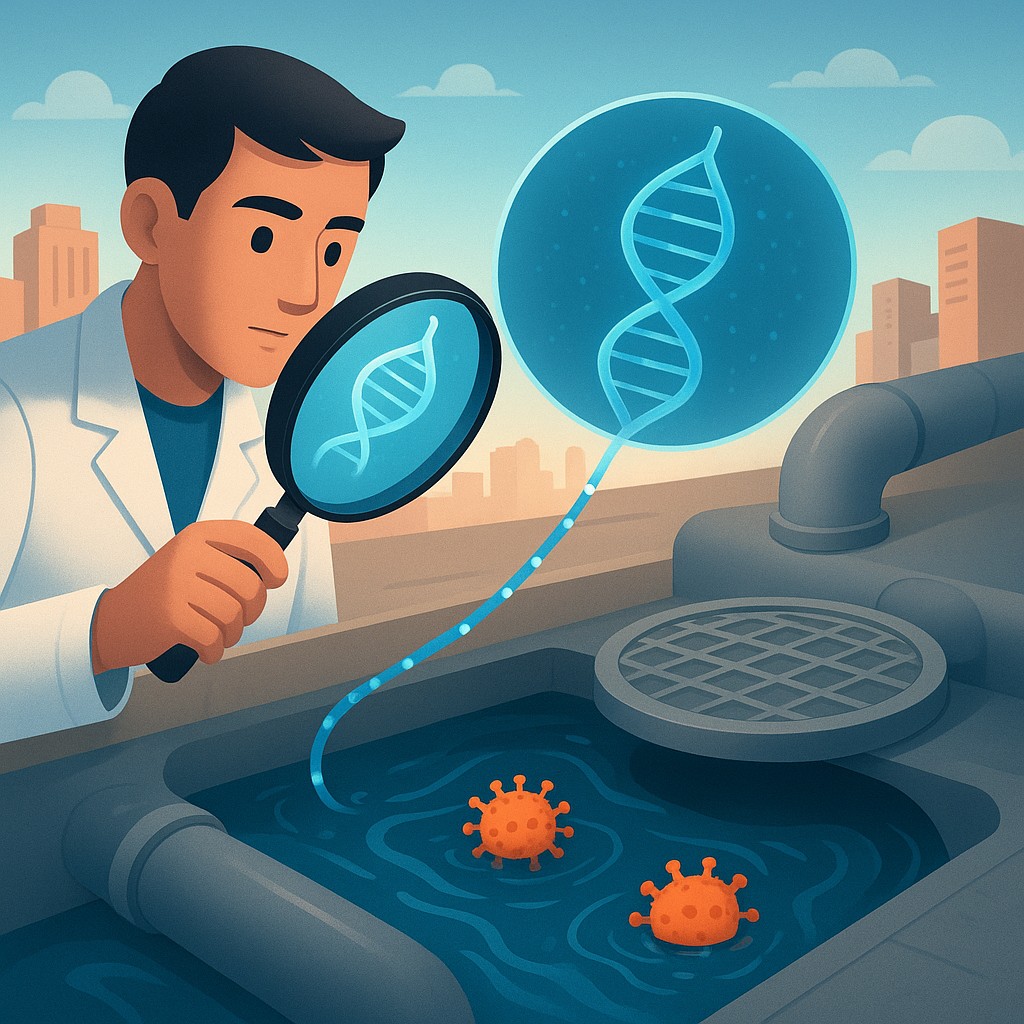
Imagine for a moment that your city is one giant, breathing organism. Like any living thing, it consumes resources and produces waste. For decades, doctors and public health officials have tried to monitor the health of this "organism" by waiting for individual cells - people like you and me - to feel sick enough to see a doctor. By the time a patient sits on that crinkly paper exam table and explains their symptoms, the virus has usually spent days or even weeks quietly hopping from person to person. Historically, we have fought outbreaks with a permanent lag, always looking at where the fire was yesterday rather than where the sparks are landing today.
There is, however, a massive, hidden library of health data flowing right beneath your feet. Every time you flush a toilet, you contribute a tiny biological status report to a collective database. This is not about snooping on your personal habits; it is about capturing the genetic echoes of a community's health. Public health agencies have realized that by intercepting these reports at sewage treatment plants, they can spot an outbreak before the first person even reaches for a thermometer. This is the science of wastewater surveillance, a field that has turned our infrastructure into a crystal ball for infectious disease.
The City's Invisible Genetic Signature
At its core, wastewater surveillance relies on a biological reality we often prefer to ignore: humans are "leaky" hosts. When a virus like the flu, RSV, or COVID-19 enters the body, it begins to copy itself. During this process, even if a person feels fine or never develops a cough, they shed fragments of the virus's genetic material (its RNA or DNA) through their waste. These fragments are not necessarily live, infectious viruses, but they are distinct enough to act as a biological fingerprint that identifies exactly what is circulating in the neighborhood.
Modern labs use a technique called qPCR (Quantitative Polymerase Chain Reaction) to find these genetic needles in the city's massive haystack of sewage. They are not trying to grow the virus in a petri dish; instead, they look for specific codes that match known germs. Because thousands of people share the same pipes, a single sample from a treatment plant can represent the combined health of hundreds of thousands of residents. It is the ultimate anonymous survey, capturing data from the healthy, the sick, and those who are just about to fall ill.
This method solves the "sampling bias" that often hampers traditional medicine. Many people avoid the doctor because they lack insurance, cannot take time off work, or assume they just have mild allergies. In the traditional system, these people are invisible. In the sewer system, however, everyone is counted. This provides a raw, unfiltered look at how common a disease actually is, rather than just the "official" version seen in clinic waiting rooms.
Racing Against the Clinical Lag
One of the most powerful features of this technology is its role as a "leading indicator." In data science, a leading indicator is a signal that shifts before a large trend becomes obvious. It is like seeing dark clouds on the horizon before the first raindrop hits your windshield. Clinical data, such as hospital admissions or positive lab tests, are "lagging indicators" because they reflect events that have already happened. By the time someone is admitted to the ICU, they have likely been infected for two weeks and have already passed the virus to several others.
Wastewater data often picks up a spike seven to fourteen days before it shows up in clinics. This head start is a goldmine for public health strategy. When officials see a sharp rise in viral fragments in the sewage but clinics aren't busy yet, they know a wave is coming. This lead time allows them to shift resources. If a specific neighborhood shows a spike in polio or measles material, health departments can set up mobile vaccination clinics or alert residents in that specific zip code before anyone actually gets sick.
This predictive power was proven during the global efforts to track COVID-19 variants. As new versions of the virus emerged, wastewater labs identified specific mutations weeks before those strains became the dominant cause of hospitalizations. Seeing this "coming attraction" allows hospitals to stock up on treatments, adjust staffing, and warn the public to start wearing masks in crowded indoor spaces again.
Navigating the Ethics of Collective Privacy
With any power to monitor a population comes significant ethical questions. It is important to distinguish between "individual surveillance" and "wastewater surveillance." Unlike a blood test or a nose swab, wastewater monitoring is naturally grouped together. A single sample from a city main represents the combined output of thousands of people. It is technically impossible to reverse-engineer a city-wide sewage sample to identify the health of one specific person or household. This anonymity is the system's greatest strength, allowing for data collection without intruding on private medical records.
However, the tool can be dialed in for more precision. Researchers can sample an entire city, a specific neighborhood, or even a single large building, such as a college dorm or a prison. This is where the ethics get complicated. While monitoring a dorm can prevent an outbreak that would otherwise shut down a campus, it also raises concerns about "targeted" data. If a specific neighborhood is labeled a "hotspot," there is a risk of stigmatizing that community or making residents feel watched by the government through their plumbing.
To manage these risks, public health agencies follow strict rules. They generally focus on germs that pose a broad threat, such as respiratory viruses or preventable diseases like polio. The goal is never to monitor personal lifestyle choices, but to track "public enemies" moving through our shared environment. The following table shows how wastewater surveillance compares to traditional medical testing.
| Feature |
Clinical Testing (Doctors/Hospitals) |
Wastewater Surveillance |
| Timing |
Lagging indicator (records symptoms) |
Leading indicator (detects shedding early) |
| Bias |
High (only sees those who seek care) |
Low (sees the entire population) |
| Cost |
High (expensive per-person tests) |
Low (one sample covers thousands) |
| Detail |
Individual diagnosis |
Population-wide trends |
| Participation |
Requires active effort from patient |
Passive and automatic |
| Privacy |
Managed via medical privacy laws |
Naturally anonymous through dilution |
The Future of the Biological Early Warning System
We are only beginning to scratch the surface of what our waste can tell us. While the technology was perfected during the COVID-19 pandemic, it is now being used for many other health challenges. Some cities use it to track "superbugs," which are bacteria that have become resistant to common antibiotics. By seeing which resistance genes are flowing through the pipes, doctors can better understand which antibiotics will actually work when a patient gets an infection.
Another promising area is monitoring the opioid crisis. By analyzing chemicals in sewage, officials can see which specific synthetic drugs are entering a community in real-time. This allows for the rapid delivery of life-saving tools like Narcan (naloxone) to specific areas where fentanyl is detected, potentially stopping a wave of overdoses before they happen. This shift from reacting to problems to preventing them represents a fundamental change in public safety.
As the technology becomes cheaper and more automated, we may one day see "smart sewers" with sensors that provide 24/7 monitoring. Imagine a dashboard in a mayor's office that shows a "green" status for the city's health, turning "yellow" the moment a new flu strain is detected on the outskirts of town. This would not be a tool for fear, but for empowerment. It allows us to treat a city not as a collection of strangers who might get each other sick, but as an interconnected community that looks out for one another.
The move from individual medicine to population-wide monitoring is one of the most exciting shifts in modern science. It turns our humblest infrastructure into a high-tech guard, standing watch over our neighborhoods while we sleep. By listening to what our waste tells us, we can stop being victims of the next "mystery illness" and start building a more resilient future. The next time you walk past a manhole cover, remember that beneath that steel and concrete, a silent conversation is happening, one that might just save your life before you even know you are in danger.