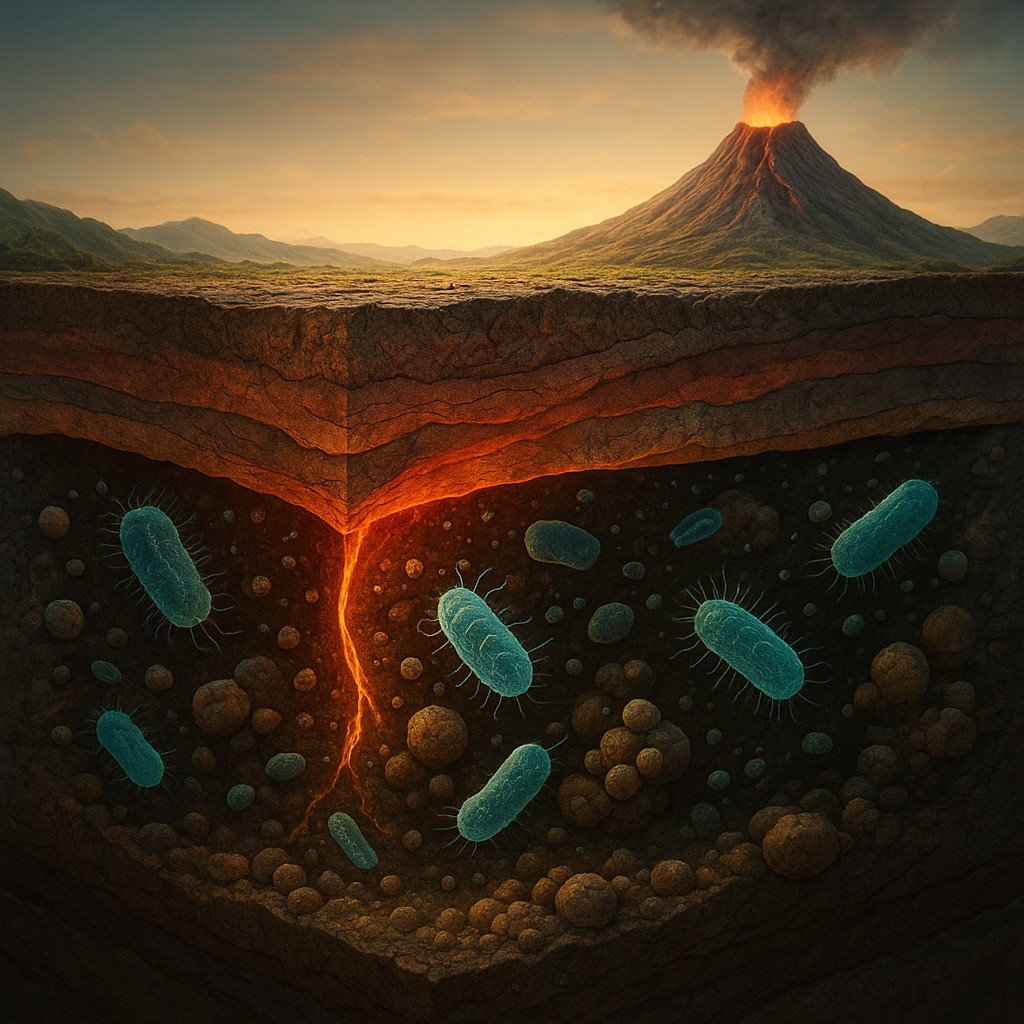
When we think of the Earth's climate, we usually look up at swirling clouds, the vast blue oceans, or the thick canopy of tropical rainforests. It is easy to see the planet as a giant, breathing organism that breathes through its "skin." However, miles beneath your feet, through solid rock and into the scorching, high-pressure depths of the crust, a secret world is hard at work. This underground realm is far from a graveyard of fossils and cold stone; it is a bustling metropolis of microscopic life that acts as a silent guardian of our atmosphere.
Recent discoveries show that microbes living deep within the Earth's crust consume massive amounts of carbon. They perform a huge "cleanup" operation that scientists previously underestimated. These tiny organisms live in the harsh environment of subduction zones - places where tectonic plates collide and one dives deep into the mantle. By capturing carbon that would otherwise burst out of volcanoes as greenhouse gases, these microscopic hitchhikers are effectively rebuilding the planet's plumbing. To understand how they do it and what it means for our future, we have to look deep into the inner workings of the Earth itself.
The Great Tectonic Conveyor Belt
To understand the role of these underground microbes, we first have to look at the massive geological machinery they call home. Our planet is divided into several large tectonic plates that are constantly in motion, moving at about the same speed your fingernails grow. In specific areas called subduction zones, one of these massive plates - usually a heavy oceanic plate - slides beneath a lighter continental plate. As it sinks, it carries down sand, mud, and vast amounts of carbon trapped in organic matter or limestone.
This process is essentially the Earth's way of recycling its crust. As the sinking plate moves deeper into the hot mantle, intense pressure and heat begin to "cook" the rocks. This heat releases gases, specifically carbon dioxide, which then rise back toward the surface. Historically, scientists believed that most of this carbon either sank all the way into the mantle or escaped back into the air through volcanic eruptions. We imagined a simple system where carbon went down and then came right back up through a volcanic chimney.
However, the Central American Trench has given researchers a much more complex picture. This subduction zone, stretching along the coast of countries like Costa Rica and Panama, serves as an outdoor lab for studying carbon movement. Researchers found a missing link in the cycle. A significant portion of the carbon that should have been coming out of the volcanoes was simply gone. It wasn't reaching the atmosphere, and it wasn't sinking into the mantle. Instead, it was being intercepted by an invisible army of microbes in the "forearc" - the region between the deep-sea trench and the volcanoes.
Dining at the Edge of Destruction
The microbes living in these deep, dark cracks are not your average garden bacteria. They are extremophiles, organisms that thrive in conditions that would instantly kill most other life. In the deep crust, they face crushing pressure and temperatures that can reach the boiling point of water. Despite these odds, they have found a home by "eating" the chemical energy provided by the sinking tectonic plate. They don't need sunlight or oxygen; they belong to a deep-seated ecosystem that survives on the Earth’s internal chemistry.
When carbon dioxide and other fluids escape from the sinking plate, they seep through the rock above. This is where the microbes lie in wait. These organisms use a process called "chemolithotrophy," which means they get their energy from inorganic rocks and gases. As carbon-rich fluids pass through their habitat, the microbes consume the carbon and build it into their own bodies or trigger chemical reactions that turn the carbon into solid minerals.
This biological intervention acts like a massive filter. Imagine a giant chimney that is supposed to release smoke into the sky, but someone has stuffed the pipe with millions of tiny sponges that soak up the soot. Because these microbes turn carbon gas into biomass (their physical bodies) or into carbonate minerals (essentially turning gas into rock), the carbon becomes "sequestered," or locked away. It stays in the crust for millions of years instead of entering the air and warming the planet. This suggests the biological "crust" of the Earth is far thicker and more influential than we ever imagined.
Balancing the Global Carbon Ledger
For decades, the global carbon cycle was viewed mainly as a physical and chemical process. We accounted for the carbon absorbed by trees, the carbon dissolved in the oceans, and the carbon buried in seafloor mud. The "deep carbon cycle" was seen as the slow, grinding part of the books, where geology took millions of years to move carbon around through melting rock and volcanic vents. Including life in this deep process changes the math significantly.
The study of the Central American Trench showed that these microbes can divert as much as 20% of the carbon that would otherwise reach the atmosphere. This is a staggering number. If we apply this to subduction zones across the globe, it means the Earth has a built-in biological thermostat that has been operating quietly for billions of years. By "eating" the carbon, these microbes prevent the atmosphere from becoming overloaded with greenhouse gases, which would lead to runaway global warming.
| Carbon Stage |
Physical Location |
Biological Role |
Climate Impact |
| Subduction |
Deep Sea Trench |
Transport of organic matter |
Removes carbon from the surface |
| Degassing |
Forearc/Crust |
Microbial consumption |
Prevents gas from reaching the air |
| Mineralization |
Deep Rock Veins |
Conversion to carbonate |
Long-term storage in stone |
| Eruption |
Volcanic Arc |
Residual gas release |
Natural atmospheric heating |
As shown in the table above, the "Degassing" and "Mineralization" stages are where the magic happens. Without the microbes, the "Eruption" stage would be much more intense. This discovery forces us to rethink the history of life on Earth. We used to think life was a passive passenger on a geological ship, merely reacting to changes in the air and climate. Instead, it seems that life deep underground is an active crew member, helping to steer the ship and maintain the conditions that allow surface life to thrive.
Misconceptions About the Deep Biosphere
One of the most common myths is that all life on Earth depends on sunlight. We are taught in school that the sun is the ultimate source of energy through photosynthesis. While this is true for us and the plants we eat, the deep biosphere is an entirely different beast. The microbes in subduction zones are part of a "dark" food web. They prove that life can exist, and even thrive, in total isolation from the surface. If the sun were to go out tomorrow, these deep-crust microbes wouldn't even notice for a very long time.
Another misconception is that the Earth's crust is a solid, impenetrable mass. In reality, the crust is riddled with fractures, pores, and channels where fluids flow. It is more like a giant, stony sponge than a solid brick. This porousness allows the microbes to move and the carbon to circulate. When we talk about "locking carbon away," we aren't talking about a literal box. Instead, we are talking about turning a mobile gas into a stable solid, fixed within the maze-like structure of the Earth's crust.
Finally, people often assume these tiny organisms are too small to have a global impact. It is hard to believe that something invisible to the eye can change the chemistry of an entire planet. But when you consider the sheer volume of the Earth's crust, the total mass of these microbes - often called "intraterrestrials" - is estimated to be enormous. In fact, some estimates suggest that the total weight of microbial life beneath the surface may outweigh all human life on the surface many times over. Their strength lies in their numbers and their constant, unceasing metabolism.
The Long-Term Climate Shield
Understanding these trench microbes isn't just a matter of geological curiosity; it is a vital piece of the puzzle for understanding Earth's climate stability. Over millions of years, the Earth has gone through massive swings in temperature, from "snowball" periods where the whole planet was frozen to "hothouse" periods where crocodiles lived near the poles. Throughout these cycles, the planet has always managed to return to a habitable middle ground. The deep carbon cycle, managed by microbes, is likely a key reason why.
By acting as a buffer, these microbes ensure the carbon cycle doesn't lean too far in one direction. When volcanic activity increases and provides more food, the microbes potentially work harder to store that carbon. This self-regulating system is a cornerstone of the Gaia hypothesis - the idea that the Earth and its biological systems behave as a single, self-regulating unit to maintain the conditions for life. While the microbes aren't "trying" to save the planet, their natural survival instincts create a more stable environment for everyone else.
Future research into these microbial communities could also help us handle human-caused carbon emissions. While these microbes work over thousands or millions of years, learning how they convert gas into minerals could inspire new technologies for carbon capture. If nature has already figured out how to turn greenhouse gases into harmless rock using biology, we might be able to mimic those processes on the surface to help balance our own modern carbon footprint.
Exploring the Frontiers of Inner Space
The realization that the Earth's interior is teeming with life that regulates our climate is humbling. It reminds us that we are part of a vast, interconnected system that extends far beyond what we can see. We often look to the stars to find strange new worlds, but some of the most alien and important creatures are living right beneath our feet, miles into the darkness. They are the silent architects of our atmosphere, the tiny engineers who have been carbon-proofing the planet since long before humans arrived.
As we continue to explore the Central American Trench and other subduction zones, we will undoubtedly find more surprises. We are just beginning to map the "Deep Life" that inhabits our planet, and every new discovery helps us understand how the Earth remains such a resilient home. It is a story of cooperation between the cold, heavy movements of tectonic plates and the warm, energetic pulse of microscopic cells.
So, the next time you feel a breeze or enjoy a mild spring day, give a silent thanks to the billions of microbes dwelling in the crushing depths of the crust. They are hard at work, eating the Earth’s carbon and keeping the sky from falling, one molecule at a time. Their invisible labor proves that even the smallest organisms can hold the keys to a world's survival. The deep carbon cycle is a reminder that the Earth is not just a rock we live on, but a living, breathing system that protects us in ways we are only just beginning to understand.