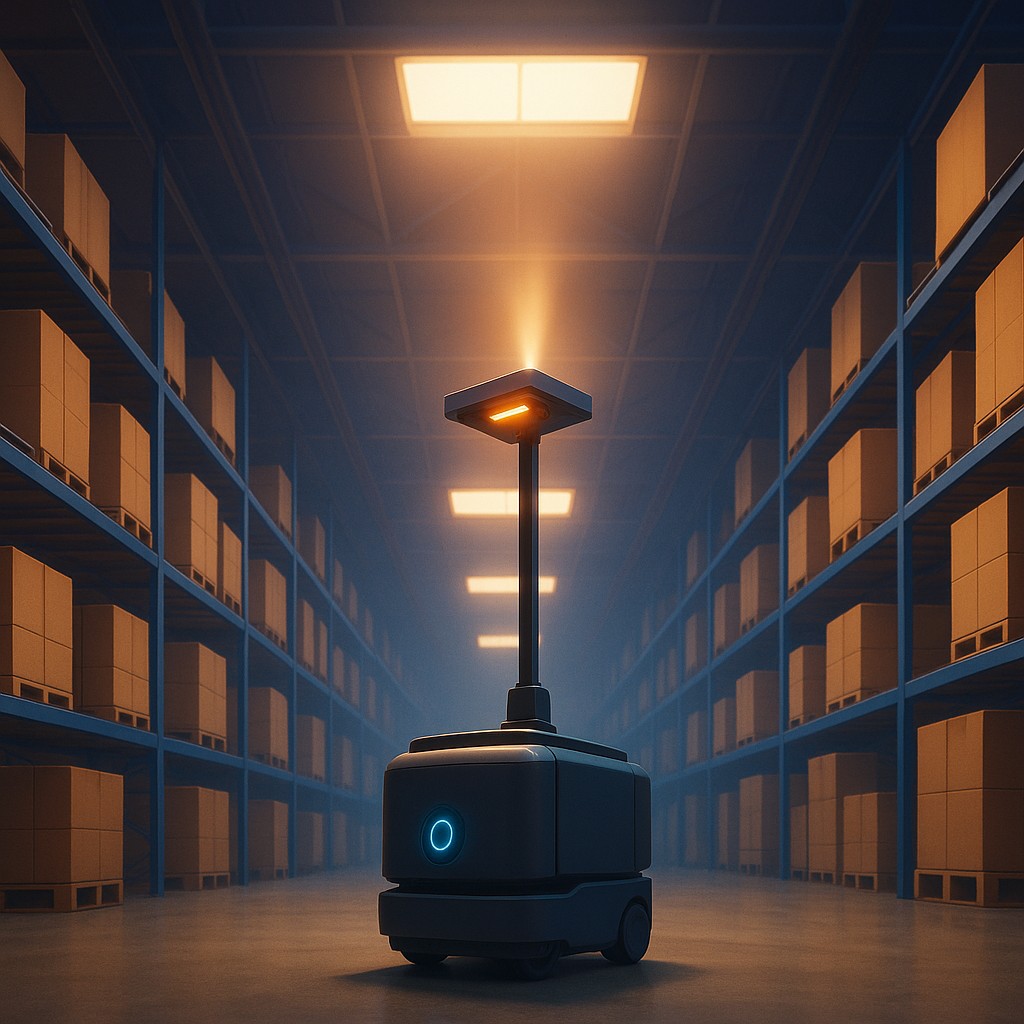
Imagine you are trying to navigate a crowded stadium. If you spend your time obsessively tracking every person, bag of popcorn, and spilled drink around your feet, you will move at a snail,s pace and likely bump into someone anyway. Your brain would be so overloaded by the shifting, chaotic floor-level data that you would fail to notice the giant signs hanging from the rafters that actually tell you where you are. This is the struggle of the traditional warehouse robot. These machines rely on sensors that attempt to map a messy, ever-changing floor, only to get confused when a forklift moves or a pallet is misplaced.
Instead of battling the chaos of the ground, a new breed of autonomous robots has decided to stop looking at the floor and start looking up. By treating the ceiling like a stable, glowing map of constellations, these machines have effectively turned the warehouse roof into a high-tech internal GPS. This shift in perspective is not just a quirky design choice, but a fundamental change in robotic architecture. It separates the act of finding one,s position from the act of dodging obstacles, helping warehouses run faster and with far fewer collisions.
The Problem of Sensory Overload in Dynamic Spaces
For decades, mobile robots have attempted to solve the positioning problem by using Simultaneous Localization and Mapping, commonly known as SLAM. In a typical SLAM setup, a robot uses lasers or cameras to build a map of its surroundings, noting where walls, shelves, and obstacles reside. The issue arises when those surroundings refuse to stay still. In a busy logistics hub, boxes are constantly being moved, people are walking by, and carts are shuffled from one aisle to another. This creates a map that is perpetually outdated the moment it is saved.
When a robot relies on floor-level data for navigation, it must constantly perform complex calculations to distinguish between a permanent structural pillar and a temporary stack of cardboard boxes. If the robot misidentifies a moving person as a wall, it stops entirely to avoid a collision. If it misses a small obstacle because its sensors are cluttered with similar-looking objects nearby, it risks a crash. The processor inside the robot ends up wasting its power on filtering, noise, rather than focusing on the primary goal of reaching a destination efficiently.
Ceiling Odometry as a Static Anchor
The genius of the ceiling-vision approach lies in how it exploits a stable environment. While the floor of a warehouse is a kinetic disaster zone of human activity, the ceiling is almost always a static expanse of industrial lights, air ducts, and structural beams. By simply pointing a camera upward, the robot gains access to a set of permanent landmarks that act as a celestial map. It uses a technique called visual odometry, where the software identifies unique patterns in the overhead lighting or ceiling architecture and uses them to calculate exactly how far it has moved and in which direction.
Because these overhead features are essentially permanent, the robot does not need to constantly update its internal map or recalibrate its path based on the chaos below. It tracks its position by observing how the ceiling patterns shift relative to its movement, much like a sailor navigating by the North Star. Since the ceiling will not sprout a new box or walk into the robot, the visual data is incredibly reliable. It requires only a fraction of the processing power needed for traditional floor mapping. This leaves the system with plenty of extra brainpower to dedicate to smarter path planning and faster movement.
Separating Location from Obstacle Avoidance
By moving the primary navigation sensor to the ceiling, engineers have achieved a rare feat in robotics: they have separated localization from obstacle avoidance. Think of this as the difference between having eyes on the road and having a GPS on your dashboard. When you drive a car, your GPS provides the framework to tell you how to reach your destination, while your eyes handle the immediate, second-by-second task of avoiding the car in front of you. Traditional robots tried to do both with the same set of sensors, often failing at one or both.
In this new setup, the machine uses its ceiling-facing camera to answer the question, "Where am I on the facility map?" while a separate, lightweight sensor array or a simple bumper system handles the question, "Is there anything currently in my path?" This modular approach allows the robot to move with confidence. It knows exactly where it is in the facility because the ceiling has not moved, and it can react to a human or an object crossing its path without losing its sense of place. It turns out that a robot is a much more capable worker when it does not have to map its own feet before taking a step.
Comparing Navigation Architectures
To truly grasp why this shift is revolutionary, it helps to look at the differences between standard SLAM and this newer, ceiling-based visual odometry model. The primary distinction is how each system perceives the reliability of its environment:
| Feature |
Floor-Based SLAM |
Ceiling-Vision Odometry |
| Data Stability |
Low (constantly changing) |
High (static ceiling) |
| Processing Goal |
Constant map re-learning |
Pattern matching to anchors |
| Risk Factors |
Distraction by dynamic clutter |
Direct sun or roof obstruction |
| Computational Load |
High (memory intensive) |
Low (efficient algorithms) |
| Primary Advantage |
Works in all spaces |
Speed and accuracy in clutter |
As the table shows, the trade-off is clear. Floor-based systems are universal, but they struggle with accuracy in high-traffic areas. Ceiling-vision systems are arguably more robust in real-world industrial settings, provided the facility has a consistent overhead structure. The simplicity of the ceiling approach is what makes it so scalable. You do not need to install beacons or tags in the floor, which saves a fortune in installation costs and maintenance.
The Future of Invisible Infrastructure
The movement toward ceiling-centric navigation signals a broader trend in automation. Instead of fighting against the complexities of our human-centric world, developers are finding clever ways to use the environment itself as part of the machine,s toolkit. We are moving away from the era of "smart robots in dumb rooms" toward a collaborative model where the architecture of the building facilitates the work of the machines within it. This does not mean the robots are less advanced; it means they are becoming more sophisticated by knowing what information they can safely ignore.
Learning to ignore the static of the world is a skill humans spend a lifetime mastering. We learn to filter out the background hum of traffic so we can hear our phone ring, and we learn to walk through a crowd without studying the shoes of everyone we pass. These autonomous robots are essentially learning the robotic equivalent of that self-awareness. By looking up, they stop worrying about the trivialities of the warehouse floor and start focusing on the efficiency of their mission.
The next time you see a machine zipping through a factory or a warehouse, consider that it might not be busy analyzing your every move. It is likely staring at the lights, mapping the geometry of the roof, and calculating its path through the constellations of the ceiling. It is a reminder that the best way to handle a complicated problem is not always to throw more processing power at it, but to change the angle of the lens. Keep looking for those opportunities in your own work where a slight shift in perspective could turn a chaotic mountain of data into a simple, clear, and stable path toward your goal.