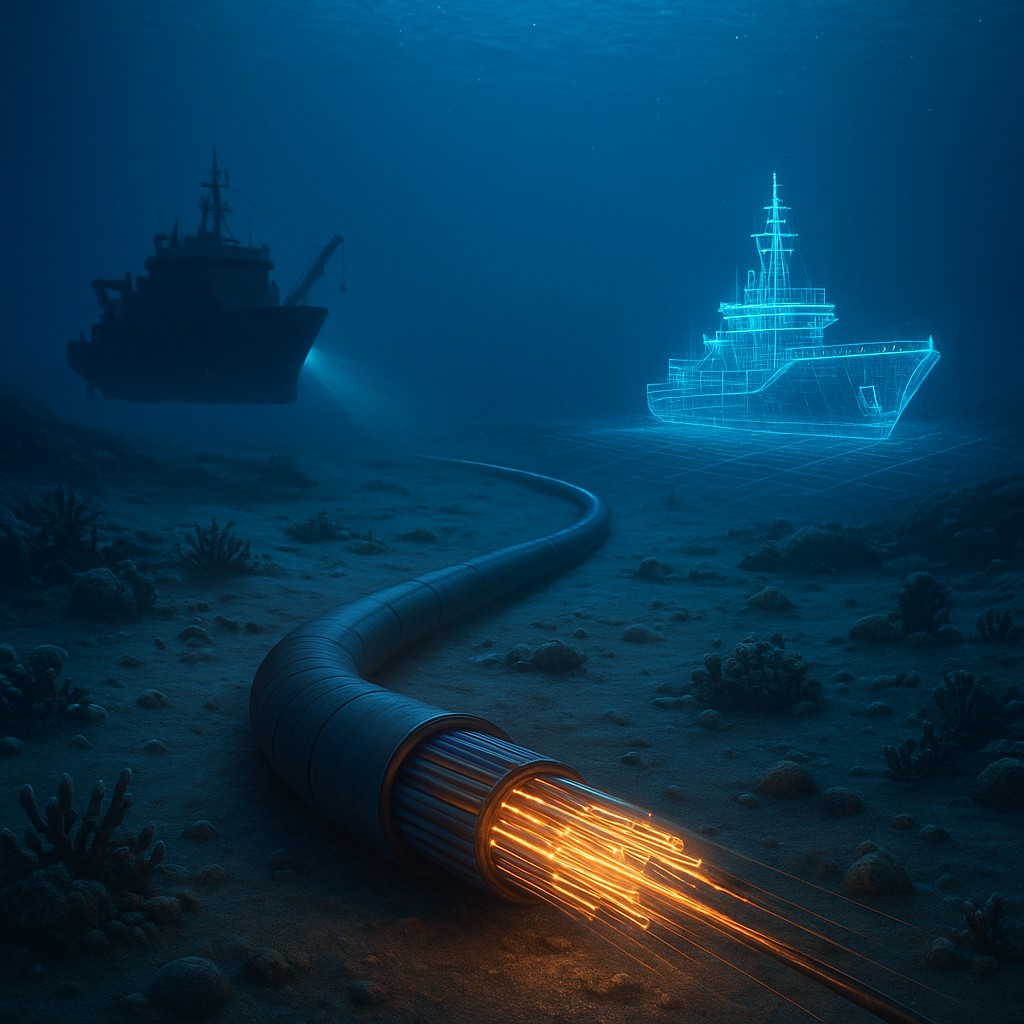
Deep beneath the rolling waves of the Atlantic and Pacific, hidden in the silent, freezing darkness of the seafloor, lies the true heart of modern civilization. We often imagine the internet as something floating in the "cloud" - a weightless, airy entity living in the sky. In reality, the internet is anchored to the mud by thousands of miles of fiber-optic cables. Some are no thicker than a garden hose, yet they carry trillions of dollars in financial transactions and endless streams of data every single day. These cables are the fragile, hidden nervous system of our global economy. For decades, we have treated them with a "fix it when it breaks" mentality, an approach that is becoming increasingly dangerous as global tensions rise.
When a stray anchor snags a cable or a shifting tectonic plate severs it, the impact on regional connectivity can be devastating. However, the nature of the threat is changing. We are no longer just worried about accidental errors by fishermen or underwater landslides. Maritime security experts now face the reality of intentional sabotage, where bad actors might try to "blind" a nation by cutting its digital lifelines. to fight this, the maritime security world is borrowing a concept from high-tech manufacturing and aerospace: the digital twin. This technological leap marks a shift from reactive repairs to predictive planning, turning the ocean floor into a monitored, simulated, and defended battlefield.
The Ghost in the Machine of the Deep Blue
To understand how we protect these cables, we first have to understand what a digital twin actually is. Imagine a physical object, like a massive underwater cable stretching from New Jersey to Ireland. Now, imagine building a perfect, one-to-one virtual replica of that cable inside a computer. This virtual version is not just a static map; it is alive. It constanty receives data from sensors on the ocean floor, satellite images of ship movements, and real-time weather reports detailing currents and pressure changes. If a massive storm rolls across the North Atlantic, the digital twin calculates exactly how much stress that specific surge puts on the physical cable’s outer shielding.
This "ghost version" of the infrastructure allows engineers to test "what-if" scenarios without ever getting their feet wet. They can simulate a 50,000-ton cargo ship dragging its anchor across a specific spot to see if the buried cable will hold or snap. Because the digital twin is connected to real-world data, it can flag problems immediately. If a fishing boat lingers over a sensitive junction for too long, or if the water temperature around a repeater - a device that boosts the signal - spikes unexpectedly, the digital twin alerts security teams. It transforms a silent, invisible asset into a transparent, monitored system that exists simultaneously in the physical mud and the digital world.
Moving from Firefighting to Foresight
The traditional way of managing underwater cables was remarkably basic. If a cable stopped working, a specialized repair ship would be sent to the general area. It could take days or weeks to arrive, only to spend more time fishing for the broken ends in the dark. This "emergency room" strategy is a nightmare for national security. By using digital twins, maritime authorities are moving toward a predictive model. Instead of waiting for the lights to go out, sensors can detect the "vibrational signature" of a vessel approaching a restricted zone. The system then checks the vessel's official ID data against its actual behavior to determine if it is a legitimate merchant ship or something more suspicious.
Predictive maintenance also saves millions of dollars in wear and tear. Underwater cables face immense pressure and corrosive salt, but they do not wear down evenly. A section of cable tucked in a calm trench might last fifty years, while a section exposed to fast currents near a continental shelf might fray in ten. The digital twin tracks these environmental stresses with precision. It tells operators which specific three-mile stretch of cable is likely to fail next month. This allows them to schedule maintenance during calm seas rather than rushing out during a winter gale. It turns the entire ocean into a predictable chessboard where we can see the opponent's moves before they are even made.
The Logistics of Protecting the Invisible
Managing these networks requires a blend of high-level physics and gritty maritime patrolling. The digital twin acts as the central brain, while the "muscles" are the naval vessels and autonomous underwater vehicles (AUVs) - uncrewed robotic subs - that act on its insights. When the simulation shows a high risk of "anchor drag" in a shallow corridor due to a hurricane, authorities can issue warnings to shipping fleets or send drones to monitor the area. This targeted approach is essential because the ocean is simply too big to patrol everywhere at once. We have to know exactly where to look.
| Feature |
Reactive Traditional Model |
Predictive Digital Twin Model |
| Primary Goal |
Repairing breaks after they occur |
Preventing breaks before they happen |
| Data Source |
Visual inspections and signal loss |
Live sensors, satellites, and AI models |
| Response Time |
Days to weeks for mobilization |
Real-time alerts and preventative patrols |
| Cost Efficiency |
High emergency repair costs |
Strategic, planned maintenance costs |
| Security Type |
Passive (hidden by the ocean) |
Active (monitored by digital replicas) |
While the table above highlights the clear advantages of the digital twin approach, this technology is not a magic wand. Building a digital twin requires an immense amount of data, and the ocean is a notoriously difficult place to collect it. Water blocks most radio waves, meaning we cannot use GPS or standard Wi-Fi to talk to sensors at the bottom of a trench. Instead, we rely on acoustic modems that use sound waves or specialized fiber-optic sensing, like Distributed Acoustic Sensing (DAS). This technique turns the cable itself into a giant microphone capable of "hearing" nearby ships or seismic activity.
Where the Simulation Meets the Silent Trenches
Despite the brilliance of these virtual models, the deep sea remains one of the most mysterious places on Earth, and that mystery provides cover for those who wish to do harm. The digital twin is exceptionally good at tracking things we can see from space, like merchant ships, or things we can measure with sensors, like water pressure. However, it struggles in "ultra-deep" zones, such as the Hadal trenches, which can be over six miles deep. In these regions, placing sensors is nearly impossible due to the crushing pressure, which can exceed 15,000 pounds per square inch.
This creates a "blind spot" in the digital twin's vision. A sophisticated actor using a deep-diving robotic sub could, in theory, approach a cable in these deep zones without being detected by surface sensors. This is the current frontier of maritime security research. Engineers are working on ways to use the light traveling inside the fiber-optic cables themselves to detect disturbances. Because light is sensitive to even the slightest vibration, a submarine passing near a cable might cause a microscopic "jitter" in the data stream. If the digital twin is smart enough to recognize that jitter, it can pinpoint an intruder even in the pitch-black basement of the world.
Correcting the Myth of the Wireless World
One of the biggest hurdles in cable security isn't technological; it is psychological. Many people believe that the move toward satellite internet, like Starlink, makes underwater cables obsolete. This is a dangerous mistake. While satellites are great for reaching remote areas, they cannot handle the massive volume of data required for the global backbone. A single fiber-optic cable can carry more data per second than thousands of satellites combined. If the underwater networks failed, satellites would be immediately overwhelmed, leading to a total collapse of international banking, cloud computing, and global communications.
Furthermore, we often think of these cables as indestructible steel pipes. In reality, they are surprisingly thin. While the portions near the shore are heavily armored to withstand boat anchors and shark bites (sharks occasionally bite cables, though they don't like the taste), the cables in the deep ocean are often protected by only a thin layer of plastic. They are not fortresses; they are delicate glass threads. This is why the digital twin is so vital. We cannot make the cables invulnerable, so we must make the environment around them transparent and predictable.
The Future of Sovereign Sea-Shields
As we look toward the next decade, combining artificial intelligence with digital twins will likely lead to "self-healing" or "self-rerouting" networks. Imagine a system where the moment a digital twin detects a high probability of a cable cut in one region, it automatically moves 100 percent of the traffic through cables in another ocean before the cut even happens. This proactive rerouting would ensure that the user never even notices a glitch. The goal is to create a digital shield that is so fast and so smart that sabotage becomes pointless.
The journey from laying heavy copper wires across the Atlantic in the 1850s to monitoring virtual "ghost cables" in a 3D simulation shows incredible human ingenuity. We have taken the most chaotic, unmanageable environment on our planet - the deep ocean - and begun to map its every pulse. By mastering the digital twin, we are not just protecting wires; we are protecting the shared knowledge, trade, and connection of the entire human race. It is a high-stakes game of chess, but for the first time in history, we are beginning to see the whole board.