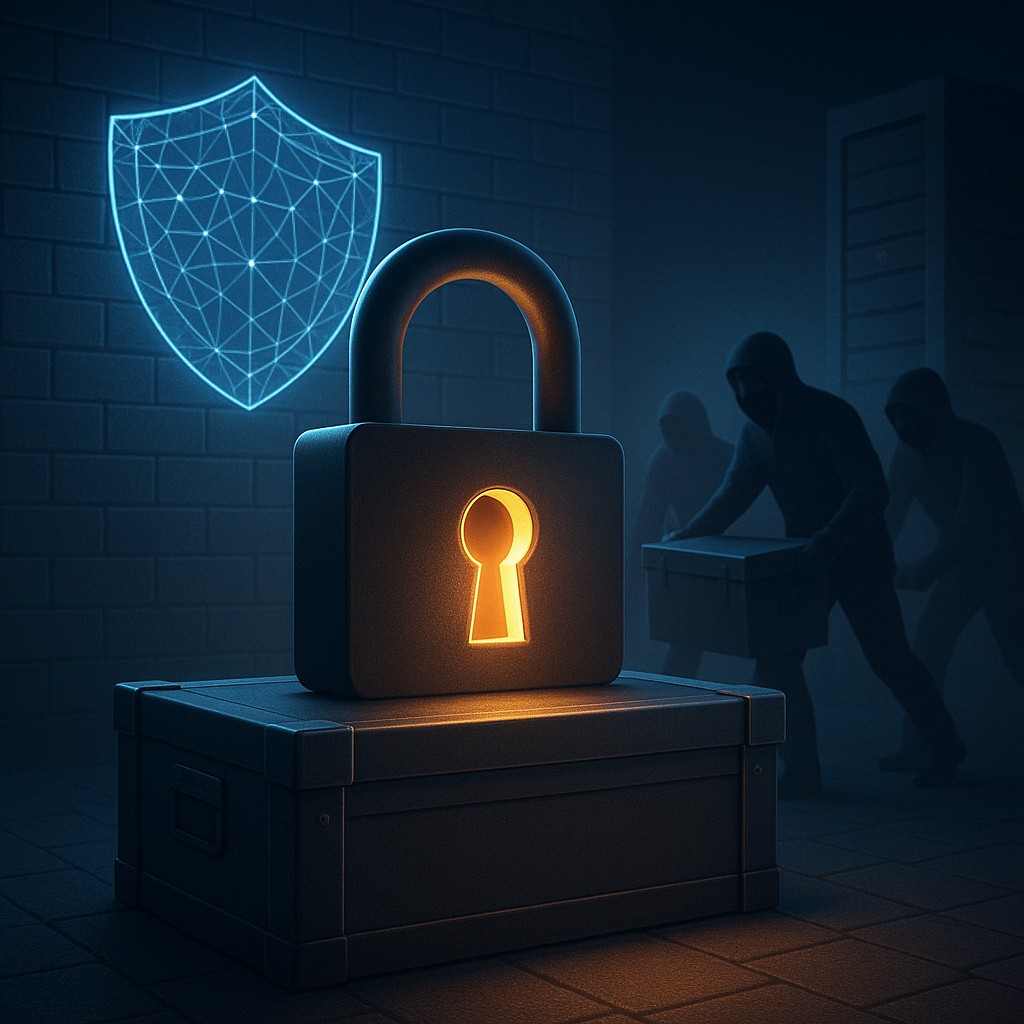
Imagine for a moment that you are a high-stakes digital archivist. Every day, you receive thousands of locked trunks filled with secrets, ranging from casual gossip and medical records to state intelligence and financial blueprints. You secure these trunks with the most advanced padlocks ever designed. These mechanisms are so complex that even the world’s fastest locksmith would need billions of years to pick them. You feel safe.
But then, you notice something unsettling: a group of shadowy figures is hauling your locked trunks away into a massive warehouse. They cannot open them today, but they are betting that one day, a master key will be invented. They hope to make your "unbreakable" locks look like cheap plastic toys.
This is the reality of our current digital landscape, a trend security experts call "Harvest Now, Decrypt Later." We are currently living in a golden age of encryption. Our data is protected by mathematical problems that today's computers find nearly impossible to solve. However, the ticking clock of quantum computing threatens to change everything. While a fully functional, large-scale quantum computer capable of breaking modern encryption does not exist yet, the data we send today is already being intercepted and stored by adversaries waiting for the technology to catch up. To fight this future threat, the engineers behind your favorite messaging apps are already installing "quantum-proof" locks on your digital trunks.
The Mathematical Wall and the Quantum Sledgehammer
To understand why we need a new kind of security, we first have to appreciate how the old kind works. Most of the encryption protecting your texts, emails, and bank transfers today relies on a branch of mathematics called number theory. Specifically, it relies on the fact that multiplying two incredibly large prime numbers is easy, but finding those original two primes if you only have the final product is extraordinarily difficult.
It is a one-way street. If I give you the number 15, you can tell me the prime factors are 3 and 5 in a heartbeat. But if I give you a number that is hundreds of digits long, even the most powerful supercomputers on Earth would have to grind away for centuries to find the answer.
Standard computers are essentially very fast calculators that think in bits, which are either ones or zeros. They tackle problems one step at a time. To break modern encryption, a standard computer has to try a massive number of combinations, which is why your secrets stay safe. Enter the quantum computer. Instead of bits, it uses qubits. These can exist in multiple states at once thanks to a property called superposition. When you combine this with another quantum quirk called entanglement, you get a machine that does not just calculate faster, it calculates differently. In 1994, a mathematician named Peter Shor developed an algorithm proving that a sufficiently powerful quantum computer could factor those massive prime numbers in minutes rather than millennia.
Preparing for the Harvest Now Attack
The most pressing threat is not that a quantum computer will suddenly appear tomorrow and empty your bank account. The real danger is the "Harvest Now, Decrypt Later" strategy. Because digital storage is cheap, certain groups can capture encrypted traffic moving across the internet today and simply wait.
Ten or twenty years from now, when the hardware matures, they can run Shor’s algorithm on that archived data. For a grocery list, this is irrelevant. For the identity of a whistleblower, a corporate trade secret, or a government’s long-term strategic plan, this is a catastrophic security breach waiting to happen.
This is why apps like Signal, Apple’s iMessage, and Google’s RCS are moving towards Post-Quantum Cryptography (PQC) immediately. They are not waiting for the threat to materialize because the data being sent right now might still be sensitive in two decades. By integrating quantum-resistant algorithms today, developers are ensuring that even if a message is intercepted and stored for thirty years, the "master key" of the future will still be useless. We are essentially upgrading the locks on our trunks before the trunks even leave the house. This ensures the contents remain scrambled long after current encryption standards have fallen.
Navigating the Multidimensional World of Lattices
With the "prime number" trick essentially defeated by the theoretical power of quantum bits, mathematicians had to find a new type of math that even a quantum computer could not shortcut. The most promising solution is called lattice-based cryptography.
Imagine a vast, multidimensional grid of points. To a human or a standard computer, a 2D grid is easy to navigate. But lattice-based math involves thousands of dimensions. The "key" involves finding a specific point in this massive thicket that is closest to another given point, which is hidden behind layers of intentional mathematical noise.
Quantum computers are great at finding patterns in periodic math, like the repeating cycles used in prime factorization. However, they struggle with the "shortest vector problem" found in these high-dimensional lattices. There is no known quantum shortcut to navigate this geometry. It is like trying to find a specific needle in a haystack, but the haystack is shifting in 500 different directions at once, and every time you look at it, the needle seems to move. By basing our new encryption on these complex geometric structures, we are building a defense that remains strong whether the computer doing the cracking uses silicon chips or atomic particles.
| Feature |
Classical Encryption (RSA/ECC) |
Post-Quantum Encryption (Lattice) |
| Mathematical Basis |
Factoring large primes or elliptic curves |
High-dimensional geometry (lattices) |
| Primary Threat |
Brute force (from current PCs) |
Shor’s Algorithm (from Quantum PCs) |
| Key Size |
Small and efficient |
Significantly larger and heavier |
| Computational Cost |
Very low |
Higher (requires more processing) |
| Current Status |
Standard but eventually vulnerable |
Being integrated into modern apps now |
The Weight of the New Digital Armor
While lattice-based cryptography is incredibly secure, it does not come for free. In software engineering, there is always a trade-off. Traditional encryption keys are tiny, often just a few hundred bits. They travel across the internet almost unnoticed. Post-quantum keys, however, are quite "chunky." Because they have to describe complex multidimensional structures, they can be many times larger than the keys we use today. This means that every time you start a "secure" chat, your phone has to send and receive much more data just to say hello.
Beyond the data size, these new algorithms require more "computational lifting." Your phone’s processor has to work harder to encrypt and decrypt a message using these complex geometric lattices. For a single message, you will not notice the difference. But for a server handling millions of connections a second, or a battery-powered device trying to stay alive all day, this increased "overhead" (the extra processing power required) is a significant hurdle. Engineers are currently working on optimizing these protocols so that we get the benefit of quantum-level security without our phones turning into pocket-sized heaters every time we send an emoji.
Hybrid Systems and the Bridge to the Future
Because we are currently in a transition period, almost no one is switching entirely to post-quantum encryption yet. Instead, the industry is moving toward "hybrid" systems. Think of this as putting two different locks on your door. One lock is the traditional one we have used for years, and the second is the new, fancy quantum-proof lock.
Even if the new math has a hidden flaw we have not discovered yet, the old lock still holds. And if a quantum computer appears, the old lock might fail, but the new one will keep the door shut.
This "belt and braces" approach allows the world to test these new algorithms in the wild without risking current security. It is a massive logistical undertaking. Every time a major platform like Signal or Apple updates its protocol, it has to ensure that older versions of the app can still talk to newer versions and that the "handshake" (the initial connection) between devices remains seamless. We are essentially rebuilding the engine of the internet while the car is driving 70 miles per hour down the highway. This proactive shift is a rare instance of the tech world solving a problem decades before the crisis actually arrives. It proves that sometimes, the best way to predict the future is to secure it.
The transition to post-quantum security underscores a fundamental truth about our digital lives: privacy is a moving target. As our tools for calculation grow more powerful, our tools for protection must evolve as well. By reaching into the abstract realms of multidimensional geometry to defend against machines that haven't even been fully built yet, we are playing one of the most sophisticated games of hide-and-seek in human history. It is an inspiring reminder that even as the landscape of technology shifts beneath our feet, human ingenuity remains one step ahead, ensuring that our secrets stay ours for as long as we need them.