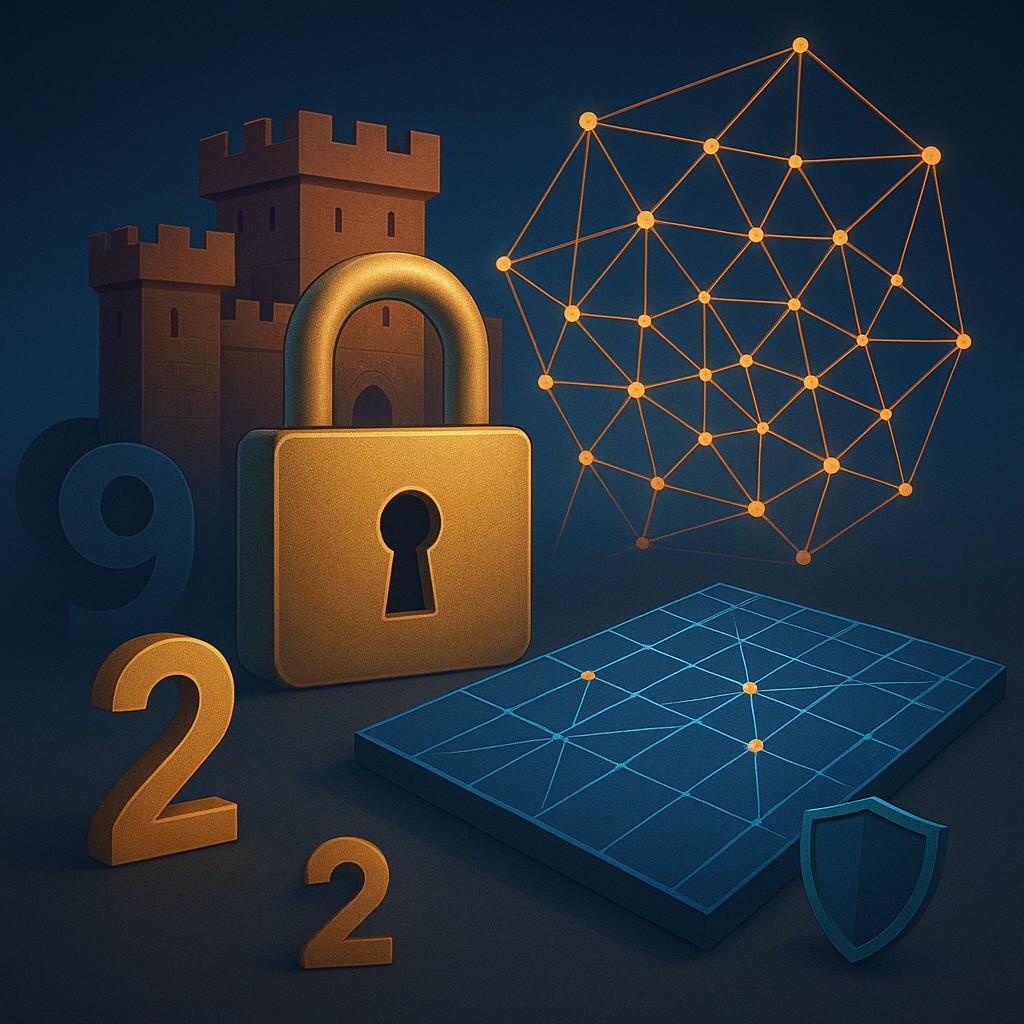
Imagine for a moment that all your digital secrets - from banking passwords to private messages - are locked inside a vault that relies on a specific kind of math problem. For decades, this system has worked perfectly because standard computers are quite slow at solving these puzzles, which usually involve finding the prime factors of enormous numbers. However, a new kind of "super-key" called a quantum computer is on the horizon. These machines don't just crunch numbers faster; they use the laws of subatomic physics to bypass the lock entirely, turning a task that would take a thousand years into a morning chore.
This looming threat has triggered a quiet revolution in cybersecurity. Experts aren't just building stronger versions of the old locks; they are pivoting to an entirely different branch of mathematics to ensure our data stays safe once today’s encryption becomes obsolete. This new frontier is known as post-quantum cryptography. It swaps traditional number theory for complex, multi-dimensional geometry known as lattices. It is a shift from thinking about numbers on a line to thinking about points hidden in a vast, invisible grid of a thousand dimensions, where even the most powerful quantum machine gets lost in the fog.
The Fragile Castle of Prime Numbers
To understand why we need to change everything, we first have to look at how we have done things since the 1970s. Most modern encryption, such as the RSA algorithm that secures your web browser, is based on "asymmetric" math - problems that are easy to do in one direction but hard to reverse. If I give you two large prime numbers, say 13 and 17, you can multiply them in seconds to get 221. But if I give you 221 and ask which two primes I used, it takes more effort. Now, imagine those prime numbers are 300 digits long. For a normal computer, finding those original ingredients is so difficult that it would take longer than the age of the universe to crack the code.
The problem is that in 1994, a mathematician named Peter Shor discovered a set of instructions - an algorithm - that changes the rules of the game. When run on a sufficiently powerful quantum computer, Shor’s Algorithm can find those prime factors almost instantly. It does not use "brute force" by trying every possible combination. Instead, it uses quantum interference to "see" the mathematical structure of the entire problem at once. Because the internet is built on the difficulty of finding these factors, a working quantum computer acts like a universal skeleton key. This isn't just a future problem, either. There is a "harvest now, decrypt later" risk, where bad actors could steal encrypted data today and simply wait five or ten years for a quantum computer to exist so they can read it.
Stepping Into the Multi-Dimensional Grid
If prime numbers are the old castle walls, lattice-based mathematics is the new, impenetrable forest. At its simplest level, a lattice is just a regular arrangement of points in space, like the dots on graph paper or the structure of a crystal. In two dimensions, you can easily see the pattern. If you start at a center point called the origin, you can reach any other point in the grid by taking steps in certain directions. These "steps" are called vectors. If you have two vectors pointing in different directions, you can combine them to land on any intersection in the grid.
Cryptographers scale this up from two dimensions to hundreds or even thousands. Humans are good at visualizing 2D or 3D space, but as soon as you add a fourth, fifth, or 800th dimension, our intuition - and the logic of our algorithms - begins to fail. In these high-dimensional spaces, a lattice is a dizzying cloud of points that are mathematically related but impossible to visualize. This geometric complexity provides the perfect hiding spot for sensitive data because it creates problems that are easy to set up but notoriously hard to solve backward.
The Shortest Vector Problem as a Digital Anchor
The most famous of these puzzles is the Shortest Vector Problem (SVP). Imagine I give you a collection of very long, messy vectors that take you wildly across a 500-dimension lattice. Your task is to use those messy steps to find the single shortest possible path from the center to the nearest neighboring point. In a 2D grid, you could just use a ruler. In a 500-dimensional lattice, finding that shortest path is like trying to find a specific blade of grass in a field that spans multiple galaxies using only a blurry map that points the wrong way.
What makes the Shortest Vector Problem special is that quantum computers do not seem to have a "cheat code" for it. Shor’s Algorithm works because prime factoring has a very specific rhythm that quantum waves can detect. Lattices lack that specific structure. Even with their ability to explore many possibilities at once, quantum computers still have to use something close to an exhaustive search to find that shortest vector. This "computational grind" is exactly what we want. It means that whether you are using a laptop or a futuristic quantum processor, the wall is still too high to climb.
| Feature |
RSA/ECC (Current) |
Lattice-Based (Post-Quantum) |
| Mathematical Foundation |
Number Theory (Factors/Logs) |
Geometry (Shortest Vector Problem) |
| Quantum Resistance |
Vulnerable to Shor's Algorithm |
Resistant to known quantum attacks |
| Key Size |
Small and efficient |
Larger than current standards |
| Complexity |
One-dimensional (Numbers) |
Multi-dimensional (Grids) |
| Primary Use |
Web traffic, digital signatures |
Future-proof secure communication |
How We Hide Data Inside Geometry
To turn a lattice into an encryption system, we use a method called Learning With Errors (LWE). Think of this as a game of "noisy math." In a normal world, if I tell you that 10 times a secret number equals 50, you know the secret is 5. But in the LWE world, I add a tiny bit of random error to the result. I might tell you that 10 times a secret, plus a little "jitter," is roughly 52. If I give you just one of these equations, you can't solve it. If I give you thousands of equations with different little jitters, the problem becomes finding the "best fit" through a massive cloud of points in high-dimensional space.
The person supposed to receive the message has a "trapdoor" - a special set of short, clean vectors that makes the noise easy to filter out. This is like having noise-canceling headphones that know the exact frequency of the static, leaving only the clear music behind. An attacker, however, only sees the long, messy vectors and the noise. For them, trying to find the secret is the same as solving the Shortest Vector Problem. This shift moves the goalposts of security. We are no longer relying on the idea that calculation is slow, but rather that finding your way in a high-dimensional maze is fundamentally confusing.
The Global Transition to New Standards
Because the threat of quantum computers is a matter of "when" rather than "if," global organizations have already begun switching our digital foundations. The National Institute of Standards and Technology (NIST) recently finalized several new standards for post-quantum cryptography. The most prominent, such as ML-KEM (originally known as Kyber), are built directly on these lattice principles. These are no longer just theoretical papers; they are being built into web browsers, VPNs, and government communication channels today.
This transition is one of the largest "under the hood" upgrades in the history of the internet. It is a massive logistical challenge because lattice-based keys are generally larger than the RSA keys we use now. This means data packets might get slightly bigger, and the "handshakes" that happen when you connect to a website might take a few extra milliseconds. However, this is a small price to pay for security that remains valid even if a breakthrough in quantum hardware occurs tomorrow. We are essentially replacing the wooden stilts of our digital world with reinforced concrete, ensuring that the structures we build today will not collapse when the quantum tide comes in.
Misconceptions About the Quantum Threat
A common myth is that quantum computers will be able to solve "any" hard problem. In reality, they are quite specialized. They are brilliant at finding patterns, which is why they destroy RSA, but they struggle with "NP-hard" problems - a class of puzzles that are difficult for any computer to solve. Lattice problems fall into a category where quantum computers do not have a massive advantage. Moving to lattice-based math does not make a system "unhackable," as no such thing exists. Skilled hackers might still find flaws in how the math is set up or steal a key through social engineering.
Another misconception is that we should wait for quantum computers to exist before we start caring. In cybersecurity, the day you realize you've been compromised is often far too late. If a government captures encrypted military secrets today and stores them for ten years, those secrets might still be sensitive when a quantum computer finally cracks them. By using lattice-based cryptography now, we are creating "forward secrecy." We are ensuring that the data sent today remains a mystery to the "supercomputers" of tomorrow.
The shift to lattice-based mathematics is a fascinating moment where abstract geometry becomes the frontline of global defense. It reminds us that security is not a finished product but a constant race between the complexity of our problems and the power of our tools. By embracing the geometric chaos of high-dimensional lattices, we are building a digital landscape that can withstand the most profound technological shift of our century. As you navigate the web in the coming years, you won't see the grids or the vectors, but you can rest easier knowing your data is hidden in a mathematical maze so complex that even a computer using the laws of the universe cannot find the exit.