Imagine you are flipping through an enormous book of global statistics. You scan the populations of thousands of cities, the lengths of long rivers, or the stock prices of every company on the NASDAQ. If someone asked you which digit starts these numbers most often, you would likely trust your gut and say it is a fair game. Between 1 and 9, there are nine possible leading digits, so it stands to reason that each has a roughly 11 percent chance of appearing. In a world of random chance, a city should be just as likely to have a population starting with an 8 as it is to start with a 1, right?
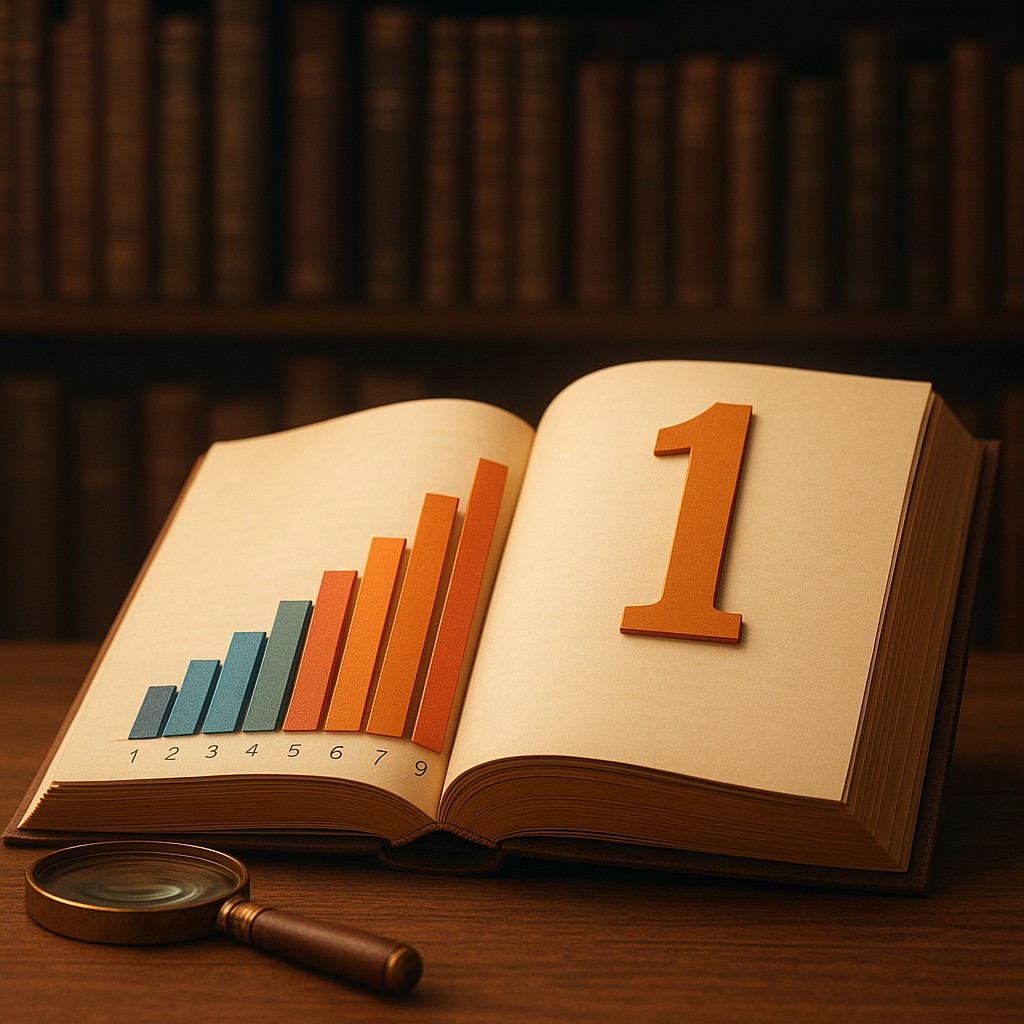
As it turns out, our intuition is spectacularly wrong. In the messy reality of our universe, numbers do not play fair. If you actually counted those first digits, you would discover that a number begins with 1 about 30 percent of the time. The digit 2 shows up about 18 percent of the time, and by the time you reach 9, it appears as the leader less than 5 percent of the time. This bizarre phenomenon is known as Benford's Law. It acts as a hidden mathematical fingerprint that reveals whether a dataset is truly natural or a poorly constructed fake.
The Librarian and the Logarithm Books
The discovery of this law did not happen in a high-tech laboratory or through a supercomputer simulation. Instead, it traces back to 1881, when an astronomer named Simon Newcomb noticed something peculiar about his library books. In the days before pocket calculators, scientists relied on books of logarithm tables - reference guides used to perform complex multiplications. Newcomb realized that the early pages of these books, which contained numbers starting with 1, were significantly more worn, dirty, and thumbed-through than the later pages. It seemed his colleagues were constantly looking up numbers starting with 1 and almost never needed the sections for numbers beginning with 8 or 9.
Newcomb published a paper on his observation, but the idea sat dormant for over fifty years. Then, an engineer named Frank Benford noticed the exact same thing. Benford, perhaps fueled by a mix of curiosity and obsession, decided to test this theory across twenty different fields. He analyzed the surface areas of 335 rivers, the molecular weights of thousands of chemical compounds, street addresses, and even numbers taken from the front pages of newspapers. No matter where he looked, the same pattern appeared. The number 1 was the undisputed champion, followed by 2, then 3, in a predictable, descending curve.
This mathematical curiosity is not just a quirk of how we count; it is a fundamental property of how things grow. To understand why 1 is so popular, we have to stop thinking about numbers as a flat line. Instead, think of them as a ladder where the rungs get closer together as you climb. We are used to additive thinking, where moving from 1 to 2 feels the same as moving from 8 to 9 because you just add 1 in both cases. However, the natural world often operates on percentages and ratios, which is where the math starts to get interesting.
The Struggle to Escape the Number One
To grasp why the digit 1 is so persistent, imagine you have a small savings account with 100 dollars. For that balance to start with a 2, you need to grow your wealth by 100 percent to reach 200 dollars. That is a massive leap that might take years of interest or a very lucky side hustle. However, once you finally reach a balance of 800 dollars, you only need a modest 12.5 percent increase to reach 900 dollars and change that leading digit to a 9. Because it takes so much more "effort" for a value to double from 1 to 2 than it does to nudge forward from 8 to 9, numbers spend a disproportionate amount of time lingering in the "1" zone.
This concept is often called "orders of magnitude." If you look at the stock market, a stock price spends a long time growing from 10 dollars to 20 dollars because it has to double in value. But the jump from 90 dollars to 100 dollars is relatively quick. Once it hits 100 dollars, the leading digit is back to 1 again. The price will now stay with a leading digit of 1 all the way until it hits 200 dollars. Benford's Law is essentially a reflection of the fact that we live in a logarithmic world. We perceive life through straight lines, but nature scales through proportions.
This distribution is so precise that it can be captured by a simple formula: the probability of a digit "d" being the first digit is equal to the log base 10 of (1 + 1/d). This formula produces the specific probabilities that define the law. For those who prefer a quick reference over a calculator, the following table illustrates how digits are distributed in a dataset that follows Benford's Law.
| Leading Digit |
Predicted Probability |
Cumulative Probability |
| 1 |
30.1% |
30.1% |
| 2 |
17.6% |
47.7% |
| 3 |
12.5% |
60.2% |
| 4 |
9.7% |
69.9% |
| 5 |
7.9% |
77.8% |
| 6 |
6.7% |
84.5% |
| 7 |
5.8% |
90.3% |
| 8 |
5.1% |
95.4% |
| 9 |
4.6% |
100.0% |
Catching Criminals with Calculus
One of the most thrilling applications of Benford's Law is in forensic accounting and fraud detection. When people try to "cook the books" or fabricate tax returns, they usually try to make their fake numbers look random. If a corrupt executive is inventing expenses, they will often scatter numbers across the board. They unconsciously make sure they use plenty of 7s, 8s, and 9s to make the list look varied and natural. To a human eye, a list of expenses where every digit appears equally seems legitimate. To a mathematical eye, it looks like a neon sign flashing "FRAUD."
Modern tax authorities and auditors use software to scan thousands of transactions against the Benford distribution. If a company's ledger shows that the digit 1 only appears as the first digit 10 percent of the time, while the digit 6 appears 25 percent of the time, an investigator will be at their door before they can finish their morning coffee. It is incredibly difficult for a human to fake a dataset that follows Benford's Law unless they are specifically aware of the math. Even then, maintaining that consistency across thousands of entries is a taxing mental feat.
This tool has been used to flag irregularities in everything from international economic data to election results. For example, researchers have used it to examine reported COVID-19 case numbers to see if data was being smoothed or adjusted by officials. While a deviation from Benford's Law does not prove guilt, it acts as a reliable "smoke detector." It tells experts exactly where they need to look for a fire. It is the silent guardian of data integrity, protecting us from those who think they can outsmart the inherent patterns of the universe.
Where the Law Meets Its Limit
As powerful as Benford's Law is, it is not a magic wand for every pile of numbers. It has very specific requirements. The most important rule is that the data must span several orders of magnitude. This means the numbers need to range from the tens into the hundreds, thousands, or even millions. If your dataset is restricted to a narrow range, the law breaks down completely.
Take human height as an example. Most adults are between 150 and 200 centimeters tall. Because the range is so limited, you will see an absolute explosion of the digits 1 and 2, but virtually no one starts with a 9. Similarly, ZIP codes do not follow Benford's Law because they are assigned based on geography, not growth. You cannot use this law to analyze a list of phone numbers, lottery results, or Social Security numbers, because those are labels rather than measurements of quantity or size.
Another fascinating exception occurs when there are artificial "ceilings" or thresholds. For instance, if a store sells most items for 9.99 dollars to make them look cheaper, the leading digit 9 will appear far more often than Benford predicts. If a government offers a tax break for any business expense under 2,500 dollars, you will likely see a suspicious cluster of leading digits like 2, 3, and 4 as people try to stay just under the limit. Understanding these exceptions is just as important as understanding the law itself. It prevents us from accusing an honest shopkeeper of fraud just because they like using the number nine.
Finding Harmony in the Chaos
Learning about Benford’s Law changes the way you look at the world. It suggests that beneath the apparent chaos of city populations, flowing rivers, and fluctuating markets, there is a deep structure that connects everything. We often think of mathematics as something we invented to help us build bridges or balance checkbooks, but Benford’s Law reminds us that math is something we discovered. It is a language the universe was speaking long before we arrived to transcribe it.
This law serves as a humbling reminder that our human intuition is often ill-equipped to handle the true nature of scale and probability. We crave symmetry and equal distribution, yet nature prefers a skewed path. By embracing these patterns, we become better thinkers and more effective problem solvers. Whether you are a student, a hobbyist, or a seasonal investigator, keeping the "Power of One" in your mental toolkit helps you see the hidden blueprints of the world around you.
The next time you find yourself staring at a wall of data or a complex spreadsheet, do not feel overwhelmed. Instead, look for the ones. They are there, waiting to tell you a story about how things grow, how they change, and whether they are telling the truth. Mathematics isn't just a collection of cold formulas; it is a lens that brings a blurry world into sharp, 30 percent more predictable focus. Stay curious, keep questioning the numbers, and remember that sometimes the most profound secrets are hidden at the very beginning of the line.