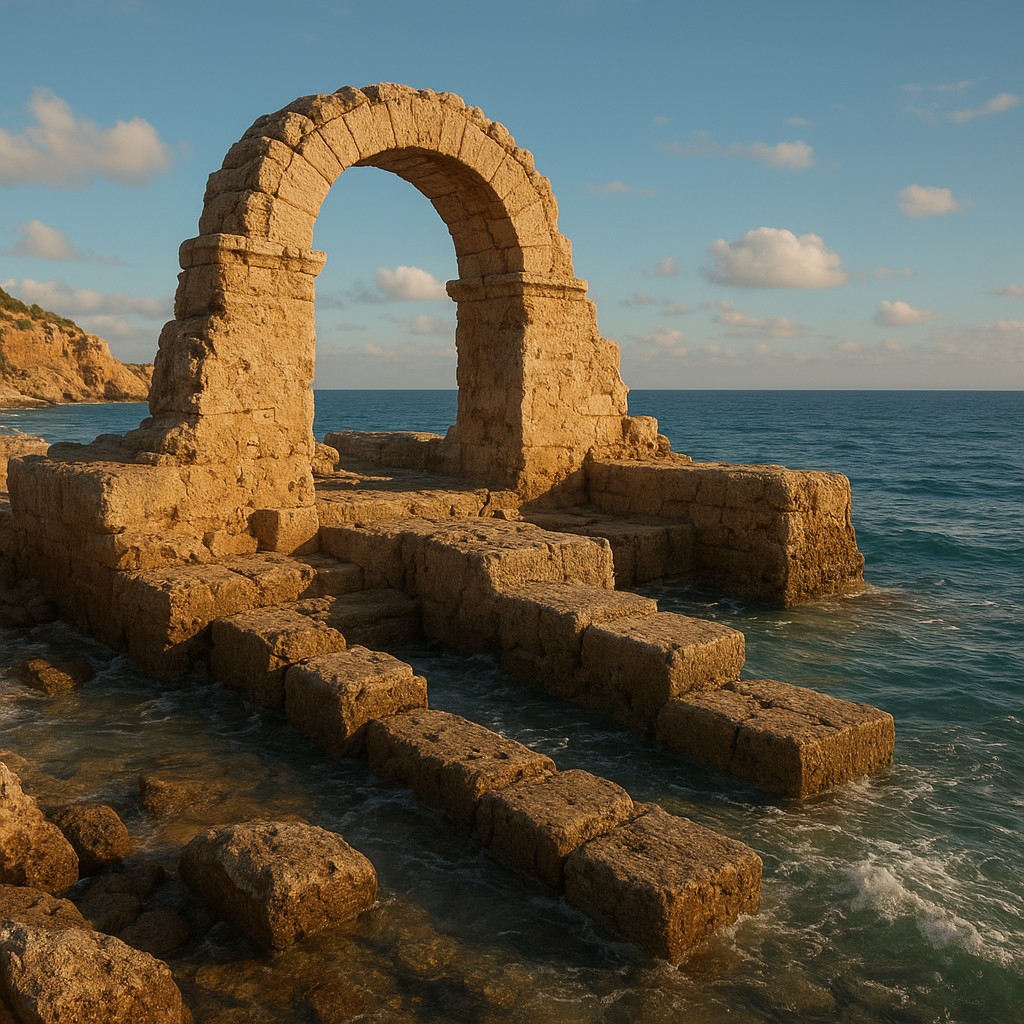
Imagine standing on the Italian coast, looking out at a crumbling harbor wall that has survived the battering of Mediterranean tides for two thousand years. While we often think of the ancient world as a place of primitive tools and fragile materials, these Roman piers tell a different story. Modern concrete structures, built with the help of supercomputers and advanced chemistry, frequently begin to crack and fail within fifty years when exposed to salt water. Yet, their Roman counterparts seem to be doing the impossible. They are not merely surviving the ocean; they are thriving because of it.
This endurance is no accident or stroke of luck. It is the result of a sophisticated understanding of materials that we are only now starting to decode through high-powered microscopy. The Romans discovered a recipe that defies our modern logic of decay. In our world, the ocean is a destroyer, a corrosive force that eats away at steel reinforcement and turns solid blocks into rubble. In the Roman world, the ocean was a finishing agent – a silent partner in a chemical reaction that continued for centuries after the original builders had passed away. By looking at the microscopic architecture of these ancient blocks, we can learn a vital lesson about designing with nature rather than against it.
The Chemistry of Eternal Stone
To understand why Roman concrete behaves so differently from our own, we have to look at the fundamental "glue" that holds the rocks together. Modern concrete typically uses Portland cement, a material made by heating limestone and clay to extreme temperatures. It is incredibly strong and sets very quickly, allowing us to build skyscrapers in months. However, Portland cement is chemically static once it dries. It forms a rigid structure that is prone to "sulfate attack" when exposed to seawater. The salt penetrates the pores of the concrete, reacts with the cement, and creates internal pressure that leads to cracking and eventual collapse.
The Romans used a vastly different approach, centered on a material called volcanic ash, or pulvis puteolanus, named after the town of Pozzuoli. They mixed this ash with lime and seawater to create a mortar, then added chunks of volcanic rock. Unlike modern cement, which is designed to be inert once cured, Roman concrete remained chemically active. The lime reacted with the volcanic ash to form a binder that was less rigid but much more resilient than modern alternatives. This initial reaction provided the strength needed for the structure to stand, but a second reaction, triggered by the surrounding ocean, gave the concrete its legendary longevity.
A Mineral Guardian Born from Salt
The secret weapon hidden inside these ancient maritime structures is a rare mineral called aluminous tobermorite. In a lab, this mineral is notoriously difficult to make because it requires high temperatures and very specific conditions. Yet, the Romans managed to grow these crystals at room temperature in the middle of the sea. When seawater filters through the microscopic cracks of a Roman pier, it dissolves bits of the volcanic ash and reacts with the lime. This process triggers the growth of tobermorite crystals right in the heart of the material.
These crystals do not just fill space; they perform a feat of molecular engineering. As the tobermorite grows, it creates a plate-like structure that reinforces the concrete from the inside out. If a tiny crack begins to form due to the pressure of the waves, the incoming seawater provides the raw materials for more crystals to grow, effectively "healing" the material as it ages. This creates an interlocking matrix that is more flexible than modern concrete, allowing it to bend slightly under stress rather than snapping. It is a self-repairing system that turns the ocean’s corrosive power into a constructive force.
Comparing the Old Guard and the New Wave
When we compare modern materials with ancient ones, we often find a trade-off between speed and durability. Modern construction is a race against the clock, where every hour spent waiting for concrete to dry is money lost. Roman construction, while slower, was designed for a civilization that thought in terms of centuries rather than fiscal quarters. The following table highlights the fundamental differences in how these two systems interact with the environment.
| Feature |
Modern Portland Concrete |
Roman Marine Concrete |
| Primary Binder |
Portland Cement (Calcium Silicate) |
Volcanic Ash + Lime |
| Reaction to Seawater |
Expansion, cracking, and erosion |
Mineral growth and reinforcement |
| Structural Reinforcement |
Steel rebar (prone to rusting) |
Interlocking mineral crystals |
| Curing Speed |
Days to weeks |
Decades to centuries |
| Environmental Impact |
High CO2 during production |
Lower heat, natural minerals |
| Primary Failure Mode |
Brittle fracture and corrosion |
Gradual erosion (but stays solid) |
This comparison reveals a fascinating irony. We use steel to make our concrete stronger, but the steel often kills the structure. When salt water reaches the steel rebar, the metal rusts and expands, blowing the concrete apart from the inside. The Romans, lacking steel, relied on the chemistry of the minerals themselves. By removing the vulnerable metal and replacing it with a mineral that gets stronger when wet, they created a material that could theoretically last forever.
The Challenge of Living on Roman Time
If this ancient concrete is so much better for the environment and lasts significantly longer, why aren't we using it for every bridge and pier we build today? The answer lies in the "decades to centuries" row of the table above. Roman concrete is a "slow-burn" material. The mineral reactions that create tobermorite take a long time to reach their peak strength. In a world where a developer needs a bridge to be functional in eighteen months, waiting fifty years for the chemical reaction to "get good" is a difficult sell.
Furthermore, the specific volcanic ash used by the Romans is not available everywhere. The luck of geography gave the Roman Empire access to the Pozzolane Rosse ash flow, which had the perfect chemical profile for this seawater reaction. While we can find similar volcanic deposits in other parts of the world, each source requires its own unique "tuning" of the recipe. Modern engineering thrives on standardization. We want a bag of cement in Tokyo to behave exactly like a bag of cement in New York. Nature, unfortunately, is rarely that consistent.
There is also the matter of patience. Our current economic systems are built on short-term cycles, whereas Roman concrete represents a form of "slow infrastructure." Taking the time to build something that lasts two thousand years requires a societal shift in how we value assets. We currently view a bridge as a product with a fifty-year lifespan that we replace later. The Romans viewed a harbor as a permanent extension of the land itself.
Reimagining the Future of Coastal Cities
Despite the hurdles of speed and logistics, the lessons of Roman concrete are becoming increasingly relevant as we face rising sea levels and more intense storms. Our coastal cities are currently defended by walls of modern concrete that are essentially ticking clocks. If we could integrate the Roman "healing" mechanism into our 21st-century designs, we could build seawalls that actually grow sturdier as the oceans rise. Scientists are currently experimenting with "geopolymers" and bio-concrete, trying to mimic the Roman ability to create minerals within the structure.
Imagine a future where our piers and coastal defenses are not just passive barriers, but active, living systems. We could potentially develop hybrid mixes that provide the immediate strength of Portland cement for construction, but include the volcanic "seeds" necessary to trigger long-term reinforcement from seawater. This would allow us to meet the demands of modern schedules while giving our infrastructure the gift of ancient longevity. We are learning that the "state of the art" is often a conversation between our newest technology and the forgotten wisdom of the past.
The study of Roman concrete teaches us that durability is not about being the hardest or most rigid thing in the room. True resilience comes from a material's ability to adapt, react, and improve in response to its environment. By shifting our perspective and viewing the "destructive" elements of nature as potential collaborators, we can begin to build a world that is not just temporary, but truly enduring. The ancient ruins of Italy are not just relics of a fallen empire; they are a blueprint for a more sustainable and permanent way of living on a changing planet.