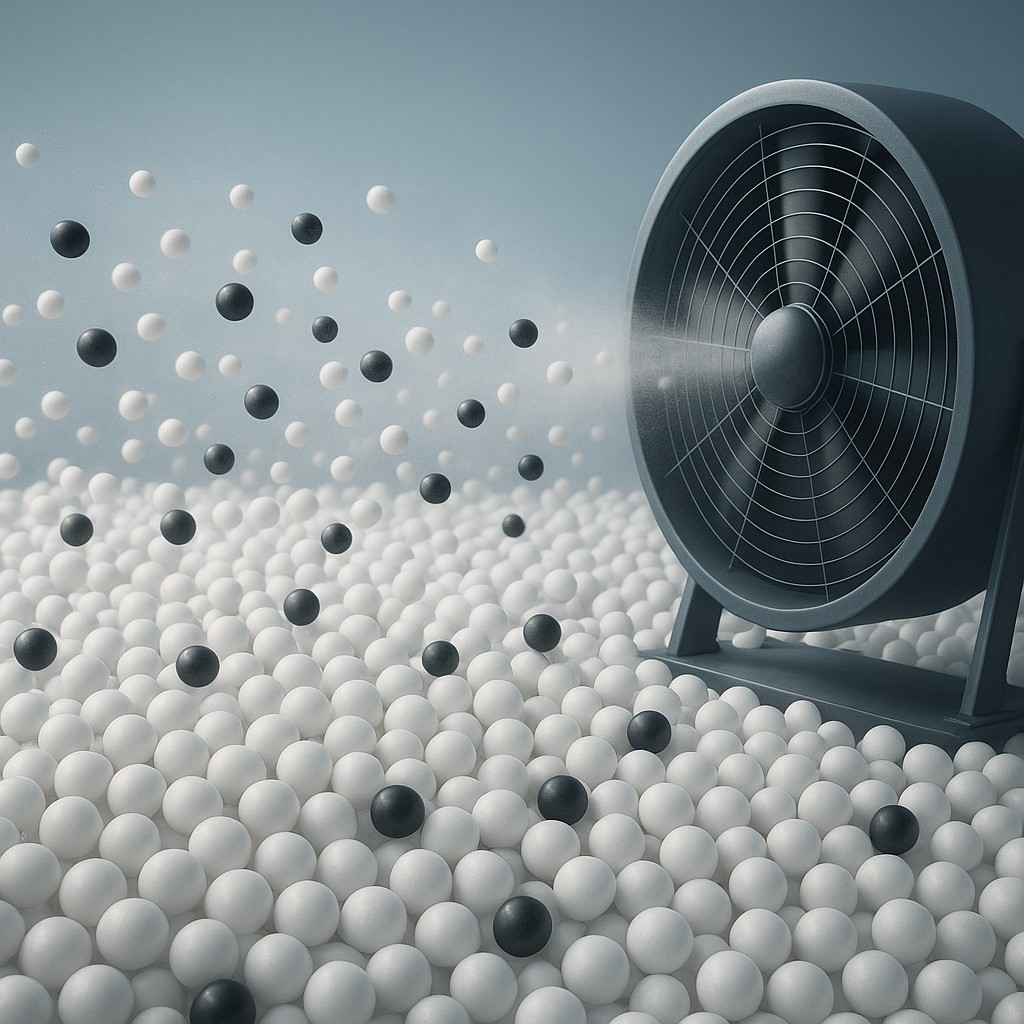
Imagine you are standing in a stadium filled with one million ping-pong balls. All of them are white, except for 420 that are painted a deep, matte black. Your job is to find every single black ball while a massive industrial fan blows the entire pile around the room at sixty miles per hour. This is the staggering mathematical reality of Direct Air Capture (DAC). While we often describe carbon dioxide as a massive blanket warming the planet, it is actually quite scarce on a molecular level. It makes up only about 0.04 percent of our atmosphere. To "scrub" the sky, we aren't just looking for a needle in a haystack; we are looking for a specific type of hay in a mountain of golden straw.
For decades, we focused on "point-source" capture. This involves putting a filter on a factory smokestack where the CO2 is thick and easy to grab. But once carbon is adrift, the atmosphere doesn't care where it came from. Direct Air Capture is our attempt to build a giant chemical vacuum cleaner that can sit in a desert or on the frozen tundra and pull back the carbon that has already escaped into the wild. It is a feat of extreme engineering that treats the entire sky like an ore we can mine for invisible gas.
The Molecular Magnetism of Sorbents
To catch something as elusive as a CO2 molecule, you need more than just a fine mesh screen. Carbon dioxide molecules are small enough to sail through almost any physical filter. Instead, DAC plants rely on the logic of chemical attraction. Imagine the surfaces inside a DAC machine are covered in a "chemical glue" designed to ignore nitrogen and oxygen but grab CO2 the moment it touches the surface. These substances are known as sorbents. In the world of DAC, there are two primary styles of sorbents: solid "sponges" and liquid "showers."
Solid sorbent systems use large, porous filters coated with amines, which are organic compounds derived from ammonia. As giant fans pull outside air through these filters, the CO2 molecules literally stick to the amine coating. This is a molecular game of Tetris where the board is only sticky for one type of piece. Liquid systems, on the other hand, use an "air contactor" that looks like a high-tech cooling tower. A liquid solution, often containing potassium hydroxide, trickles down over a honeycomb structure while air blows upward. The CO2 reacts with the liquid to form a stable salt, effectively turning a gas into a liquid solution that can be pumped away for processing.
The brilliance of these sorbents lies in their selectivity. If the chemicals weren't picky, they would be instantly overwhelmed by the nitrogen that makes up 78 percent of the air. By using materials that have a high "affinity" (a natural chemical attraction) for carbon, engineers ensure that even though the fans move massive amounts of nitrogen and oxygen, the only thing that stays behind is the carbon we want to remove. It is a process of extreme refinement, turning the chaotic soup of the atmosphere into a concentrated stream of pure gas.
Breaking the Chemical Bond
Once the sorbent is "full," the machine faces a new problem. You have trapped the carbon, but now it is stuck to your equipment like gum on a shoe. To make the process useful, you have to get the CO2 off the sorbent so you can reuse the chemical "sponge" and bottle the gas. This is the "regeneration" phase, and it is where the laws of physics demand a heavy payment. You have to convince the CO2 to let go, and that requires energy, usually in the form of heat or a change in pressure.
In solid sorbent systems, the chamber is sealed and the temperature is raised to about 80 to 100 degrees Celsius, or a vacuum is used to lower the energy needed for the release. This provides enough energy for the CO2 molecules to wiggle free from their amine anchors. In liquid systems, the process is even more intense. The carbon-rich liquid is turned into small solid pellets of calcium carbonate, which are then heated in a furnace called a "calciner" to a blistering 900 degrees Celsius. This mimics the process used to make cement, releasing the CO2 in a pure, concentrated form while recycling the base chemicals back to the start of the loop.
This cycle of "capture and release" is what makes DAC a continuous process. It is a rhythmic breathing cycle for a machine: inhale the thin air, hold the carbon, exhale the pure gas, and repeat. However, because we are fighting the natural tendency of gases to stay mixed, we have to "pay" for that order with energy. This is why DAC plants are often built next to geothermal vents, wind farms, or nuclear plants. If you use coal or gas to power a carbon capture machine, you might end up releasing more carbon into the sky than you pull out, which is completely counterproductive.
Distinguishing Between Capture Methods
To understand where DAC fits in the broader toolkit of climate technology, it helps to compare it to the more traditional methods we have used for years. While they all deal with CO2, the challenges vary wildly based on how concentrated the gas is at the start.
| Feature |
Point-Source Capture |
Direct Air Capture (DAC) |
Biological Capture (Trees) |
| CO2 Concentration |
High (10% to 15%) |
Extremely Low (0.04%) |
Low (Atmospheric) |
| Location |
Limited to factories |
Can be built anywhere |
Needs fertile land and water |
| Energy Required |
Low to Moderate |
Very High |
Low (Solar energy) |
| Permanence |
High (Geologic storage) |
High (Geologic storage) |
Variable (Risk of fire or decay) |
| Scalability |
Limited by factory count |
High (Unlimited air) |
Limited by available land |
As the table shows, DAC is the most difficult from an energy perspective, but it offers the most flexibility. Unlike a point-source system, which only stops new emissions, DAC can address "legacy emissions" that have been floating in the sky since the Industrial Revolution. It is also more predictable than planting forests, which can be vulnerable to wildfires or pests that release the stored carbon back into the atmosphere in a single afternoon.
The Plumbing of the Earth
Once we have our pure, concentrated stream of CO2, the question becomes: what do we do with a trillion tons of gas? We can't just put it in a giant balloon and hope it doesn't pop. The most common solution is "sequestration," which is essentially putting the carbon back where it came from. We take the gas and compress it until it becomes a "supercritical fluid," which has the density of a liquid but moves like a gas. We then pump it deep underground into salt-water aquifers or empty oil and gas reservoirs.
In some cases, like the CarbFix project in Iceland, the CO2 is dissolved in water and pumped into basaltic rock formations. Within just a few years, a chemical reaction occurs between the acidic water and the minerals in the rock, turning the gas into solid stone. This is the "gold standard" of carbon storage because once the carbon becomes part of the Earth's crust, it isn't going anywhere for millions of years. It effectively undoes the act of mining fossil fuels by turning emissions back into stable minerals.
Alternatively, some companies are looking to turn this captured carbon into a resource. This is known as Carbon Capture and Utilization (CCU). The gas can be used to carbonate soda, create carbon fiber for airplanes, or even be combined with hydrogen to create synthetic aviation fuels. While utilizing the carbon doesn't always "remove" it permanently, it creates a circular economy where we stop pulling new carbon out of the ground and simply recycle what is already in rotation.
Addressing the Skepticism of the Skies
It is important to address the elephant in the room: isn't this just an expensive way to avoid the hard work of cutting emissions? Critics of DAC often argue that the high cost and massive energy requirements make it a "moral hazard" that encourages people to keep burning oil under the assumption that a machine will just clean it up later. This is a valid concern, and almost every climate scientist agrees that DAC is not a replacement for moving to renewable energy. It is an "and," not an "or."
The reality is that some parts of our global economy, like heavy shipping, aviation, and steel manufacturing, are incredibly difficult to run on electricity alone. Furthermore, we have already pumped so much CO2 into the atmosphere that simply reaching "net zero" might not be enough to avoid the worst effects of warming. DAC represents a "negative emissions" strategy. It is the eraser for the mistakes we have already made. By framing it as a cleanup crew rather than a license to pollute, we can see it as a necessary insurance policy for a planet already in the danger zone.
Another common misconception is that DAC consumes massive amounts of water. While some liquid-based systems do lose water through evaporation, many newer solid-sorbent designs are actually "water-positive" in certain climates. Because the process involving amines can sometimes trap moisture from the air along with the CO2, these machines can be designed to "sweat out" fresh water as a byproduct. In a dry region, a DAC plant could theoretically provide both carbon removal and a small but steady supply of water, turning a climate liability into a local asset.
The Economics of Thin Air
At the moment, the biggest hurdle for DAC isn't the chemistry; it's the cost. Catching a ton of CO2 from the open air currently costs several hundred dollars, whereas catching it from a smokestack might cost only sixty. This is largely due to the "energy penalty" of dealing with such low concentrations. However, technology history is full of examples of "impossible" costs that collapsed under the weight of industrial scaling. Solar panels were once an exotic luxury for satellites; now they are the cheapest form of electricity in history.
The "learning curve" for DAC is just beginning. As we build more plants, we discover better sorbents that require less heat, more efficient fans that use less electricity, and better ways to integrate these systems into industrial areas. Governments are also beginning to step in with "carbon credits" or subsidies, creating a market where "cleaning the air" is a service that people are willing to pay for. If the cost can drop to around one hundred dollars per ton, DAC could become a massive global industry, employing millions and processing billions of tons of air every year.
We are essentially trying to build a new utility, similar to the way we built sewage systems and waste management in the 19th century. We realized then that we couldn't just throw trash in the streets and expect to stay healthy. Today, we are realizing we cannot just throw carbon into the sky and expect the climate to stay stable. DAC is the industrialization of our responsibility to the atmosphere, a way to move from being passive observers of the climate to active managers of the Earth's chemistry.
The challenge of pulling carbon from the sky is a testament to human ingenuity and a reminder of the scale of our impact on the world. It is a technology that requires us to think about individual molecules and the entire planet at the same time. While the giant fans and chemical towers of DAC plants might look like something out of a science fiction novel, they are grounded in simple, elegant chemistry. They represent our refusal to accept a warming world as inevitable. As these machines begin to dot the landscape, they serve as a quiet hum of hope, working twenty-four hours a day to turn back the clock on our carbon footprint, one molecule at a time.